

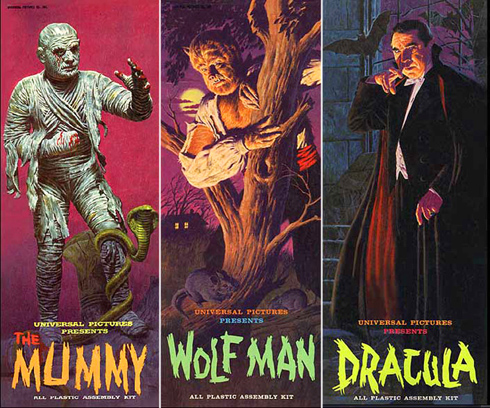
Something changed between the time I was watching horror films on TV as a kid, and those screened in theaters a generation later. My horror movies starred recycled monsters from before World War II — Karloff’s Frankenstein monster, Lugosi’s Dracula, and the classic Wolfman played by Lon Chaney, Jr. I had the plastic models of all three, meticulously assembled and painted, lined on the bookshelf above my bed. They were scary, but lovable–victims in their own right. And let’s not forget the sympathetic Hunchback of Notre Dame as brought to life by Charles Laughton. Or King Kong, for that matter, whose rampage was entirely justified.
Mainstream movies turned darker, grosser, and more violent with the likes of Psycho (1961), Night of the Living Dead (1969), Rosemary’s Baby (1968), The Exorcist (1973), and the rise of Stephen King. But those films couldn’t hold a blowtorch to the wave of British horror films that followed.
And where would a young, impressionable teenage mind see trashy exploitation films in the 1970s? Based on the feedback I received, the Civic on Chestnut Street played the very best and the very worst. So the discount cinema where kiddies watched The Three Lives of Thomasina (1963) and The Incredible Mr. Limpet (1964)– Disney flicks about a cat and a dolphin–slowly turned to the dark side.
Middle schoolers, according to one response, got their first taste of R-rated comedy with the arrival of Animal House (1978). The rise of VCRs forced the B-theaters, like the Civic, to discount prices even further. For 90 cents, a reader told me, you could watch movies all day. For an extra dime, you could sit in the balcony. Saturday double-features ran as low as 75 cents in an era when the new multiplex at the mall was charging $3 to $4.
How low was the bottom? Many locals will recall (but few will admit attending) the Civic Theater’s brief flirtation with X-rated fare. The erotic Emmanuelle (1974) might be called an art film; the slogan announced–”Lets you feel good, without feeling bad.” But there was no denying the adult content of films such as Intimate Playmates and The Swingin’ Stewardesses (1976).
SEE: Reefer Madness shuts down Civic
The bottom, however, may have been the European exploitation films that found their way into discount American cinemas in the mid 1970s. One reader, after listing dozens of classic action and horror films he saw at the Civic, notes two films no mother would allow her kids to see. Frankenstein Must Be Destroyed included a rape scene by the monster and was rated “M” for “Mature.”
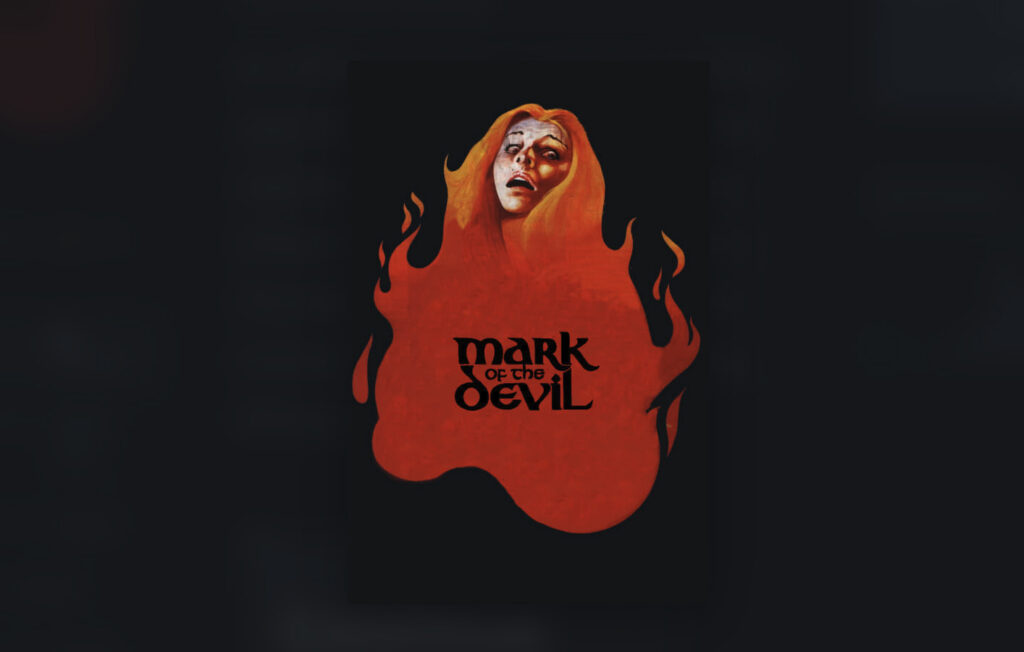
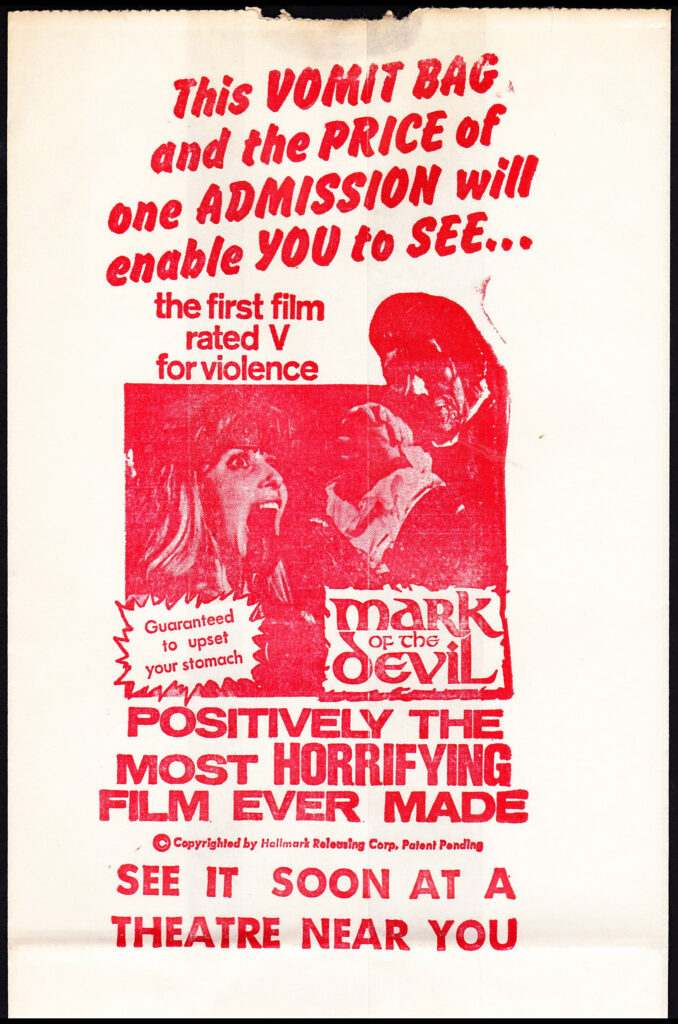
Desperate for audiences at any cost, the Civic hit bottom with Mark of the Devil, a German-made schlockfest billed as “Positively the most horrifying film ever made” and “rated V for Violence.” Set in Austria, the film depicts the torture of women accused of witchcraft–and most horribly, is based on historical facts. It was marketed in the USA by the distribution of vomit bags printed with the disclaimer that the film was “Guaranteed to upset your stomach.” Today, in a world highly desensitized to violence, that phrase might accompany the evening news.
(c) J. Dennis Robinson, adapted from a history of the MUSIC HALL
 “Reefer Madness” Closed Civic Cinema in 1947