

Note: While a reporter (later editor and owner) of the Portsmouth Herald, Ray Brighton authored a key history column. He was fond of transcribing early documents. This rare research into the mysterious Captain Samuel Haley, son of Sam Haley, of Haley’s Island (Smuttynose Island) at the Isles of Shoals is a revealing peek into the family that occupied the island from the American Revolution to the sale to Thomas Laighton in 1839. It appeared in the newspaper on June 14, 1958. –JDR
SEE: Brief history of the Isles of Shoals
The original of the document that is to be quoted here probably was presented before the Legislature of Massachusetts between 1816 and 1820 in an effort to get that state to repair the breakwater between Mallaga and Smut-tynose Islands at the Isles of Shoals. [Note: That breakwater that separated Sam Haley’s two islands was rebuilt again in 2025.]
It will be remembered that prior to 1820 Maine was part of Mas-sachusetts, and the two islands mentioned still are within the bounds of the Pine Tree State.
Samuel Haley, the author, was the son of the man who first purchased Smuttynose and ran a profitable business there.
Apparently, part of the living the Haleys wrested from the turbulent seas around their home was the succor of shipwrecked mariners. Any time he or his sons rescued anyone, or saved a ship, Haley expected payment.
His writing gives an “account of some of the vessels cast away at the Isles of Shoals,” during the course of his life:
“Capt. Alexander Millican was lost on Duck Island in a severe cold N.W. wind. It was so full of reake (seaweed) or vapor, that they did not see till they struck.
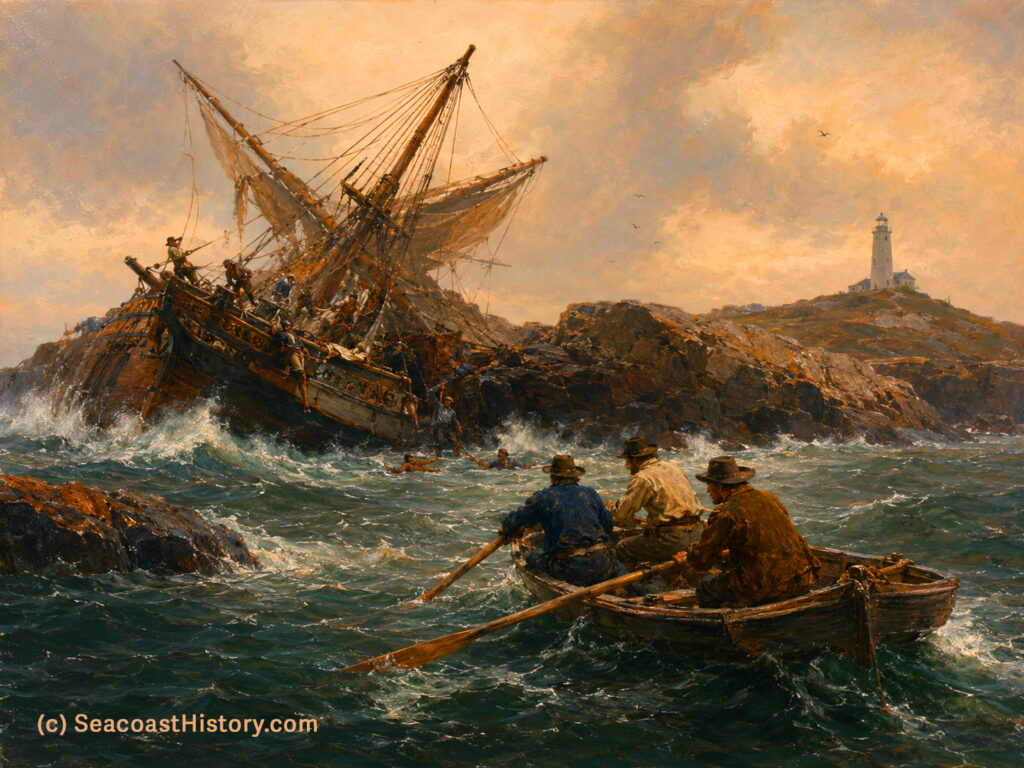
“They got on said desolate island and would have all perished had I not sent my boat with five men and took all seven men off and brought them to my house that evening, in the month of January, 1813.
“Three of my sons were in my boat, which made up the five men, and some of them got froz-en by it being so cold. After that we got the topsail off and saved her also, and carried her (Millican’s ship) to Portsmouth harbor; said vessel being about 110 tons, schooner rigged.
“Capt. Benjamin Lovett of Beverly was lost on Hog (Ap-pledore) Island ledge in a schooner of 75 tons in a heavy storm, I and my sons and men, with another boat and men, got the captain, his son and five others of from the ledge and wreck on the same ebb tide, and brought them to my house almost perished.
“Capt. Peleg Wodsworth was lost on Lunze (Lunging) Island in a sloop; he and his men saved. The vessel was got off and brought into Haley’s dock and was repaired.
“Capt. Kimball of Newbury was lost on Halfway Rock off Isles of Shoals, was got off and towed into Haley’s dock, and was repaired.
Capt. Abram Trethen was upset and towed Into Haley’s dock, half full of water and repaired. She was a schooner of 90 tons.
“Capt. Joseph Lewis of Townsend in a new sloop struck on a rock called the Three Sisters. She was beat off and drifted near the Shoals, and myself and sons, and men in my boat and Mr. John Newton and men in his boat, towed her about half full of water. We got her in to said Haley’s dock. The captain and his men gave up, being tired out by pumping; we gave them a speil and were the means of saving the men’s lives and vessel.
“Capt. Benjamin Henderson was cast on White Island, bound to the West Indies. Said vessel was got off and towed to this dock and repaired.
“Capt. Ellet was piloted into this said dock by my son Daniel Haley in the first part of a very heavy gale. Said vessel and car-go, consisting of dry goods, and valued, so the captain told me. at $75,000. It came on one of the heaviest gales that were ever known but yet it was all safe in this said Haley’s dock.
“Capt Edgar was shipwrecked in a heavy gale of wind very near these islands, and all his sails blown to pieces. After the storm the vessel was towed into Haley’s dock in a calm and the men, vessel and cargo all saved, safe and sound.
“The Spanish ship from Cadiz (the Sagunto), bound to New York was cast away on this is-land (Smuttynose) sometime in the 14th night or 15th morning in January, 1813, and every soul lost and the ship stove to pieces and but very little of the cargo saved. I and my sons and what other men I hired picked up fourteen of the dead men and buried them in my burying 3field, but I did not get my pay from any man.
“Capt. Daniel Huntress came from Boston bound to Portsmouth, loaded with freight: took a squall of wind from the northwest, carried away his masts near these Islands, and was towed to Haley’s dock and saved all.
“Not only what I have mentioned, but I know several more vessels that were cast away on these islands since I can remember. Some were drowned, and we assisted those that were saved when they were in distress.
“Besides a great many more vessels and open boats that ran into Haley’s dock from year to year at most all times in the year ever since my remembrance, and they saved them-selves and their vessels, and open boats in distress of weather.
“At one time there were 40 people in their fishing boats; they ran into this harbor in a storm and were safe. And at another time I know of more than 75 people who were drove in here in the month of March in their open boats.
“They came out from Portsmouth, Old York, Rye, Hampton and other places in the morning when it was pleasant and moderate; as they were fishing there came up a squall of wind from the northwest and blowed a gale of wind for two or three days; they made out to get into Haley’s dock; they had no provisions.
“I and John Newton supplied them or else they would have suffered. But he or I never got our pay for it to this day. This gale was on March 11, 1807.”
One can but admire the terse prose in which Samuel Haley described shipwrecks and rescues that in our day would bring newspaper headlines. The daring of Haley, his sons, and John Newton in snatching distressed mariners from the jaws of death beggars our imagination.
Haley expected to be paid for his service, and well he might. But for him, and men like him, the Isles of Shoals would have been infamous as a graveyard for ships.
 The Most Horrifying Film Ever Made