

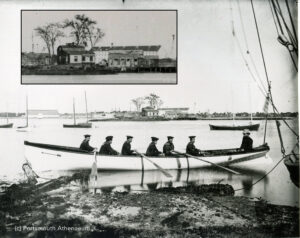
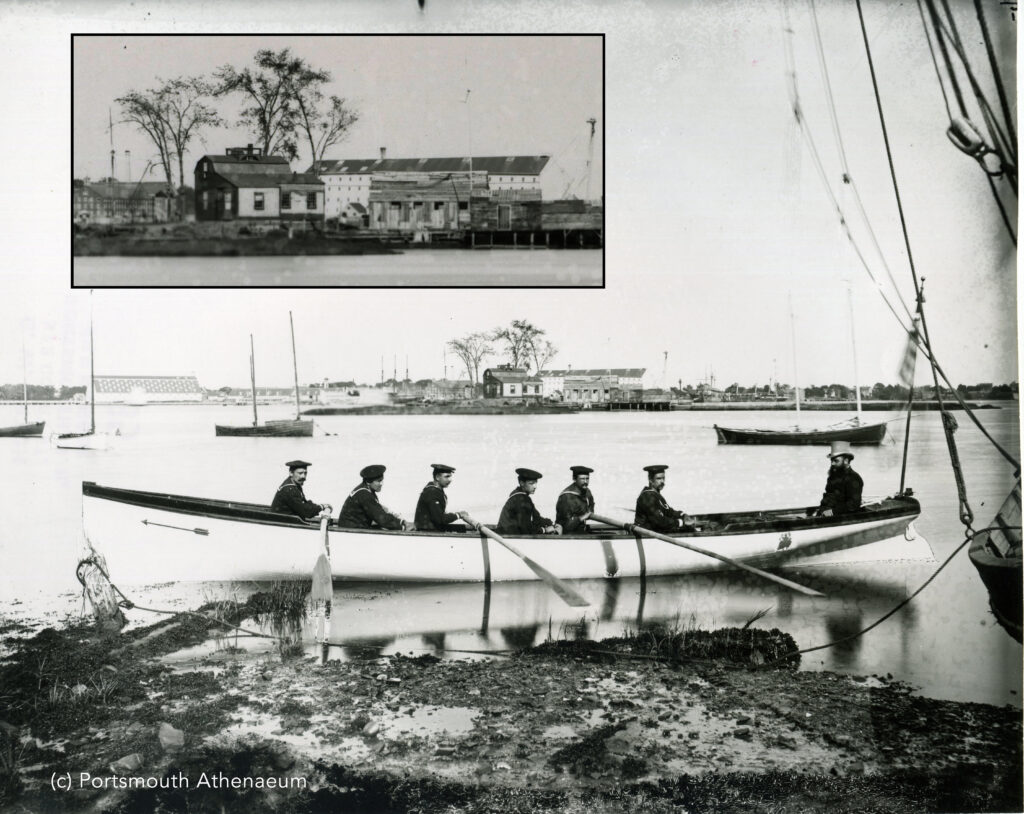
Sometimes what you’re looking for in an old photo is not in the foreground. I’d love to know who these guys in the rowboat are. The dark-skinned man with the beard and top hat appears to be a dignitary ferried to shore by a crew of six sailors. They are sitting in their boat at what is now Prescott Park during low tide. But my fascination is with what can be seen behind them. The background shows Four Tree Island as it appeared at the end of the 19th century. We seem to be looking at the “Four Tree Island Museum and Emporium.”
A little background
I serve as a late-night spy for the Special Collections committee at the Portsmouth Athenaeum. I do my work from home, usually well after midnight, scanning the latest eBay auction items up for sale. Back in November 2009, a unique item popped up and I was pleased to learn that the Athenaeum was able to add it to their collection. At first glance, it looks quite innocent.
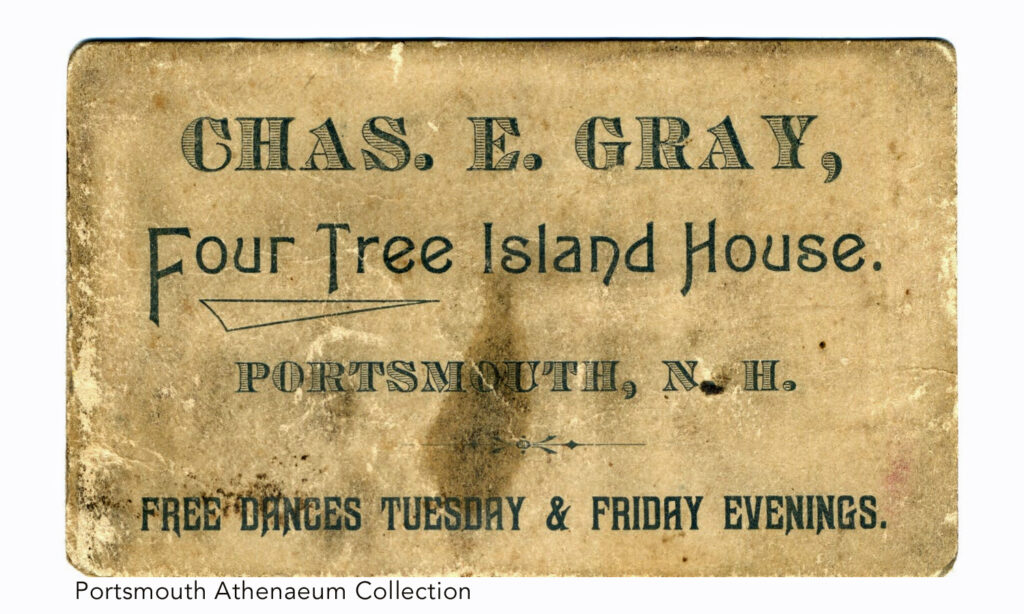
We rarely see any physical evidence of the bordellos and dance halls that once thrived in Portsmouth’s South End. Among the more bizarre establishments, legend says, was the bar on Four Tree Island owned by Charles E. Gray in the late 19th century. Today, Four Tree Island, just off Prescott Park, is joined to Peirce Island by a 20th-century causeway. It is a popular family picnic area in the summer.
READ MORE: Four Tree Island Illegal Lottery
Clues to Gray’s Four Tree Island Bordello
The eBay item is a ticket the size of a playing card. It promotes “Free Dances Tuesday & Friday Evenings” at Gray’s Four Tree Island House. In his chapter on Portsmouth’s Red Light District (They Came to Fish, 1976), Ray Brighton says Gray purchased Four Tree Island in 1877 for $40. Gray’s famous “menagerie” reportedly featured an alligator, a stuffed cow that dispensed beer from its udders, and a pair of boots that once belonged to outlaw Jesse James. The “museum” and other buildings burned in a spectacular blaze in 1907. A lengthy legal circus began after Gray’s death when five women claimed to be his widow.
Was Gray’s establishment one of a dozen prostitution sites in the gritty waterfront area? The back of the card includes two stanzas of a poem that openly refer to sexual behavior. Advertising was understandably rare, and what existed was coded. Sites in the Combat Zone were usually disguised as saloons, oyster bars, or even ice cream shops. Although everyone in town knew what was going on, even sideways references like this have not been seen, to my knowledge, in this town. The city’s sex trade was a widely known secret across New England and survived until 1912 with the support of local police and politicians. The card reads:
LAST FALL
A little horsehair sofa,
In a corner stood,
Youth and maiden sparking,
So-fa — so good
THIS SPRING
A little baby in a crib,
Giving lots of bother,
Youthful mother making bib,
So-fa — no father.
The poem implies that the brief affair begins on a sofa, like those found in bordellos. It also notes that the couple is young. While the “maiden” in the verse seems innocent, local bordello owners like Mary Baker were known to display their latest teenage residents around town to drum up business. Boys from the Navy Yard as young as 14 were prime targets for these houses of ill fame. Cadets often lived aboard the remodeled “Old Ironsides” ship just acaross the Piscataqua River.
An article in a 1912 Portsmouth newspaper noted that a Dover girl was solicited for a Portsmouth bordello. The poet on Gray’s dance ticket is without sympathy for the teenage mother here, and indicates that the male has abandoned the girl and moved on. Even stranger is the use of the Maine /New Hampshire dialect in “so-fa” for “so far,” the same familiar accent later made popular by “Bert and I” comedians Marshall Dodge and Tim Samples.
Behind the men in the boat
Gray’s Emporium, as seen in the detailed blowup. shows four or five small doors to the right of the building, perhaps bathing cabinets or outhouses. The building burned at the dawn of the 20th century, but we know that this picture was taken a few years earlier.
Close examination indicates the photo was taken before 1897. That’s when the USS Constitution, also known as “Old Ironsides,” was towed out of Portsmouth Harbor back to its current location in Charlestown, Massachusetts. The “cabbed over” historic frigate is barely visible in the background here. We can also see the famous wooden Franklin Shiphouse and other large buildings at the Portsmouth Naval Shipyard across the PIscataqua River in Kittery, Maine.
It’s only minor sleuthing with a trickle of information on a topic that deserves much more research in a world of few documents.
© 2009 J. Dennis Robinsn, all rights reserved., updated 2026
 Where There’s a Will, There’s a Way