

NOTE: Scroll down to read the full Portsmouth Daily Chronicle article from May 7, 1889
We have a love-hate relationship with lotteries. According to NPR, Americans spend up to $100 billion annually on lottery tickets. Imported with the nation’s first immigrants, lottery sales became illegal in the 19th century. And yet, despite the odds, the lure of winning big money or prizes from a low-cost ticket, kept the practice alive. NH, with no income tax, became the first state to sanction a state lottery in 1963. Massachusetts followed suit in 1971, but its residents continue to purchase NH tickets since no sales tax is imposed on winners.
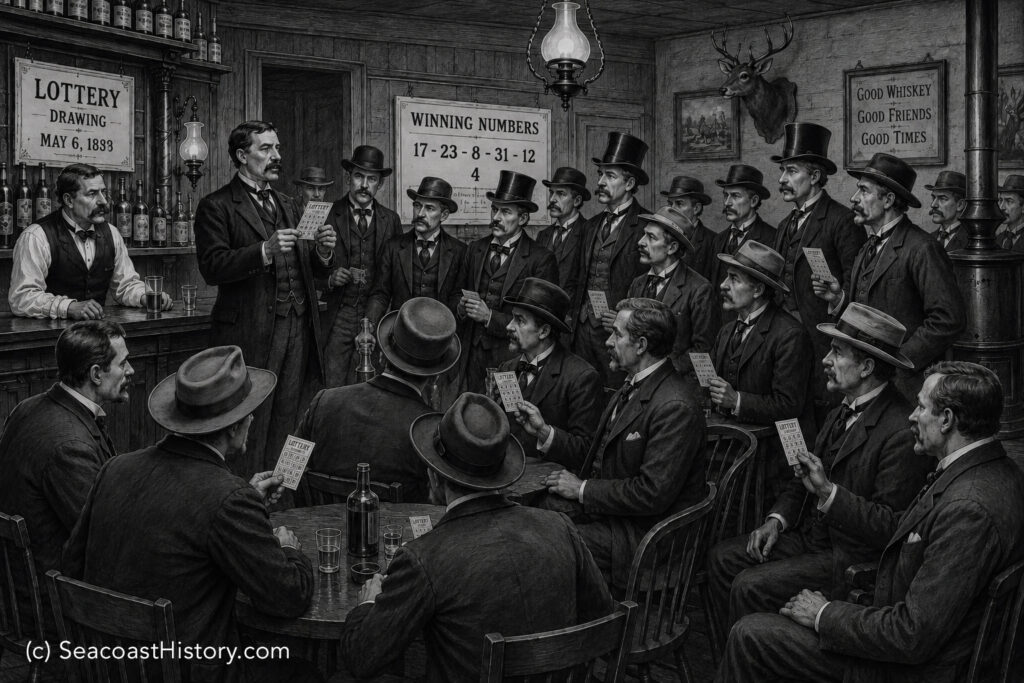
From 1833, lottery ticket sales were considered illegal gambling in Massachusetts. And yet, in 1889, the Gen. Lander Post, in Lynn. MA was about to read out the winners of the 22nd annual lottery. Exactly what went wrong isn’t clear, but the veteran’s group decided it was safer to announce the results in Portsmouth, NH. Dozens of men arrived in the city by train and found their way to the infamous Red Light district in the South End. Ticket holders were ferried just offshore at what is now Prescott Park to Four Tree Island, today a popular picnicking site.The island was then home to a rowdy bar and possible bordello owned by Charles E. Gray.
According to a vintage article submitted by a Kittery reader, Portsmouth police were waiting at the docks to arrest the Massachusetts gamblers and load them into the “job wagon” for a trip to the local court. As soon as the men were put in the wagon, a Portsmouth Daily Chronicle reporter noted, they rushed right out the other end, leaving only the sheriff and the driver. The collusion between the police and local bordello owners has been well documented. The reporter’s mocking coverage depicts the city sheriff and officers like fumbling Keystone Cops.
Not only was everyone let go, apparently without even a fine, but the Chronicle took the opportunity to publish the winning lottery numbers and prizes at the conclusion of the article. The first prize was $2,500, worth about $90,000 today. The heyday of the gambling and sex trade in the South End lasted until the bordellos were shut down by decree following a series of murders in 1912.
THANKS TO Jennifer Gray for spotting this article in response to our recent blog about bordello owner Charles E. Gray (no relation).

A DRAWING ON FOUR TREE ISLAND
Portsmouth Daily Chronicle
May 7, 1898
About fifty gentlemen, with nothing of the “rough” in their appearance, but well-dressed and respectable looking, arrived in this city in a special car attached to the 10:50 A. M. train from Boston on Monday, and immediately dispersed in all directions, in squads of from two to half a dozen. Different routes they took, but most of them found their way to various places along the waterfront in a short time, and were quickly ferried to Four Tree Island, where they held the fort during the day. The occasion of this influx was the 22d annual drawing of the lottery of Gen. Lander Post, No. 5, G. A. R., of Lynn. Mass., the Massachusetts authorities having on Saturday positively refused to allow the drawing to take place in that state, necessitating it taking place in some other locality, and Four Tree Island having been selected for the purpose.
The drawing was concluded about four o’clock, and the drawing committee (the mysterious gentlemen who came in the special car) then made ready to return to the mainland and the city of shoe leather; but warning was given that Sheriff Ed. Coffin and a host of deputies were awaiting their landing, with numerous job wagons in which to carry them away to state prison at the least, and possibly to instant execution. “Then and there was hurrying to and fro,” and throwing the wheel of fortune overboard, and hiding papers under the house, etc.; and then with fear and trembling the committee made sail (in dories) for the fish wharves.
The first lot that landed, on Dixon’s wharf, were escorted in the most gentlemanly manner by Deputy Sheriff John S. Whidden to a job wagon, but as fast as he put them in one side, they went out on the other, so at the end only he and the driver were left. But on State street the fugitives ran foul of the sheriff himself, who scooped into his job wagon about twenty, all told, and took them in triumph to his office, where they were ushered into the terrible presence of County Solicitor Emery. The reporters who came down with the party, and the representatives of the local papers, were too “fly” to drop into the net, and modestly passed through side streets where there was no deputy sheriff to molest or make them afraid. In the sheriff’s office it was found that there was no evidence sufficient to justify the captives being held, and they departed from the office, and when the Flying Yankee train went through, they departed from the city, their special car being coupled on the rear of that train.
Owing to the panic created by the sheriff and his deputies we were unable to get a full list of the lucky ticket holders, but give the numbers drawing the principal prizes as follows:
No. 19,045, $2,500 to a Manchester man.
Numbers 47,738; 50,635; 9,453; 41,380, $1000 each.
Numbers 16,708; 48,265; 48,778, $100 each.
No. 1030, J. I. C. buggy.
No. 16,648, parlor organ.
No. 62,382, upright organ.
No. 5,062, gentleman’s diamond ring.
No. 49,820, parlor suite.
No. 25,569, bicycle.
No. 39,783, gentleman’s diamond pin.
No. 25,934, tricycle.
It was reported that Messrs. Robert A. Stott and James Kehoe of this city each drew a rifle, and that a number of other Portsmouth men also drew prizes of more or less value.
© 2026 SeacoastHistory.com
 The Bordello Behind Seven Guys in a Boat