


We no longer think as our Founders thought. They were schooled in the classics. Educated leaders, the men who formed the government of the United States, looked to ancient Greece and Rome for models of morality, liberty, government, art, and citizenship.
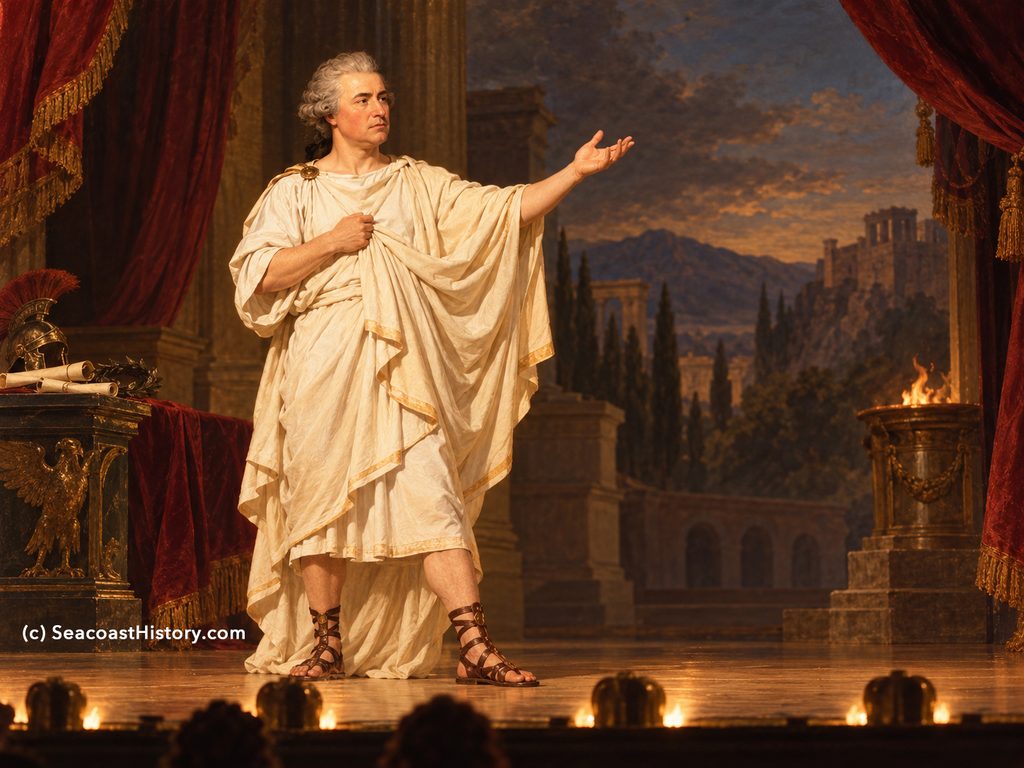
Cato the Elder (95 BC – 46 BC) was one of those models. An influential Roman senator, Cato opposed the growing power of Julius Caesar. He feared the republic was becoming a dictatorship. Cato resisted Caesar by using a senator’s governing tools. He blocked Caesar’s funding, employed the filibuster, passed laws, and refused to bend the rules, even under political pressure.
In colonial America, Cato’s resistance to authority gained popularity as Parliament imposed new taxes on sugar, tea, and printed paper. A play about Cato, written in English, came to increasingly mirror the American desire to resist tyranny and embrace liberty. Written in 1713, Cato, a Tragedy by Joseph Addison, was widely read. But reading a play was a far cry from performing a play onstage in New England.
The theater ban
In October 1774, months before the bloody revolution began at Lexington and Concord, the fledgling Continental Congress voted to ban all theater performances in the 12 original colonies (Georgia did not participate). With war looming, such entertainment was deemed wasteful, distracting, even morally corrupt. The ban extended to cockfighting, horseracing, and overly elaborate funerals. American leaders, it was implied, were going to be better men than their British counterparts.
Ironically, New Hampshire leaders had, for generations, copied the behavior of the British aristocracy. The last three royal governors, all members of the wealthy Wentworth family in Portsmouth, were theater, gambling, and horse racing fans. Indeed, outside of Virginia, some considered Portsmouth to be the most elite “social capital” in America, and therefore, more British-like than their puritan-like neighbors in Massachusetts and Maine.
Two months later, Seacoast residents would raid the British armory at Fort William and Mary in New Castle. The following year, they would drive the royal Gov. John Wentworth and his family out of the region forever. But Portsmouth, a city split between the new patriotism and loyalist traditions, did not entirely abandon its banned amusements. Scenes from popular plays were sometimes performed in local taverns where captive animals, including an African lion, were exhibited for a fee, and enslaved humans were auctioned. Plays, including the works of Shakespeare, were considered among the “lewd amusements” that corrupted society.
Not everyone agreed that plays fell into the same category as bear baiting or cockfighting. Men raised on Greek and Latin, founders Benjamin Franklin, Thomas Jefferson, and John Adams among them, were drawn to classical stage performances, including Shakespeare. George Washington, whose formal education ended at age 11 when his father died, also favored theater productions that contained valuable life lessons.
READ about Prince Whipple
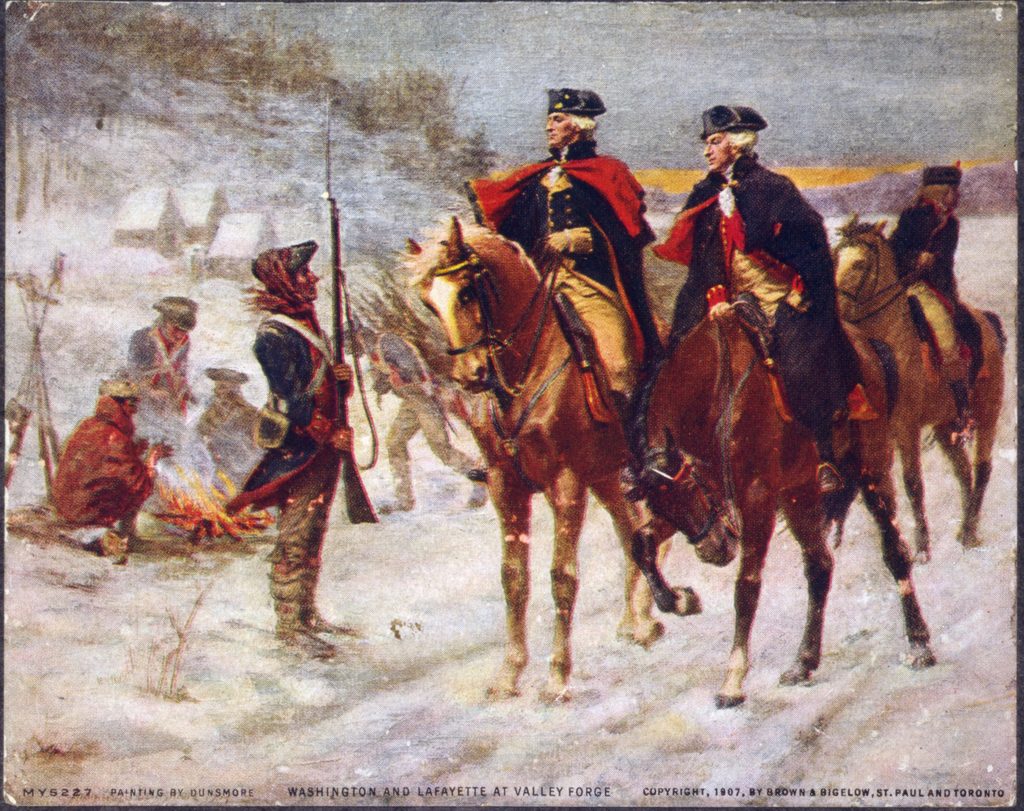
According to Pulitzer Prize-winning biographer Ron Chernow, Cato was among Washington’s favorite role models. In 1778, the same year the Continental Congress renewed its theater ban, Washington allowed a production of Addison’s play about Cato staged “to buck up his weary men” at Valley Forge. Like a coach trying to psych up a fading team, Washington hoped Cato’s resolve to take on a despot like Julius Caesar would be inspirational in a war against a tyrannical King George III and the British Empire.
The Portsmouth connection
Months before Washington staged the play Cato at Valley Forge, it was performed in Portsmouth, NH, in defiance of the theater ban. Jonathan Mitchel Sewall, a local lawyer and poet, put an added spin on the Portsmouth production. An avid revolutionary, Sewall wrote a new epilogue to the play comparing the noble Cato to General George Washington and King George to Julius Caesar.
Nancy Hammond, an expert on the life of JM Sewall, notes that his revolutionary epilogue was reprinted in newspapers in Boston and Connecticut and likely other cities. This was in April 1778, a pivotal time in the war as the French began their support of the American patriots. The Marquis de Lafayette, who had pledged his support to the colonists, was also mentioned in JM Sewall’s version of the Cato play,
“Doesn’t it seem likely,” says Hammond, “that the players at Valley Forge would have used Jonathan’s epilogue?” It’s an intriguing theory and may explain why a performance of Cato was selected to fire up the weary troops at Valley Forge.
Inspiring words
As an attorney, Sewall certainly knew he was skirting the law when he participated in a banned play. But Portsmouth was not Boston. Locals had stolen the King’s gunpowder and driven his governor out of the country. In April 1778, even as Sewall’s words were going viral in newspapers, John Paul Jones captured a British warship in the sloop of war Ranger, built at Portsmouth Harbor. These were heady times and Sewall’s “No Kings” protest was part of the new patriotism.
Unfortunately, for modern readers, there is a dramatic glitch. In Addison’s play, and in history, Cato died and Julius Caesar rose to power. Learning that his forces were about to be defeated, Cato killed himself, rather than serve under a dictator.
“It wasn’t about how Cato died, but how he lived!” Hammond says today. For Sewall, Cato was a symbol of a principled man who refused to bow to tyranny and corruption. In Addison’s tragedy, Cato became a martyr for freedom. In Sewall’s epilogue, Washington was the embodiment of that noble spirit. It would be five long years before the war ended. Then, in 1789, President Washington rode up Congress Street (formerly King Street) in Portsmouth. And Jonathan Mitchel Sewall, his biggest fan, was there to greet him and sing his praises in a fresh new poem.
AN EXCERPT from Jonathan Mitchel Sewall’s epilogue to the play Cato”
Did Rome’s brave senate nobly strive to oppose
The mighty torrent of domestic foes?
And boldly arm the virtuous few, and dare
The desperate perils of unequal war?
Our senate too, the same bold deed has done,
And for a Cato, armed a WASHINGTON!
A chief in all the ways of battle skill’d,
Thy scourge, O Britain! and Columbia’s boast,
The dread, and admiration of each host!
Whose martial arm, and steady soul, alone
Have made thy legions quake, thy empire groan,
And thy proud monarch tremble on his throne.
Thanks to Nancy Hammond, author of The Life and Times of Jonathan Mitchel Sewall.
© 2026 J. Dennis Robinson. All rights reserved.
 Marketing a Jewish-owned Victorian Five-and-Dime
