


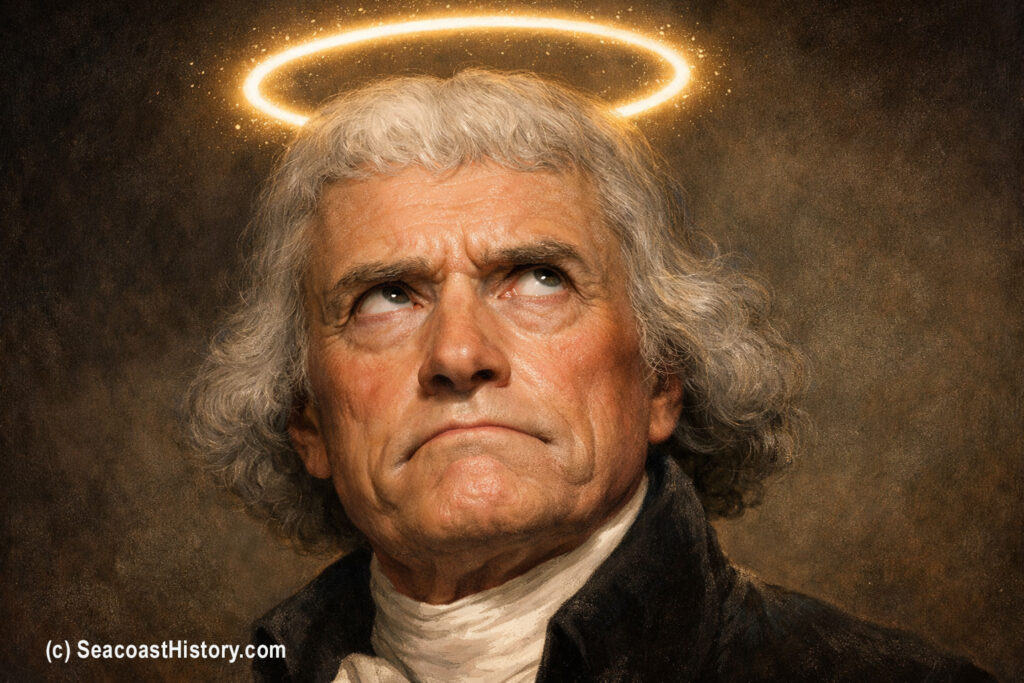
The two good things about being an aging historian are (1) I’m starting to understand American history, and (2) I look old enough to know what I’m talking about. This week, I’m talking about Thomas Jefferson.
It is no secret that the man who penned the Declaration of Independence came to dislike George Washington. Jefferson once described Washington’s mind as “slow in operation, being little aided by invention or imagination.” The third president came to fear that our first two executives, Washington and John Adams, were leading America down the wrong path. They and other Federalists, he complained, were building a powerful central government that looked too much like the corrupt British monarchy that Jefferson despised. His Democratic-Republicans, the nation’s first political party, pressed for a smaller, less powerful, central government.
According to historian Charles Brewster, a scandal arose when Portsmouth-born Tobias Lear, Washington’s secretary, reportedly destroyed some of Washington’s presidential papers after his death in 1799. The letters, written by Jefferson, accused Washington of being an autocrat and a monarchist. Lear later got a juicy political appointment to the Middle East after Jefferson took office. It looked to some like collusion.
Jefferson was also friends with Portsmouth merchant and privateer John Langdon, a relative of Tobias Lear. Langdon and Jefferson were fellow founding fathers and both hated the British monarchy. Langdon became the first “president” of New Hampshire, but declined President Jefferson’s offer to make him Secretary of the Navy and later declined to run for vice-president. In 1810, as Jefferson retired forever from public office, the two old revolutionaries were still corresponding.
“My dear friend,” Jefferson wrote to Langdon, “for five and thirty years we have walked together through a land of tribulations.” With the War of 1812 looming, Jefferson complained to Langdon that the spoiled inbred monarchs of Europe were either–in his words– fools, ciphers, idiots, or madmen.
Good news, bad news
By the time he was 65, Thomas Jefferson had written the stirring words of the Declaration, served as governor of Virginia, been a Congressman, Secretary of State, Vice President, and President of the United States. His Louisiana Purchase doubled the size of the nation in 1803 by acquiring 823,000 square miles from France for $15 million, roughly four cents per acre. That same year, he sent Lewis and Clark to explore the unknown territory to the West. Their three-year fact-finding journey from St. Louis to the Pacific Ocean and back redefined the nation. Retiring to his palatial home at Monticello, Jefferson founded the University of Virginia, the first American college independent of any religious organization. He died on July 4, 1826, exactly 50 years after the signing of the Declaration of Independence.
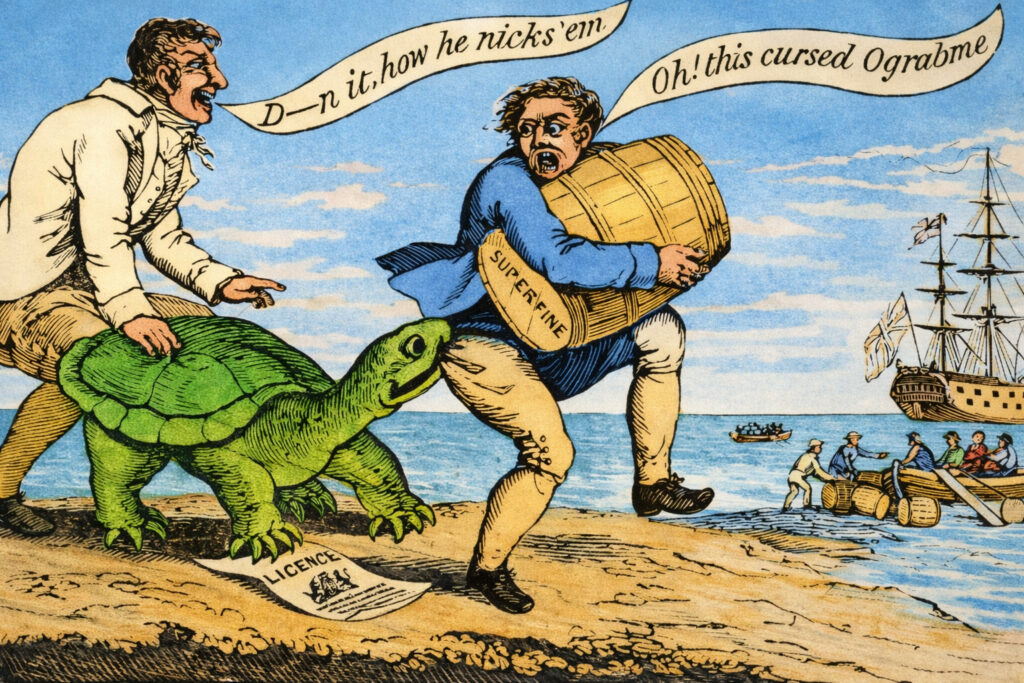
And yet in New England, Jefferson was often remembered as the man who destroyed our maritime economy. In 1807, in an effort to punish France and Britain for interfering with American shipping, Jefferson issued the Embargo Act. But the plan backfired and threw tens of thousands of men out of work. By banning all American merchants from trading with their key customers, Atlantic seaports stagnated. Portsmouth, like many others, never recovered. A political cartoon from that era shows a giant turtle named Ograbme, biting into a sailor attempting to sell some cargo. O-Grab-Me is “embargo” spelled backwards.
Despite an affected disinterest in public office, Jefferson proved to be an ambitious and sometimes ruthless politician. He often worked behind the scenes, writing anonymous attacks (what we now call trolling) or conspiring with unsavory journalists to malign his political enemies, including Alexander Hamilton, his own vice president, Aaron Burr, and his sometimes friend John Adams. Often contemplative to the point of silence, Jefferson was mysterious even to those who knew him. John Adams called him a “shadow man.” Biographers have labeled him a “paradox” and an “enigma.”
Historian Joseph Ellis agrees. “If he [Jefferson] were a monument, he would be the Sphinx,” Ellis told New Hampshire filmmaker Ken Burns. “If he were a painting, he would be the Mona Lisa.”
Jefferson was also involved in a presidential sex scandal. He was accused of carrying on an affair with an enslaved African named Sally Hemings. The news story, curiously, was published by the same reporter Jefferson had hired to spread gossip about his own political enemies. While DNA evidence has been disputed, historians now generally accept that Jefferson likely fathered six mulatto children with the woman 30 years his junior.
Jefferson owned Sally Hemings by Virginia law. He inherited her entire family among 174 slaves on the death of his father-in-law John Wayles in 1774, when Sally was an infant. By 16 she was pregnant. Grief-stricken over the loss of his wife Mary in 1782 (and eventually the loss of five of their six children) Jefferson vowed never to remarry. His affair with Sally Hemings reportedly lasted for 37 years. While he owned a total of up to 600 slaves in his life, Jefferson freed only Sally’s children.
Becoming human
“The more I read about Thomas Jefferson,” one history writer told a group of us recently in Portland, Maine “the more I think he may have been the worst of the founding fathers.”
Jefferson has certainly taken his lumps as a founder. George Washington was vain and not too bright. John Adams was cantankerous. Ben Franklin was eccentric. But Jefferson, some say, was a full-on hypocrite, who could accuse his enemies of slander while secretly libeling them. The founder who could write “all men are created equal,” also wrote unapologetically about the “innate incompetence of blacks,” who he saw as inferior to whites, except in their musical ability.
A brilliant thinker, wordsmith, architect, politician, musician, scientist, and farmer, Jefferson is far from an American saint. He knew slavery was “the serpent in the American Eden,” as one of biographers put it, but he blamed King George of England for the African slave trade. At the same time, as if the two situations were equal, he blamed the king for “enslaving” white Americans with unjust taxes. Upon his retirement from office, Jefferson said he was happily “shaking off the ‘shackles of power.” Even as president, in a colossal misuse of the metaphor, master Jefferson imagined himself as the slave.
Jefferson did make early attempts to end the slave trade in Virginia, but he was a lifelong slave owner and slave trader himself, entirely dependent on treating an army of impoverished Africans as his personal property. Slaves tended his fields and ran his household, Slaves helped him tear down and rebuild his beloved Monticello six or seven times. Yet despite the forced labor of hundreds of enslaved men, women, and children, Jefferson was a spendthrift and died deeply in debt.
Although he could quote from the Christian bible when required, like many of the founders, Jefferson was not a church-goer and likely a deist. He could be contemptuous of organized religion and believed that Native Americans should be protected from Christian missionaries. It did not matter, he once said, whether his neighbor worshipped no god or many gods. What his neighbor believed “neither picks my pocket, nor breaks my leg,” Jefferson explained. There would probably never have been infidels, he once remarked, if there had been no priests.
While he railed against the despotic monarchies of Europe, Jefferson, like Franklin, was enthralled by the cultural high life of the French aristocracy in the years before the Revolution there. Given a chance to life anywhere except his beloved Virginia, Jefferson said, he would choose Paris.
Thomas Jefferson’s critics, then as now, have questioned the wisdom and sincerity of his revolutionary rhetoric. His claim that every new generation should overthrow the last sounds like anarchy. Did he really mean it when he suggested that every law, every debt, and every regime should expire every 20 years in order to let the next generation get a fresh new start? The election of 1800 was certainly one of the most bitter and contentious in American history. It took 36 ballots before a deadlocked House of Representatives finally elected Jefferson to eh presidency. The result, to Jefferson’s delight, was no bloody revolution, but a peaceful transfer of power.
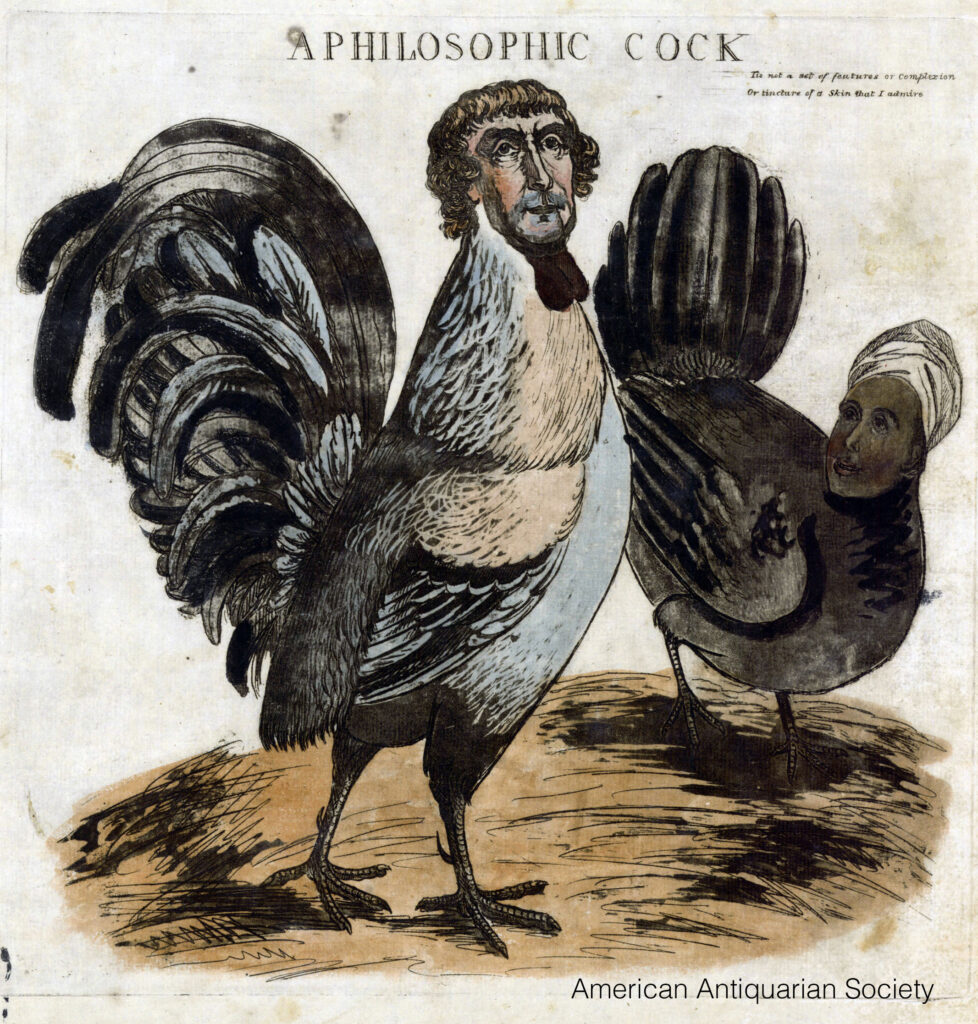
(American Antiquarian Society)
Truth will set you free
Some Americans can’t handle the truth. They long for the simplistic, sanitized, idealized Thomas Jefferson as seen in statues, on nickels, and on souvenir Coke cans. They fear the “revisionist” view of the founders as human beings and find the full disclosure disrespectful, even dangerous to democracy. Reviewing Ken Burns’ powerful three-hour PBS documentary (1997) on the life of Thomas Jefferson, one online critic accused the “leftist” filmmaker of trying to “demonize” his subject.
“In our history,” a reviewer from Oregon posted on Amazon.com, “Jefferson has been the patron political saint for those who believe in small government, decentralized power, low taxes, and individual liberty.”
Jefferson’s beautifully worded Declaration has inspired people and nations toward freedom around the world for centuries. But we do ourselves and Jefferson no good by conflating the man with his message. The more human the founders turn out to be, the more amazing the American experiment becomes. The more we forgive them, the more we can forgive modern leaders and understand our modern world.
Nancy Isenberg, author of Fallen Founder, documents how history has vilified Jefferson’s vice president, Aaron Burr, and cast him aside. Burr shot and killed Alexander Hamilton in a duel. With Jefferson’s help, Burr’s political career was then obliterated. He was tried and acquitted of treason.
In making her case for Burr, Isenberg warns us not to romanticize our founding history into a golden era filled with impossibly perfect men. To learn from the past, we have to know what really happened.
” The historic memory does not hold much history,” Isenberg says. “The founders were far more numerous than popular history suggests, and far less righteous and dignified.”
Our founders, she concludes, were “imperfect men in a less-than-perfect nation grasping at opportunities. That they did good for their country is understood and worth our celebration. That they were also jealous, resentful, self-protective, and covetous politicians should be no less a part of their collective biography. What separates history from myth is that history takes in the whole picture, whereas myth averts our eyes from the truth when it turns men into heroes and gods.”
Copyright © 2015 by J. Dennis Robinson, all rights reserved.
 Daguerreotype Reveals Face of Revolutionary War Soldier