


We can learn a lot from “trade cards.” Before junk mail, which today goes directly into the trash, Victorian shopkeepers personally handed customers these paper ads as a thank-you gift, or stacked them on the counter. New printing techniques like chromolithography, pioneered in Boston, made vivid color images affordable for merchants. Customers, especially children, found them highly collectible. Some were decorative, some educational, others humorous.
SEE anotherMarket Street trade card
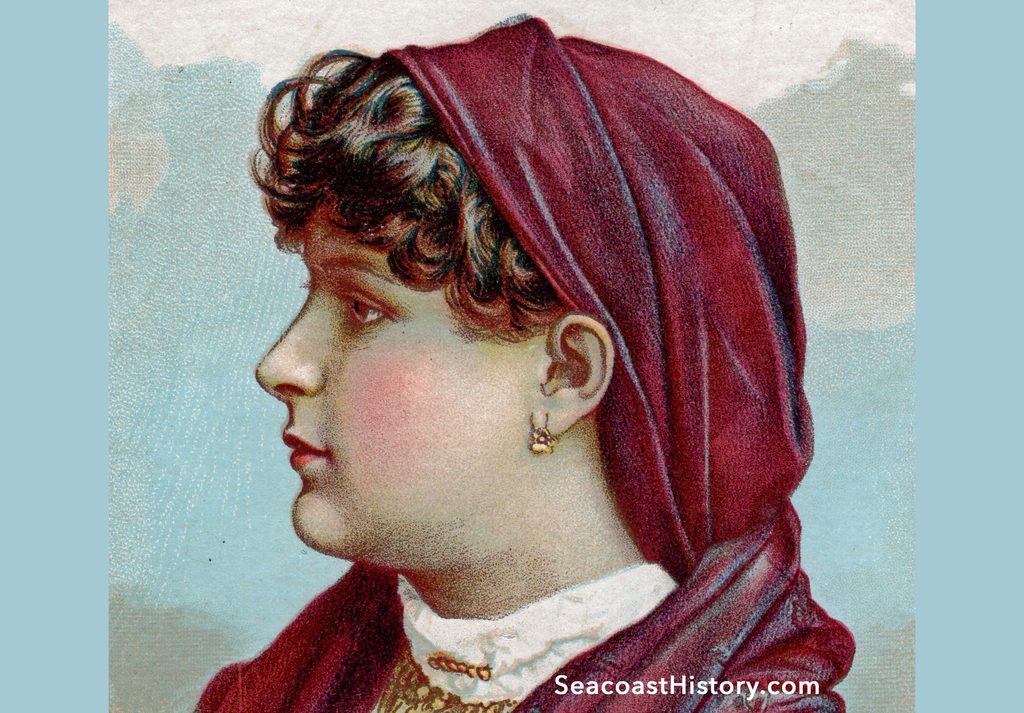
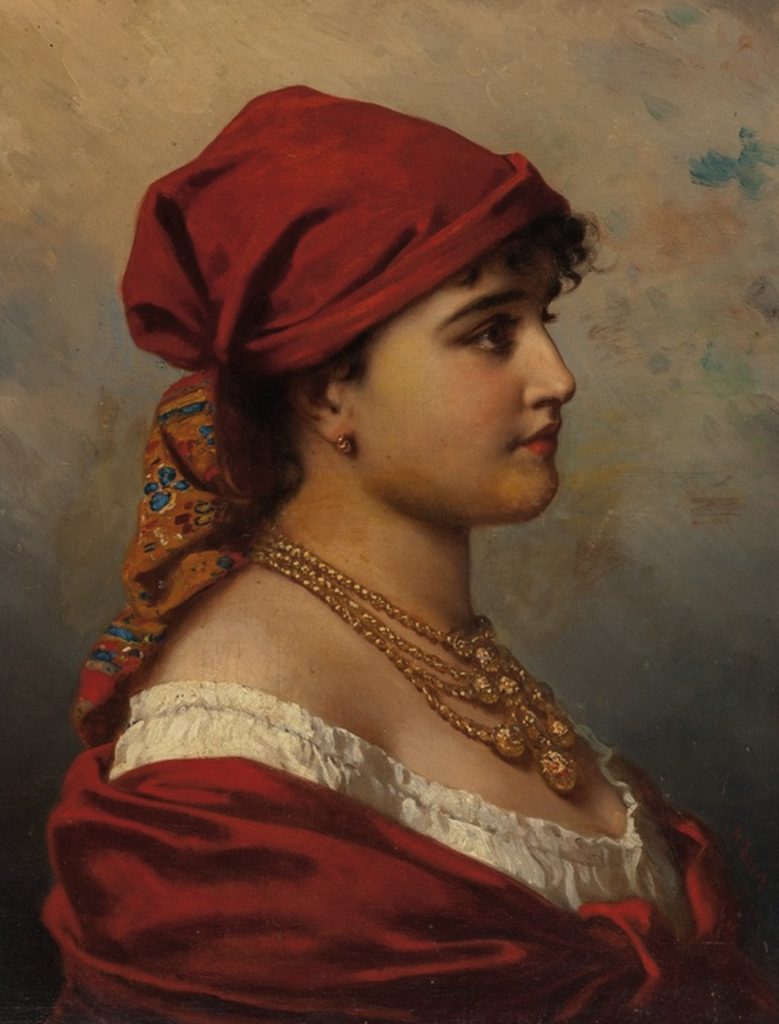
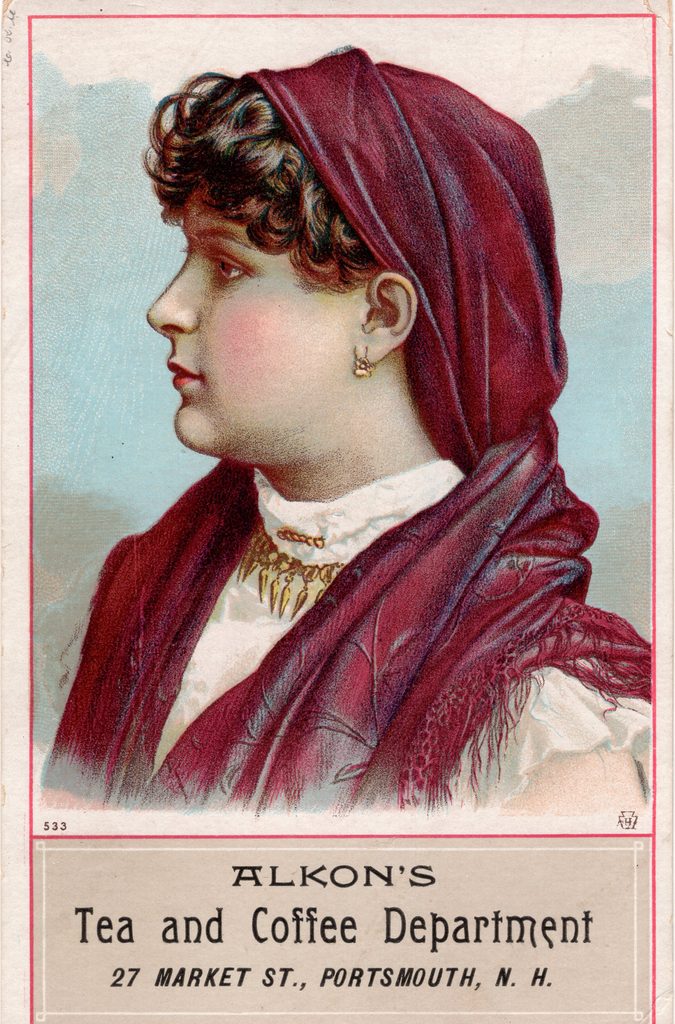
Let’s dissect this one from Alkon’s 5-and-10-Cent Store at 27 Market Street in Portsmouth, NH. A bit larger than a 3 x 5-inch index card, the front shows an attractive woman in a headscarf and shawl, possibly Mediterranean and slightly exotic, signaling mystery and romance to a curious 19th-century New England audience. She resembles a popular painting, “Woman in Red,” by the Austrian artist Anton Ebert (1845-1896), though more light-skinned.
Minimal text on the front promotes the Tea and Coffee Department, part of the Kitchen Department at Alkon’s. The back reads: “Headquarters for Dinner, Tea, and Toiletries.” The shop also featured goods made from tin, glass, wood, and agate crockery. A fragile undated flyer in the Portsmouth Athenaeum collection, probably earlier, lists the name as Alkon’s Novelty Store with a special sale on bird cages. The advertised CLOSING OUT SALE was to make room for more stock. The flyer included jelly tumblers, umbrellas, and “the largest line of Copper Bottom Boilers in the city.”
A history of Temple Israel lists only 26 Jewish families living in Portsmouth by1905 and Mayer Alkon is among them. This was the year Temple Israel was founded and also the summer of the Portsmouth Peace Treaty. Russian diplomats, while visiting Portsmouth, reportedly met and talked to Jewish shopkeepers. One Russian-Jewish immigrant remarked that, “A man with five cents in his pocket in this country is better off than a millionaire in Russia.” When the Russian diplomat asked another Jewish merchant on Market Street if he was an American citizen, the shop owner replied, “Yes, we are voters and honor the flag of America.” The merchant, likely Mr. Alkon, noted proudly that his family was well educated. A quick search shows that, in 1917, Marie Celia Alkon of Portsmouth was a liberal arts freshman at Boston University.
SEE one more trade card
Typical of a maritime town, Portsmouth had been home to Jewish families since at least 1795. Alkon ads appear in local newspapers, including a rare copy of JUNE LEAVES, a short-lived tourist publication for women.
There were just 26 Jewish families living in Portsmouth in 1905 and the population was about 14,000. Temple Israel’s historic records list those members, including Mayer Alkon.
Sometimes called an “Orientalist” style, this “Woman in Red” trade cart offered a subtle reminder that Alkon’s was a unique place to shop in a predominantly white Yankee town. The mass-produced “stock” trade cards allowed merchants a subtle way to brand their individual shops with appealing ads. The collectible gifts may have aided ethnic businesses like Alkon’s Jewish-owned tea shop to assimilate into the community. Customers not only accepted and prized these ads but passed them on to future generations in scrapbooks, letters, in frames, and tucked into family Bibles.
© J. Dennis Robinson. All rights reserved.
 General John Sullivan Honored as NH Mason
