

By Gerald D. Foss
Grand Historian
St. John’s Lodge #1, Portsmouth, NH
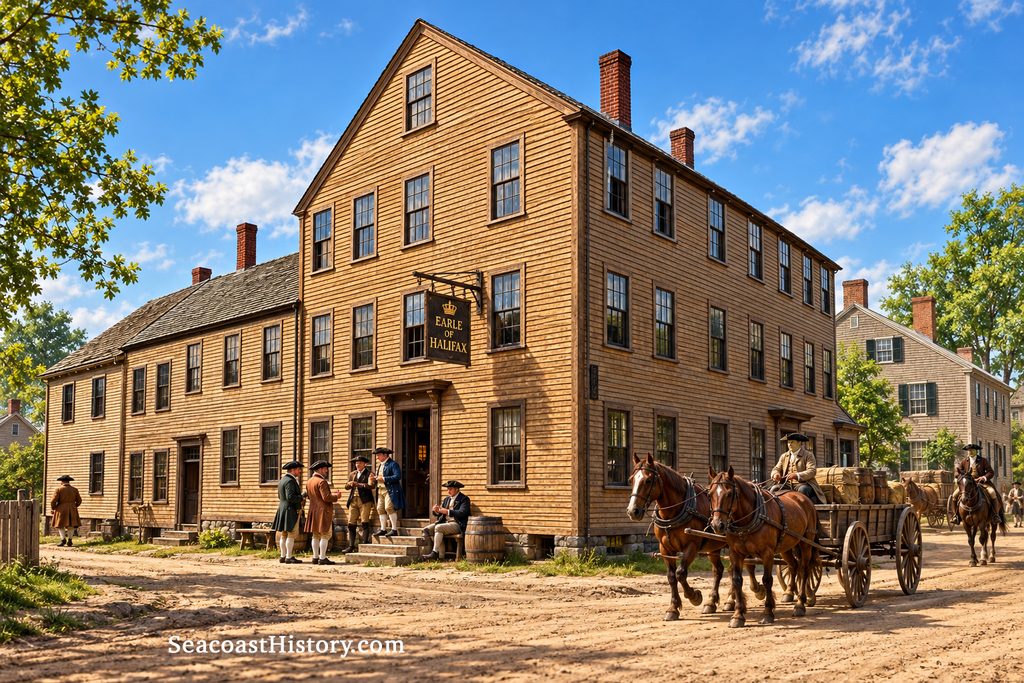
NOTE: In his history of the American Revolution, filmmaker Ken Burns tackled the harsh reality of NH governor John Sullivan’s role in destroying Indigenous family villages and failures in battle. This glowing tribute is offered here in sharp contrast to Steve Adams’ blog on Sullivan as a more complex and darker character. Foss skips over Sullivan’s 1774 powder raid, wartime battle issues, enslaved servants, Indian family raids, and litigious habits, but helps us see the strong Masonic bond among Revolutionary founders. The Earl of Halifax tavern, restored by support from the local Masonic lodge, is now the William Pitt Tavern at Strawbery Banke Museum. A masonic library and meeting room are on the upper floors.—JDR
John Sullivan was born in Somersworth, New Hampshire, February 17, 1740. He studied law and was admitted to practice before the courts of the Royal Province of New Hampshire. His home and place of business were in Durham, New Hampshire. Durham sent him to the Provincial Assembly early in 1774 as its representative. This led to his appointment as a delegate to the first Continental Congress. Appointed brigadier general in the Continental Army in 1775, he was promoted to major general in 1776. After being engaged in several prominent battles of that war he resigned his commission late in 1779.
READ alternative POV on Sullivan
He was sent to the Continental Congress again in 1780 and 1781. Attomey General of New Hampshire from 1782 to 1786, he was chosen President (Governor) of New Hampshire in 1786 and 1787. He was Speaker of the House in 1788 and also president of the Constitutional Convention which ratified the Federal Constitution. This made New Hampshire the state to establish the United States of America. He was chosen presidential elector for 1789 and cast his vote for President George Washington. Again he was elected President (Governor) of the State of New Hampshire in 1789. President Washington appointed him as the first judge of the Federal District Court in the latter part of 1789, a position which he held at his death. Harvard College conferred upon Sullivan the degree of Master of Arts in 1780 and Dartmouth College be- stowed the degree of Doctor of Laws on him in 1789.
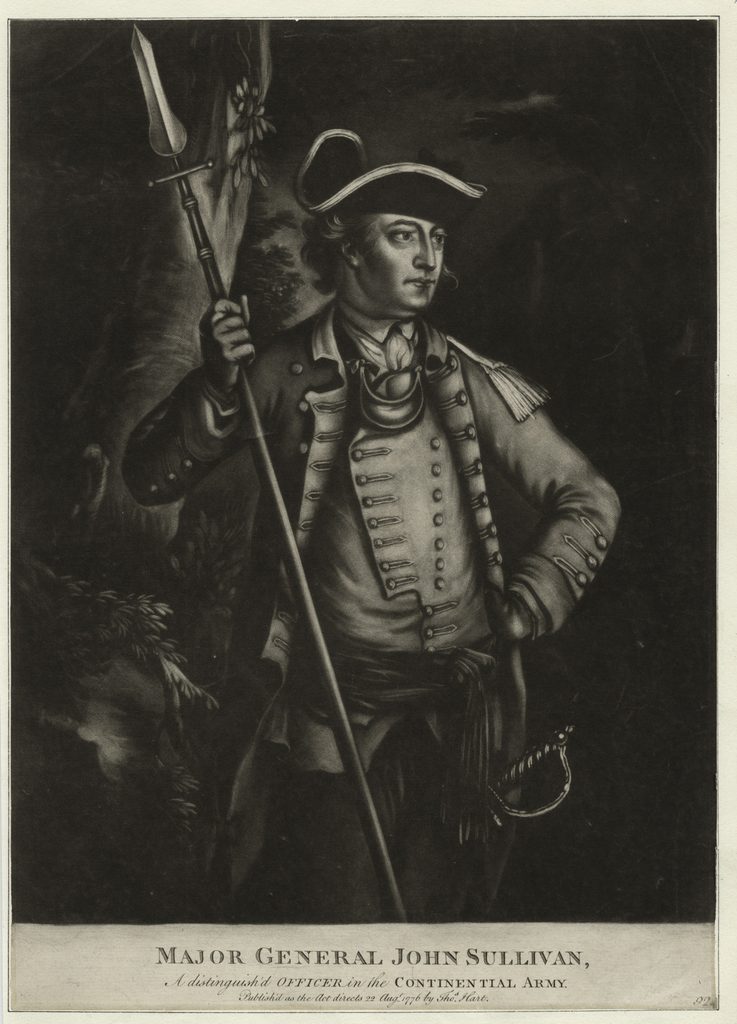
Many honors have been accorded General John Sullivan. Among them are the incorporation of the Town of Sullivan in Cheshire County, New Hampshire, in 1787; establishment in 1827 of the County of Sullivan, New Hampshire; erection of a granite monument by the State of New Hampshire in 1894 near his home in Durham, New Hampshire. More recently, a steel span across the Piscataqua River from Newington to Dover Point was named in his honor. In 1929 (Note—and demolished beginning in 2026. The United States Post Office issued a commemorative postage stamp bearing his likeness in honor of his victorious New York expedition against the Indians. The State of New York honored him in 1879 by erecting a monument at Ithaca. The Town of Epping, New Hampshire, which long had a Masonic lodge called Sullivan Lodge No. 19, renamed it Major General John Sullivan Lodge No. 2., F&AM.
Sullivan’s Masonic career commenced in old St. John’s Lodge Portsmouth, NH, on March 19, 1767. That evening the lodge held a regular communication in the house of Isaac Williams of Portsmouth. The minutes of that meeting, in part: “This evening proposed by Dr. Hall Jackson, Mr. John Sullivan, who was balloted for, and unanimously agreed to be made this evening and acquainted him with the result of the Lodge, he was ready and according was made a Mason this evening.” It would be twenty-two years before the Grand Lodge of New Hampshire would be established, but of the first officers chosen in 1789, four were present March 19, 1767. John Sullivan, Hall Jackson, George Turner and Joseph Bass. John Sullivan received the degree of Master Mason December 28, 1768,in the Master’s Lodge at Portsmouth.
On this date the lodge room was located in the new Earl of Halifax Tavern, owned and operated by Brother John Stavers. Although the name of the tavern had been changed to Pitt Tavern (see Slaves at the William PItt Tavern) during the Revolutionary War, it was in the same building that deputies from Masonic lodges met July 8, 1789 to organize the Grand Lodge of New Hampshire. From 1768 to 1774 the minutes record the occasional presence of John Sullivan, but since his home was about twelve miles from the lodge room it is to be expected his attendance was not as regular as of those living in close proximity to it. On November 22, 1775 the St. John’s Lodge minutes record that Major Joseph Cilley was made a Mason gratis “for his Good Services in Defense of his Country.” Brigadier General John Sullivan was present this evening.
This date was during the period in which General George Washington had ordered Brigadier General Sullivan to Portsmouth to check harbor defenses. The records show that Major General John Sullivan on the evening of March 27, 1777, proposed that Major Winborn Adams be made a Mason. It was done. Unfortunately, Lt. Col. Adams was killed less than six months later leading his regiment into battle at Bemis Heights. While General Sullivan was in charge of the campaign to secure Rhode Island he visited the Providence Lodge of Freemasons frequently. When he was ordered to depart from Rhode Island, the Providence Lodge voted that a committee present an address “to our worthy Brother Major-General John Sullivan, in behalf of this lodge . . . .” It was published in the Providence Gazette of March 27, 1779. The message extends “most cordial Thanks, for the particular Honor you have done them, in so frequently associating with them in Lodge;”. It is a touching tribute. General Sullivan’s reply to the address is also interesting for it shows clearly his knowledge and approbation of Masonry. In 1788 St. John’s Lodge adopted its fourth set of bylaws. At the end of the bylaws, as was the custom, each member signed his name. The well-known signature of “jno Sullivan” appears, in his own handwriting, to this set of laws.
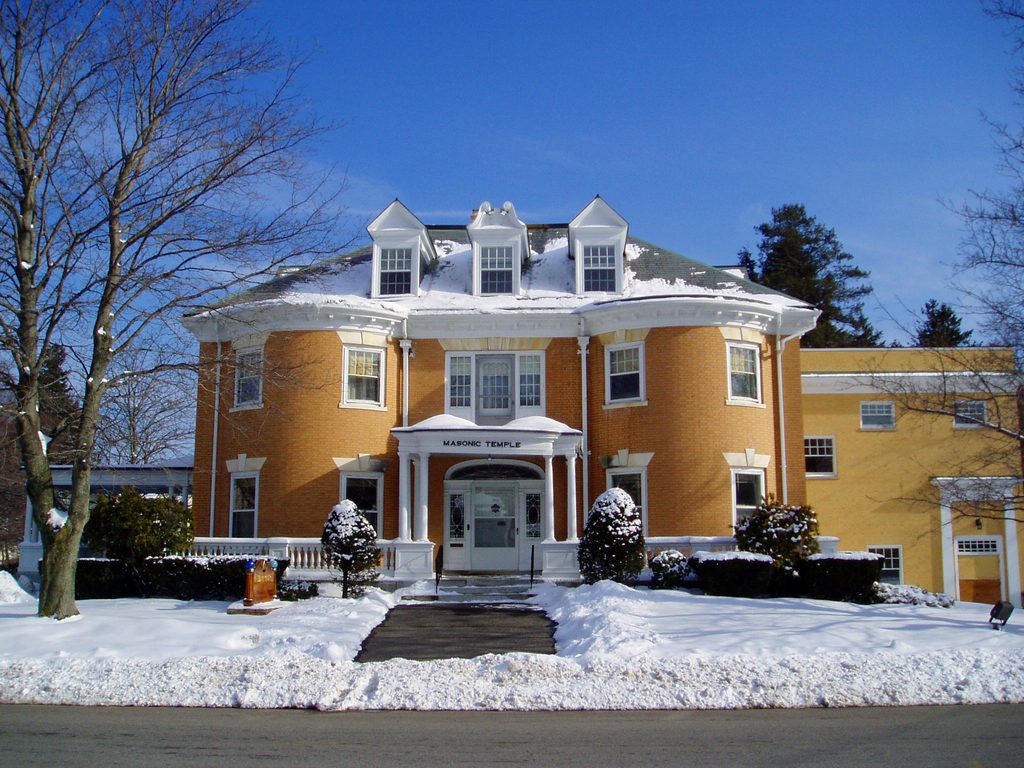
In the spring of 1789 several New Hampshire Masons were promoting the establishment of its own Grand Lodge. The first meeting was held in the Pitt Tavern July 8, 1789. Sullivan, then President of New Hampshire, was elected the first Grand Master. He was absent, but at the second meeting, held July 16, 1789, he was present to accept the office. Because he had not served as a Worshipful Master of a symbolic lodge, there was a delay in his installation as Grand Master. It was arranged for him to be elected Worshipful Master of St. John’s Lodge at its next annual meeting. (See Washington in Portsmouth)
On December 3, 1789 , St. John’s Lodge held its annual meeting and elected Sullivan Worshipful Master for the ensuing year. He was duly installed as Master of his lodge December 28, 1789, and conducted his first meeting January 4, 1790. On April 8, 1790, plans were completed for the elaborate installation ceremonies of the Grand Lodge officers for the first time in New Hampshire. The event was held in the Assembly Hall on Vaughan Street because the crowd was too large for the lodge room. Brother and Doctor Hall Jackson, the oldest Master in the chair, installed John Sullivan into the office of Most Worshipful Grand Master of the Grand Lodge of Free and Accepted Masons in and for the State of New Hampshire. Grand Master Sullivan then proceeded to appoint and install the other officers who would serve with him during the ensuing year.
The regular quarterly communication of the Grand Lodge was held April 28, 1790, at which time Most Worshipful John Sullivan presided. Six months later he declined to serve further because of ill health. On October 27, 1790, Dr. Hall Jackson, his proponent of 1767, was elected to succeed Sullivan as Grand Master. After a long illness, Sullivan died at his home in Durham January 23, 1795 and was buried in the family cemetery situated in back of his home. In this burial ground, in addition to a suitable gravestone, is a large stone on which is mounted a bronze marker. The latter was placed there by the Grand Lodge of New Hampshire in 1964, that the spot might be found if occasion should require it.
SOURCE: Excerpted with permission from Three Centuries of Freemasonry in New Hampshire by Gerald Foss, NH Publishing, Somersworth, 1972. St. John’s Lodge #1

 Gen. John Sullivan, a Contentious Hero
