



By Steve Adams
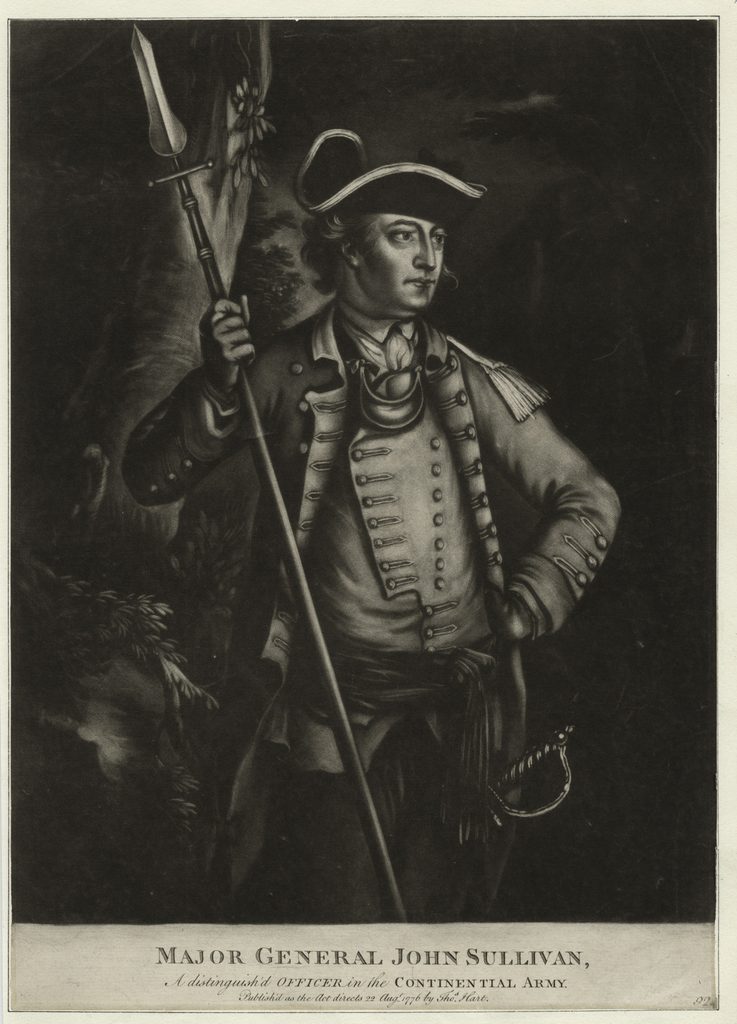
John Sullivan is among the best-known New Hampshire figures in the American Revolution, but he was also one of the most controversial. Disliked by Gen. George Washington and despised by citizens of his town in Durham, Sullivan became one of the first governors in New Hampshire after taking a major role in the American Revolution.
John Sullivan was born in the parish of Somersworth, NH, on February 17, 1740, the third son of Irish redemptioner immigrants. His father was the local schoolmaster, and he made sure his son received a good education. Sullivan read the law with Samuel Livermore, and in 1764 he bought three acres on the bank of the Oyster River in Durham and hung out his shingle there, becoming the town’s first lawyer.
Rich Lawyer, British Friend
Vain and ambitious, the black-haired lawyer was determined to get rich. Sullivan aggressively foreclosed on debts owed to him and sued his neighbors. Soon he was hated by most of Durham.
Groups of his victims attacked him more than once. In June of 1766, 133 citizens of Durham petitioned the General Court for relief from the “Oppressive Extortive Behavior of one Mr. John Sullivan.” With the aid of favorable depositions from his friends, Sullivan talked the court into dismissing the petition and then sued, unsuccessfully, for libel. Whatever his ethics, records show that, between September of 1764 and May of 1772, Sullivan won 35 actions and earned more than 3,000 pounds.
Sullivan increased his holdings in the Durham area and gradually improved his relations with the town’s residents. In the late 1760s, he supported Britain and became a favorite of Royal Governor John Wentworth. Thanks to Wentworth, Sullivan was commissioned as a major in the militia. As the Revolution loomed, he had achieved wealth, power, respect and leadership. Logically, John Sullivan should have been content to help maintain the status quo, but he was an ambitious man and seldom happy with what he had.
Converted To Revolution
As relations between Britain and New England eroded in the early 1770s, Sullivan joined the ranks of the dissidents. On July 21, 1774, the First Provincial Congress of New Hampshire met in Exeter. Sullivan represented Durham. He was elected as a delegate to the First Continental Congress. At Philadelphia, he aligned with the radicals from Massachusetts.
In November 1774, Sullivan returned to New Hampshire and on December 13, he committed himself totally to the Revolution. He led a raid on Fort William and Mary in New Castle to secure arms for the rebel cause, an act of treason against the King and a betrayal of his friend John Wentworth.
Early in 1775, Sullivan and merchant and shipbuilder John Langdon were elected to the Second Continental Congress. At Philadelphia, the delegates voted to take on the regulation of the army and appointed Sullivan a brigadier general.
Sullivan’s military career was long and controversial. After a nine-month siege the American Army drove the British out of Boston. In the spring of ’76, Washington sent Sullivan to Canada. There he took command of the sick, dispirited, and mutinous remnants of the army that had unsuccessfully invaded Canada the previous year. Stubborn and with high hopes of military victories, Sullivan wrote Washington that he was “Determin’d to hold,” but he was soon forced to retreat.
John Sullivan’s enemies in Congress criticized him severely for the retreat, but on August 9, the delegates voted to promote him to the rank of major general. At about this time, Washington described Sullivan as “active, spirited, and zealously attach’d to the cause.” Washington went on to say he had “a little tincture of vanity . . . an over desire of being popular, which now and then leads him into some embarrassments.”
In August of 1776, Sullivan joined Washington, who was confronting the British Gen. Howe in New York. On August 20, he received command of Long Island, but three days later Washington took part of his command away and gave it to Gen. Israel Putnam. The disaster that followed was due in part to the poor definition of the division of command. In the melee, the British and Hessians attacked the Americans from both sides and routed them. Brave to the point of being foolhardy, with a pistol in each hand, Sullivan engaged the Hessians in a running battle in a corn field and was captured.
While a prisoner of war, Sullivan served as an intermediary between Gen. Howe’s brother, Adm. Richard Howe, and the Continental Congress, carrying the admiral’s peace proposals. The negotiations collapsed almost immediately and Sullivan was again criticized by Congress. John Adams called him a “decoy duck whom Lord Howe had sent among us to seduce us into a renunciation of our independence.”
MORE ON Sullivan in Durham, NH

Sullivan and Washington
After Sullivan was released in a prisoner exchange, he rejoined Washington in New Jersey. On December 25, 1776, the American forces crossed the Delaware River and hit the Hessians in Trenton. Sullivan was in the thick of the fighting. He and his command captured a vital bridge across the Assanpink Creek and sealed the mercenaries into Trenton. He finally had a military victory, and his good luck continued through the early part of January, 1777, as his forces helped push the British out of Princeton.
Early 1777 found Sullivan in high spirits, but not for long. He was soon arguing with George Washington, the Continental Congress, and everybody else over commands and promotions. In response to Sullivan’s requests and complaints, Washington wrote to him saying, “No other officer of rank in the whole army has so often conceived himself neglected, slighted, and ill-treated as you have done, and none, I am sure, has had less cause than yourself to entertain such ideas.”
In August, Sullivan failed in an attempt to capture Staten Island. In September, he commanded the right flank at the disastrous Battle of Brandywine. A court of inquiry later absolved him of any blame for the failure at Staten Island, but his enemies in Congress made him the scapegoat of Brandywine.
In October, Sullivan’s bad luck accompanied him to Germantown, another disaster. From there, he went to an inconsequential command in Rhode Island in 1778 and on an indecisive campaign against the Iroquois of the Six Nations in New York in 1779. Sick, broke, and at odds with Congress, Sullivan retired from the army in November of 1779 and returned to New Hampshire.
Governor, Judge, Drinker
Sullivan’s retirement was short-lived. In New Hampshire he was a hero, and the state re-elected him to the Continental Congress, where he raised his voice on such issues as New Hampshire’s land claims in Vermont, Revolutionary finances and peace with Britain. In need of money, Sullivan accepted a loan of 68 guineas from the French minister at Philadelphia, the Chevalier de la Luzerne. His enemies in Congress were quickly on his back with charges that he had taken a bribe and was on the French payroll. Embarrassed once more, he left Congress for good in August of 1781.
Back in Durham, Sullivan busied himself with recouping his wasted fortune and with politics. One of his clients was naval hero John Paul Jones, who was sued by a former crew member. He served as attorney general and as speaker of the house. He and John Langdon led the long legislative campaign which resulted in New Hampshire becoming the ninth state to ratify the Constitution on June 21, 1788. In 1789, he was elected to a third and last term as president and in the same year President Washington appointed him as a federal judge for the district of New Hampshire. Sullivan’s appointment was something of a personal endorsement as Washington only appointed men of outstanding ability and unquestionable loyalty. He never resigned his judgeship although his health prevented him from sitting on the bench after May of 1792.
John Sullivan’s last years were miserable ones. He became involved in land feuds in Durham, went into debt and grew senile. His daily drinking irritated an ulcer and he suffered from a progressive nervous disease. Only a shadow of his former self, he was forsaken by all but his family and a few friends. He died in his home on January 23, 1795, a man who found happiness only in action and peace only in death.
By Steve Adams
SOURCE: Originally published in “NH: Years of Revolution,” Profiles Publications and the NH Bicentennial Commission, 1976. Reprinted by permission of the publisher on SeacoastNH.com in 1997. Edited by SeacoastHistory.com in 2026.
 A Simpler, Cheaper Halloween in 1932
