



Family legends are fun, but often imagined and impossible to authenticate. My mother, born of an Irish clan, suggested her three boys were distantly related to Davy Crockett, Calvin Coolidge, and the Pilgrims. The city of Dover, despite contrary evidence, clings to a founding date of 1623. I’ve received scores of emails from people named Jones who believe a childless naval hero named John Paul from Scotland was their ancestor. (He added the surname “Jones” after eluding a court trial for killing a crewman.)
So let’s take this fishy Haddock tale with a shaker of salt. Some family members swear their ancestors arrived here 10 years before the Mayflower band and lived under a big rock in coastal Maine.
According to Legends of the Haddock Family (1976), four Haddock brothers from Scotland crossed the Atlantic in search of tall pine timbers to use in building the royal navy of King James I.
They were blown off course in a storm (coincidentally like the Mayflower) and wintered here, the story goes, somewhere near the Piscataqua River in 1610. Details are sparse. No one knows the names of the brothers, what ship they arrived on, or where they settled. Over the centuries, without a shred of evidence, Haddock family tradition has honed the location of their ancestral home to “The Landing,” as they call it, somewhere in South Berwick, Maine.
The self-published family genealogy by Hugh Ransom Haddock offers a few more clues about the Haddock brothers.
Unable to fell tall timbers in the howling winter weather, they dug a cellar hole, lined it with large stones, and settled in for the season. Having brought plenty of supplies, the Haddock’s survived the bitter weather. They seemed not to make this a permanent settlement, but sailed up and down the coast gathering marketable timbers and fish.
I had never heard that story until Morris Haddock wrote from Hot Springs, North Carolina. He asked if I could direct him to the historic “Landing” site and the nearby Haddock family graves. Morris explained that family members had located both sites at the turn of the 20th century, reinvigorating the Haddock claim that they predated Plymouth Colony in Massachusetts.
Wishful thinking
America is full of Haddocks. Family genealogy websites indicate English and Irish ancestry. One Haddock descendant from Missouri, Mrs. Alma Haddock-Martin, came east to track down the old legend. She visited South Berwick around the turn of the 20th century. There Alma Martin reportedly discovered a “relative” named Ezra Haddock, who was living in town at the time.
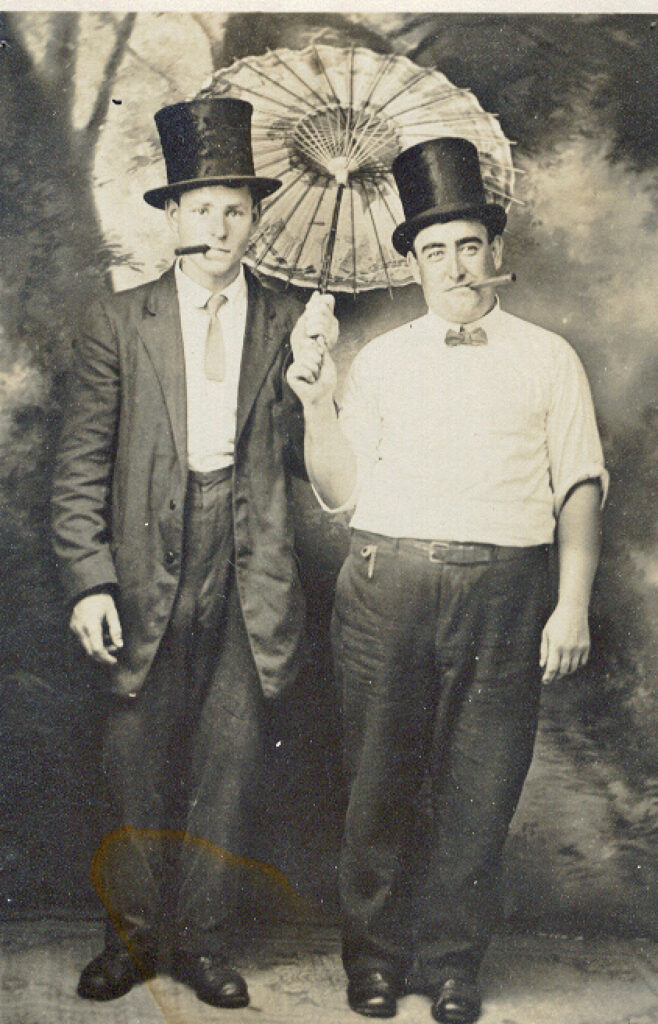
Ezra (his name was actually Enoch), according to family oral history, showed Mrs. Martin “The Landing” site. He took her to a cemetery where she identified at least two Haddock grave stones. That, on the surface, seemed to prove the old legend. But seeing ain’t always believing.
Wendy Pirsig, a former director of the Old Berwick Historical Society, confirmed that members of the Haddock family have made at least two pilgrimages to South Berwick in search of the proposed 1610 site.
Society archives include an odd photograph of Enoch Haddock in 1912. He is standing with another man holding a parasol. Both men are wearing top hats and have unlit cigars in their mouths. No one has any idea what the photo is about. Society records indicate that Enoch Haddock was born in 1895, but no one knows where. He married a South Berwick woman named Mary Perkins in 1903, when he was only 18. In 1916, Enoch married another woman who lived in Somersworth, NH. We don’t know what happened to poor Mary. Enoch Haddock died in 1918 at age 33.
History is a muddy river and facts are slippery fish. For years the Midwestern Haddocks dreamed of coming East to find their “roots.” When someone finally did, she found Enoch, who himself had only recently moved to town. But he was a Haddock, and that’s what mattered. What Enoch apparently showed Mrs. Alma Haddock-Martin was “Upper Landing,” a spot just above the Counting House Museum in South Berwick. Perhaps he also showed her a spot near the famous Hamilton House on the river there called Pipe Stave Landing. There are probably as many places called “The Landing” in America as there are people named Haddock. But it was a fascinating coincidence.
During another Haddock pilgrimage, descendants with a copy of the same family genealogy book in hand actually took a shovel to the earth near Upper Landing in South Berwick. There they found some flat stones and a few old bottles and were satisfied that this was indeed the 1610 landing site. The bottles were likely 100 years old, and the stone slabs? That’s a bit like going to Alaska in search of a chunk of ice. You’re bound to find one.
South Berwick’s vital records show no evidence that any Haddocks ever lived or died in the town in the early days. Sam Haddock lived there in the 21st century, but he told me he moved to South Berwick in the 1960s. Sam had never heard the 1610 legend until historical society members called him (after I called them) looking for clues. The graves Enoch showed Mrs. Martin over a century ago, according to family accounts, dated to the 1850s. Alma said the names appeared to be scratched on pieces of slate with a knife, but Alma was visiting New England for the first time and was unfamiliar with early grave design. The graves were located in a small cemetery about three miles from the Counting House landing where the Old Berwick Historical Society stands today. According to Pirsig, Enoch must have taken Alma to a cemetery in a nearby town.
But what, exactly, was Mrs. Martin looking for? Certainly no graves from 1610 would survive 400 years. The earliest known local carved graves are from the mid-1600s and earlier graves were not marked with carved stones. If the four Haddock brothers stayed only one winter and moved on, why would there be graves or descendants left behind at all? And how could anyone alive know the original site was called “The Landing” if the Haddocks visited South Berwick 30 years before any other settlers arrived? The first known permanent residents came to South Berwick in the 1640s. If other Haddocks followed generations later, they left no records.
The Haddock story is similar to the Victorian search for evidence of the 1623 Trading and fishing post of David and Amais Thompson located in Rye, NH. Tourists from the nearby Wentworth Hotel in nearby New Castle claimed to have found stone foundations and even human bones as “evidence” of the original habitation. Thompson, like the Haddocks, ws reportedly from Scotland when, in fact, he was an apothecary from Plymouth, England.
Popham Colony
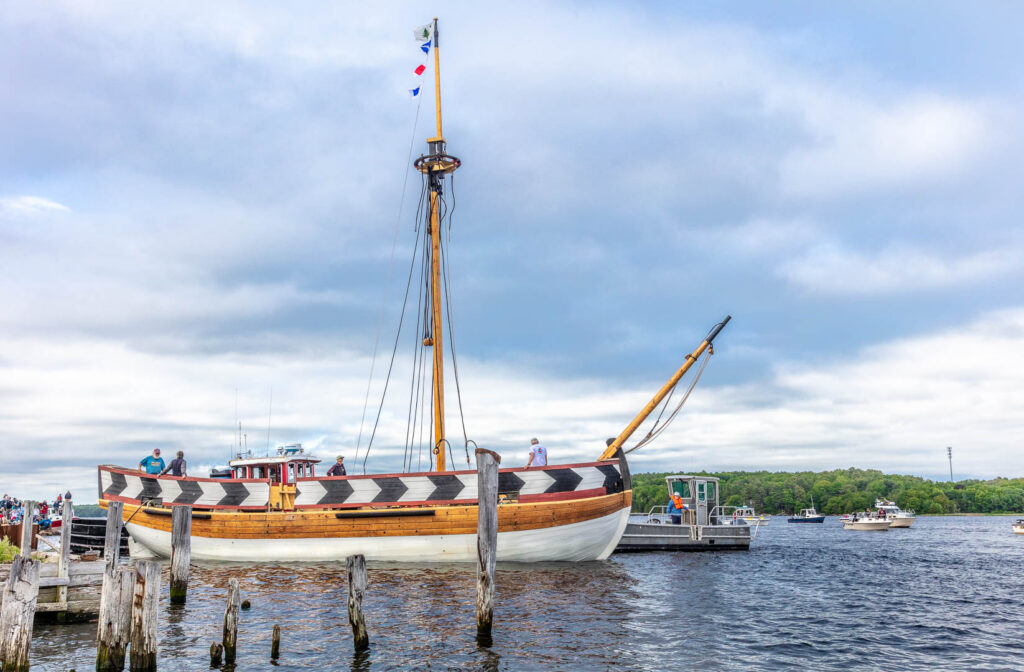
As wacky as the 1610 story may sound, it isn’t. Long before the Pilgrims landed at Plymouth, an adventurous company of Englishmen “settled” on the Kennebec River in Maine. An amazing drawing of their star-shaped settlement survives. They created Fort Sagadahoc, also called Fort St. George, in 1607 at what is now Phippsburg, Maine. History buffs will recall the year since it also marks the arrival of another group chartered by King James at Jamestown in Virginia. Back then, New England was still known as Northern Virginia. Popham Colony’s 1607 group may be the source of the Haddock legend. They survived a tough winter and, after the death of George Popham, returned home after a year. Their visit, however, is highly documented. Maine, technically, beat the Pilgrims to the punch by 13 years. Popham did something even the Pilgrims couldn’t manage. Sometime between 1607 and 1608 the skilled workers at Fort St. George built a 30-ton ship out of native woods and called it “The Virginia”. (Remember that these settlers, according to the earliest maps, had landed in Northern Virginia, not Maine). This was an enormous accomplishment, something akin to astronauts building a vehicle out of moon rocks and flying it home from the Moon. “The Virginia” made at least two transatlantic voyages and went a long way toward inspiring future colonization of New England.
Haddock family legend indicates that the four brothers had already visited the New World in the service of King James. Were the Haddocks among the 100 original unnamed settlers at Popham Colony? And if they were skilled shipbuilders and fishermen, could they not have returned to the Piscataqua in 1610?
Archaeology professor Emerson “Tad” Baker of Salem State College conducted research at the 1640’s-era Chadbourne House site in South Berwick for two decades. He is an expert on the very early colonial period around here.
“It sounds like Colonial Revival rather than colonization,” Tad told me. He is referring to the late 19th-century American fascination with all things old. Hampton, for example, had a Colonial Revival fascination with visits by imaginary Vikings due to mysterious scratches found on a stone. The mysterious “runes” were likely marks scratched by mechanical shovels during housing construction.
There have long been stories evolving out of Popham Colony, Tad Baker said, that not all of the 1607 settlers went back home when the settlement failed. Agaon, no evidence supports this theory.
Tad had never heard the Haddock family legend. He was intrigued by the reference to an underground winter shelter. There is evidence, he says, that some very early colonial shelters may have been carved into the ground with a wooden structure added on top. Other New England legends suggest that families lived in caves, possibly for years, in order to survive the Indian wars of the late 1600s.
“People have believed in such stories for a very long time,” Tad Baker says. “What do I think? I think the family is probably confusing history with family traditions.”
Copyright © 2003-2026 by J Dennis Robinson
 The First Romance of Admiral Dewey