

Close your eyes and try to picture the Piscataqua region in the 1600s. What do you see? Not much, I bet.
There are tall trees, of course, lots of them, in a dense forest that fades into forever. The forest is broken by occasional plots of cleared land, crudely fenced, and vaguely populated by horses, oxen, pigs and cattle. Wooden houses, rare and dispersed, appear along the pristine rivers, dotted with small boats and canoes. And because the rivers are the highways, the main roads, few and far between, are little more than narrow overgrown cart paths.
“All most people have to work with in picturing the 17th century,” says historian Nina Maurer, “is whatever we learned in third or fourth grade. And it stopped there. It froze there. It’s not our fault.”
What most of us know about the region’s founding century is minimal if not mythical. We see imaginary Pilgrims in dark somber outfits and buckled hats. We get a flash of the Mayflower, her sails billowing in a storm, or envision a crouching Indian warrior preparing to torch a Colonial garrison. That’s it. Then our minds hit the fast forward button and we’re off to the more familiar battles of Bunker Hill or Gettysburg or the Kennedy assassination or President Trump’s latest tweet.
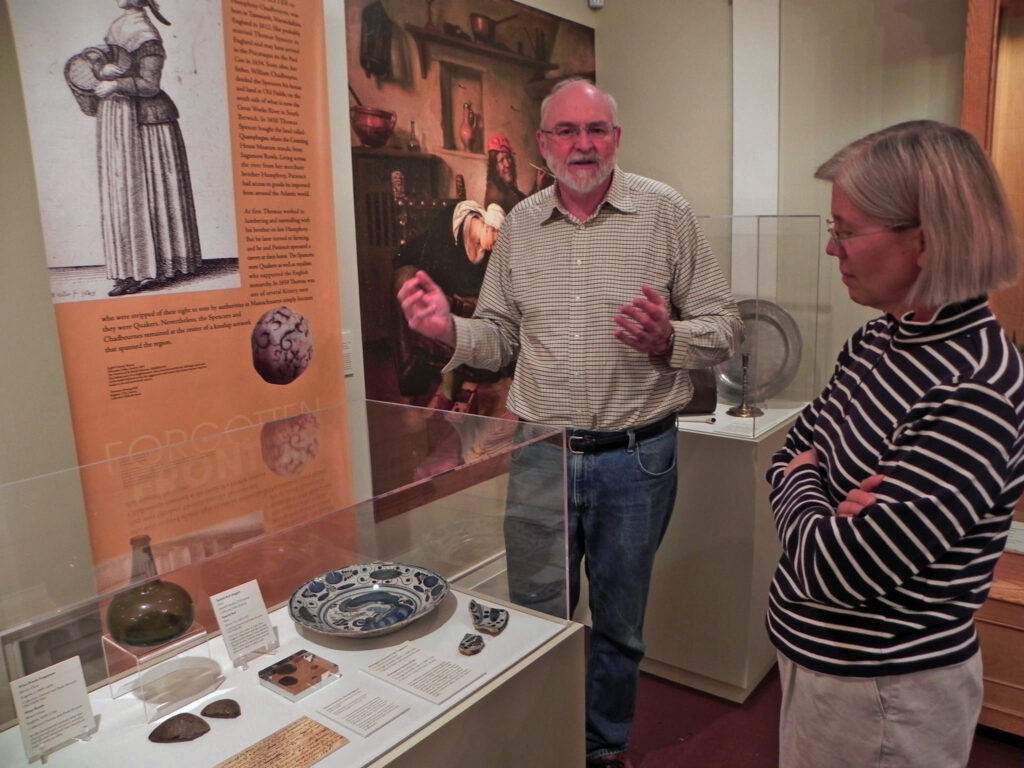
Does the past grow less relevant the further back we go? Maurer says no. She was consulting curator of a 2017 exhibition, two years and $100,000 in the making in South Berwick, Maine. “Forgotten Frontier: Untold Stories of the Piscataqua” used visual, audio, and interactive tools to show that the Seacoast region owes much of its unique character to its European founders and its indigenous people.
“Our identity as self-reliant New Englanders is connected to our struggle to control the frontier,” Maurer said during an interview at the Counting House Museum, headquarters of the Old Berwick Historical Society. “We also ended up with a much more open landscape for the same reason, because for the first century, we were the frontier.”
Professor Emerson “Tad” Baker, a 17th-century scholar, author and archaeologist, nails the question down hard. “Think about it,” he says. “Why isn’t Portsmouth like Boston?”
Like Boston, New Hampshire’s only seaport was founded in the 1630s. The Piscataqua region was rich with natural resources, particularly fish and timber. The fur trade with Native Americans got off to a good start and the peace lasted for decades. But eventually the fragile French, Indian and English populations collided. For the next half century the Piscataqua–from Dover, Durham, Exeter, Rye and Hampton to Portsmouth, Kittery, the Berwicks, and York–became a battle zone. People, property and fortunes were wiped out during the Indian resistance that lasted until the Treaty of Portsmouth in 1713.
These are stories rarely told of a distant time and diverse people. Baker, who has spent more than a decade excavating 40,000 Colonial artifacts from the Chadbourne family site in South Berwick knows the importance of the 17th century better than most. But how to translate that story to the 21st century?
“Here’s the problem,” Baker says. “I love small little broken bits of burned stuff. But how excited are other people going to get about these artifacts?”
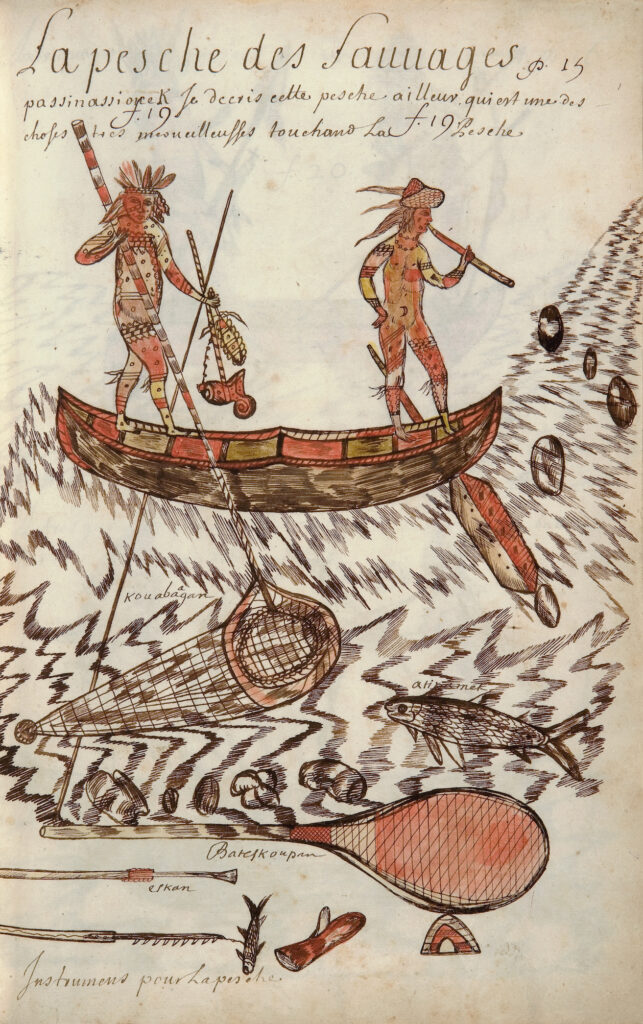
Rewind two years. On a warm July day in 2015, a team of scholars who know a great deal about the 17th century met at the historic Hamilton House in South Berwick. It was the ideal location to brainstorm about the early Piscataqua region because, looking out onto the tree-lined Salmon Falls river, the scene is all but unchanged by the centuries. The distinguished historians included Jeffrey W. Bolster, Laurel Ulrich, Baker, Richard Candee, Elizabeth Lodge and Christine De Lucia. They asked themselves, how can we engage the public in the extraordinary history of this fragile and fascinating region?
“We wanted to make the 17th century pop and come to life,” Baker says.
But how?
Creating an exhibition was not the original plan. The group considered websites, publications, a symposium, teacher workshops, and other ideas. But encouraged by Wendy Pirsig, then president of Old Berwick Historical, and starting with the artifacts from the Chadbourne dig, the “Forgotten Frontier” idea grew.

Visitors in 2017-18 were surprised to find an exhibition of such high caliber in an old brick building adjacent to a power plant in Maine. The Counting House Museum is located at the mill dam on the bank of the Salmon Falls River. It is the surviving structure of what was once a woolen factory. Now it’s home to the very active Old Berwick Historical Society.
Even the approach down the hallway to the exhibition room was professionally designed by Phineas Graphics. The large reprint of an early Piscataqua region map was special-ordered from the British Museum. An audio recording of an Indian legend, read in both English and the Penobscot language, played in the background. Walls and doors had to be moved to make way for the display cases, panel signs, and large artifacts. The freshly painted rooms, a blend of Yarmouth Oyster and Linen White with vivid splashes of red and yellow, formed the backdrop.

Eight figures from the region’s surprisingly diverse past carry the story. Sagamore Rowls, a Wabanaki leader, represents the indigenous population whose lives were uprooted by brash European settlers like Humphrey Chadbourne, a wealthy merchant and sawmill owner. We meet Quaker tavern keeper Patience Spencer and Major Nicholas Shapleigh, a royalist businessman and early slaveholder. Nearby, African-American farmer William Black (aka “Black Will”) learned to coexist with his white neighbors in the wild eastern frontier. Thomas Holmes arrived here as a young indentured prisoner of war from Scotland, while Mehitable Goodwin returned to Salmon Falls after being kidnapped to Canada by Native Americans. A French raider named Jean-Baptiste Hertel de Rouville rounds out the cast of characters.

Of course, there were the rare and carefully chosen artifacts, the often broken and burned bits that inspired the scholarly get-together that launched the new exhibition. The artifacts, drawn from various historical collections, were matched to historical figures, A wooden tankard, an ivory gaming ball or “teetotum,” a powder horn, a pewter spoon, an inscribed copper ring, a wooden trunk, a massive saw blade, scissors, and thimbles. Each item took on deeper meaning within the carefully curated context of the show.
Most impressive was a knee-high table with a large built-in computer monitor. Tad Baker and Nina Maurer and this writer stand around the glowing monitor like three witches around a steaming cauldron. But instead of predicting the future, we are conjuring the past. A projected map of the Piscataqua reacts to the touch of the curator’s hand. Towns appear. Touching the town name brings up a short biography of someone who lived there in the 1600s. In Portsmouth, for example, we get cooper Richard Jackson, whose 1664 house still stands. Going deeper may reveal the person’s house, or related objects, like those in the cases that surround us.
The touch-screen map, created by Access Maps could offer details of five Colonial families from South Berwick, so far, and one or two from other towns in the Seacoast region. But its capacity for documents, family and town records, pictures, maps, archaeological discoveries, and other data is bottomless. Eventually, Maurer predicts, it will be accessible online, linking data from libraries and historical societies across the Piscataqua region.
In 1805, Maurer reminds us, the road that passes the Counting House Museum, was once the primary inland road connecting New Hampshire and Maine. This was the turnpike for stagecoach drivers and horse riders. In fact, she notes, there was a time when the river was a road, not a boundary line. Our ancestors were highly connected in an age before smartphones and freeways. They had to be. Times were tough, life was short, and people were rugged, independent, even stubborn. Those qualities, Maurer says, still define the Yankee identity of the people who live along the scenic Piscataqua that, here and there, even our frontier families would recognize.
For more on the “Forgotten Frontier” exhibition, check out the companion print book.
Copyright 2017 by J. Dennis Robinson, all rights reserved. Updated in 2025.
 The Story of Molly Miles’ Table