


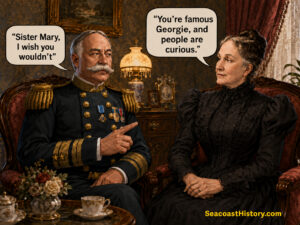
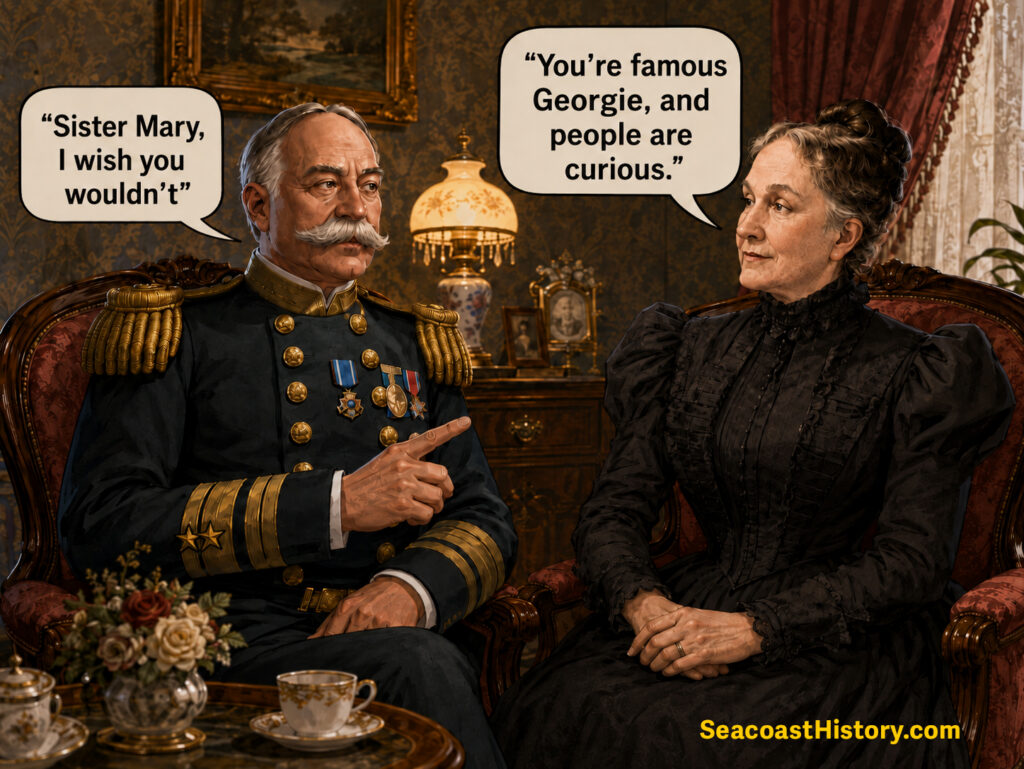
NOTE: We know precious little about Susan Goodwin of Portsmouth, NH, the first wife of Admiral George Dewey. When she died suddenly at 28 in 1872, Dewey refused to speak her name, so deep was his grief. A quarter century later, after his exploits in the Spanish-American War, Dewey was famous. In 1899, the admiral’s sister, Mary (Dewey) Greeley, broke her silence in an interview with a Minnesota newspaper. Here we get a glimpse of his relationship with the daughter of New Hampshire’s Civil War governor Ichabod Goodwin. Dewey remained a widower until 1899, the year the following article appeared, when he married Mildred McLean Hazen. – JDR
The First Romance of Admiral Dewey
An 1899 interview with Mary Perrin (Dewey) Greely (1839-1918)
READ: George Dewey Loved Susan Goodwin
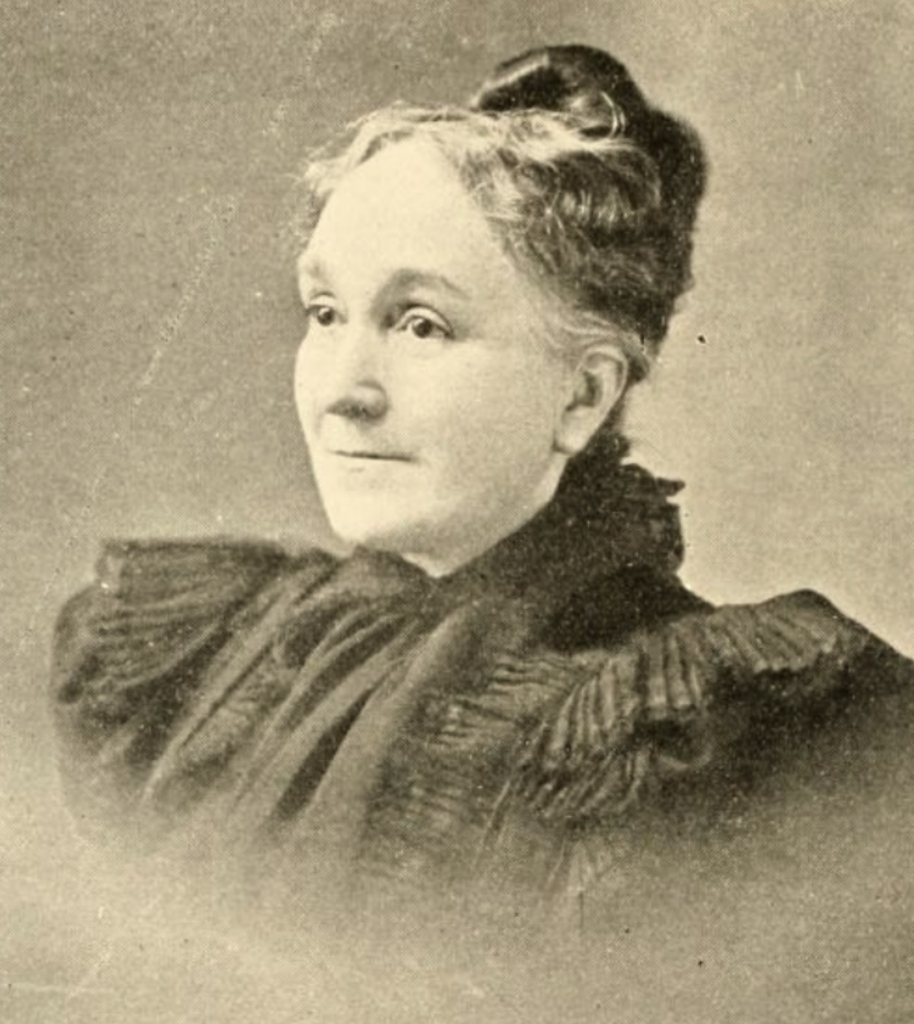
hThe real-life romance of Admiral Dewey has been told at last. It is vouched for by the one who knows more about it than any other living person except the grand old admiral himself —Mrs. Mary P. Greeley. The admiral’s sister. Mrs. Greeley is a stately, white-haired woman, in whom there is distinctly traceable a resemblance to her famous brother. The strength of his features has been refined away into the beauty of hers. She is soft of voice and gentle of manner. She lives in a quiet little home in Montpelier, and tnere she received a representative of the Sunday Journal and told the story of her brother’s love. There is a supreme love in every life. “It is a flame,” said Maurice Barrymore, “compared with which others are as matches.’ So thinks Mrs. Greeley. “I never knew of but one love affair of my brother’s,” she said, “and that resulted in marriage and ended in early death.”
Thirty-two years ago a dashing young lieutenant was stationed at Kittery navy yard, just below Portsmouth, N. H. He was scrupulously careful as to his dress, but the word ‘dude” had not been invented then, and those who ventured to sneer at “Dandy Dewey” did so under their breath. They feared not only the strong arm of “Dandy Dewey” himself, but the equally unrestrained displeasure of his friends. He had man, friends, for he was high in favor in Portsmouth society. Naval officers were always in demand at the exclusive dinners and balls at Portsmouth. But Lieut. George Dewey was the most popular of tnem all, says Ada Patterson, in the New York Journal. There was a reason for this apart from the young officer’s compelling personality.
Ichabod Goodwin, the war governor of New Hampshire,, liked him and predicted future greatness. “There’s a lot in Georgie,” he would say with a chuckle. “He has the right sort of grit. We’ll hear from him in a time that’s coming.” At that period gubernatorial opinion had more weight than now, just as congressional influence was greater than it is today. Gov. Goodwin’s social fiat had gone forth and Lieut. Dewey became the “rage” in Portsmouth’s most conservative society. Gov. Goodwin had a daughter, a gentle, pretty young creature. Susan she had been named, in memory of the mother who was gone. “Susie,” her father called her, because he disliked the dignified sound of the more austere Susan.
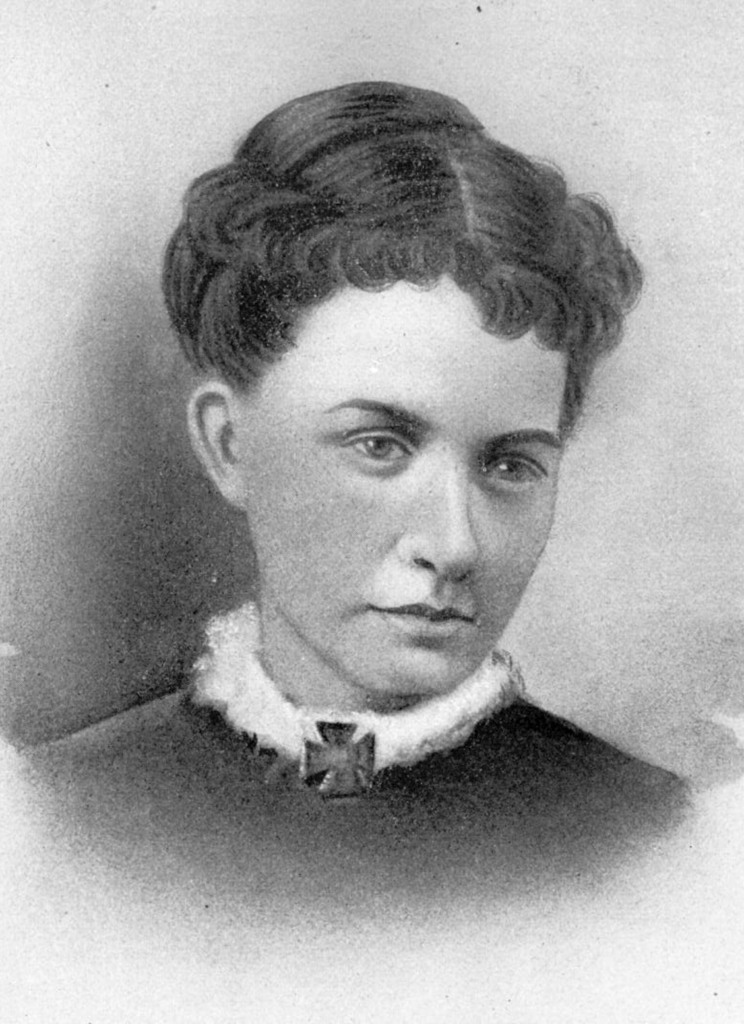
Susie Goodwin had all the housewifely arts at the tips of her dainty fingers, but there was a strain of the old Ichabod in her too, that made her find the atmosphere of the state house congenial. She often went with her father to his office, doing the work of a secretary when need be. Oftener doing the duty of the daughter, advising, suggesting, soothing. When the troublous time of 1861 came to harass the souls of the North and South, Susie Goodwin was seventeen years old. She was a slender, delicate creature, reminding one at first glance of a windblown flower. But her eyes were steady and her lips had a trick of setting themselves in a firm, straight line.
Passing a group of men on the day that President Lincoln issued his call for 75,000 troops, she heard someone say, “What will Ichabod Goodwin, the old copperhead, do now?” Susie Goodwin flushed and her eyes stared fixedly at the old state house, her pretty lips tightening. She hurried to her father’s office. They talked earnestly for a long time.
The next day, Gov. Goodwin issued a call for troops. “The legislature not being in session, I will be personally responsible for the expense of equipment,” he said. He put his entire fortune into the balance, and the cost of equipment covered it all—$6o,ooo. That was the stiff old fellow’s answer to the charge that he was a “copperhead,” and it was his schoolgirl daughter Susie, who suggested the answer.
Such a girl was Susie Goodwin, the governor’s daughter and the belle of Portsmouth. She was as beautiful, as patriotic and as positive as ever, when the war closed. The legislature had given her father’s fortune back to him and he had settled down in his Portsmouth home to enjoy private life for the remainder of his days, when Lieut. Dewey was sent to the Kittery navy yard. “Dandy Dewey” went to a ball at the home of a leading citizen of Portsmouth on the night after his arrival. As he entered he met an interesting trio. “ExGov. Goodwin and Miss Goodwin,” said his host* suavely. “With Commander Rhind, I fancy you are already acquainted.”
Commander Rhind, of the warship Narragansett, was known to every me??, young or old, in the navy. He was a gallant officer. He. too, was stationed at Kittery. “Dandy Dewey” bowed to the superior officer, to the ex-governor and to his lovely daughter. He bowed very low to Susie Goodwin and she responded with an arch courtesy. Then the trio passed on and “Dandy Dewey’s” companion, another young officer, told him that Commander Rhind’s suit for Miss Goodwin’s hand was the talk of Portsmouth. “It’s ten to one he wins her,” added the officer, but the lieutenant did not reply.
Fifteen minutes later he was leading the governor’s daughter out to dance. .He danced with her three times. The third time Commander Rhind observed, and frowned, and pulled his mustache moodily. The next afternoon when he called he found Lieutenant Dewey there. Noting the scrupulousness ‘of the young man’s dress the older one muttered something about a popinjay. Two days later “Dandy Dewey” drove with Miss Goodwin, and the next evening he met her at a dinner, from which Commander Rhind was unavoidably absent, and took her in. At the next ball he had his quota of three dances early in the evening and two were waltzes.
Governor Goodwin heard him asking for a fourth dance and heard his daughter’s laughing refusal. He was quiet at breakfast the next morning, but when the family were separating after the meal, he patted his daughter’s brown head. “Wanted another dance, didn’t he?” he chuckled. “They say George Dewey’s a bit reckless, but I’ll be hanged If I can help liking him. He has grit, and he will be heard from one of these days.” Susle, like the coy maidens of her day. said little, but her blush enlightened her father. Soon after Lieut. Dewey was delighted to receive an invitation to dine at “Gov. Goodwin’s.” He was the first guest to arrive. The governor honored Commander Rhind by claiming his society for most of the evening. “Dandy Dewey” devoted himself to Miss Susie.
Perhaps Providence favored the impetuous young man’s suit. Perhaps blind, stupid chance alone was accountable. Be that as it may, just as the alternate visits of the commander and the subordinate officer were becoming interesting to piazza and parlor conventions In Portsmouth, the Narragansett was ordered away, and Commander Rhind with it. Thereafter, there was no obstacle to the progress of “Dandy Dewey,” except such as Commander Rhind’s letters interposed. He embraced this opportunity with his usual Impetuosity. Soon the good-natured gossips noticed that Susie Goodwin wore a sparkling new brilliant on the third finger of her left hand. “Commander Rhind or Lleut. Dewey?” they queried flutteringly among themselves, just as they had fluttered and queried when a carriage stopped at the Goodwin mansion and they wondered which would alight? The old governor chuckled. Wedding cards put an end to the speculation of the gossips. “Commander Rhind or Lieut. Dewey?” they said tremblingly when they saw the Goodwin crest on the envelope. “Dewey” it was, and their delicious fevers of uncertainty were over; the wedding took place at the Goodwin mansion, Oct. 24, 1867.
Again fortune had favored the young wooer. The impending orders came, but not until after the wedding. Shortly afterward “Dandy Dewey” was ordered on duty in European waters, and for nearly two years he was separated from his young wife. When he returned, he was not only a commander, but he was also assigned to the Narragansett instead of his one-time rival, Commander Rhind. The young couple spent their second honeymoon, a prolonged one, at Newport. Here, in the closing hours of 1872, their son was born. The young mother veiled enough to rejoice in the new happiness that had come to her. “We will call him George Goodwin, dear,” she said. “George for his father and Goodwin for mine. Does that please you?” Five days after the birth of little George Goodwin Dewey his lovely young mother died.
Commander Dewey’s grief was not demonstrative. But he would never talk of his loss, nor permit any one else to do so, and he took up his naval duties again with a grim determination and absorption that were more pathetic than tears. He ordered two medallion portraits of his wife painted on ivory by an eminent Roman. One of these he carried with him until it was lost at sea. The other is one of the treasures of the Goodwin home at Portsmouth. And now that Gov. Goodwin’s prediction has been fulfilled and we “have heard from George” in the thunder from Manila that rolled round the world, the admiral’s homecoming would be sweeter were there one more to see his splendid welcome, one whom in those long gone, golden days he called wife.
 Living on Deer Street Before We Tore It Down