

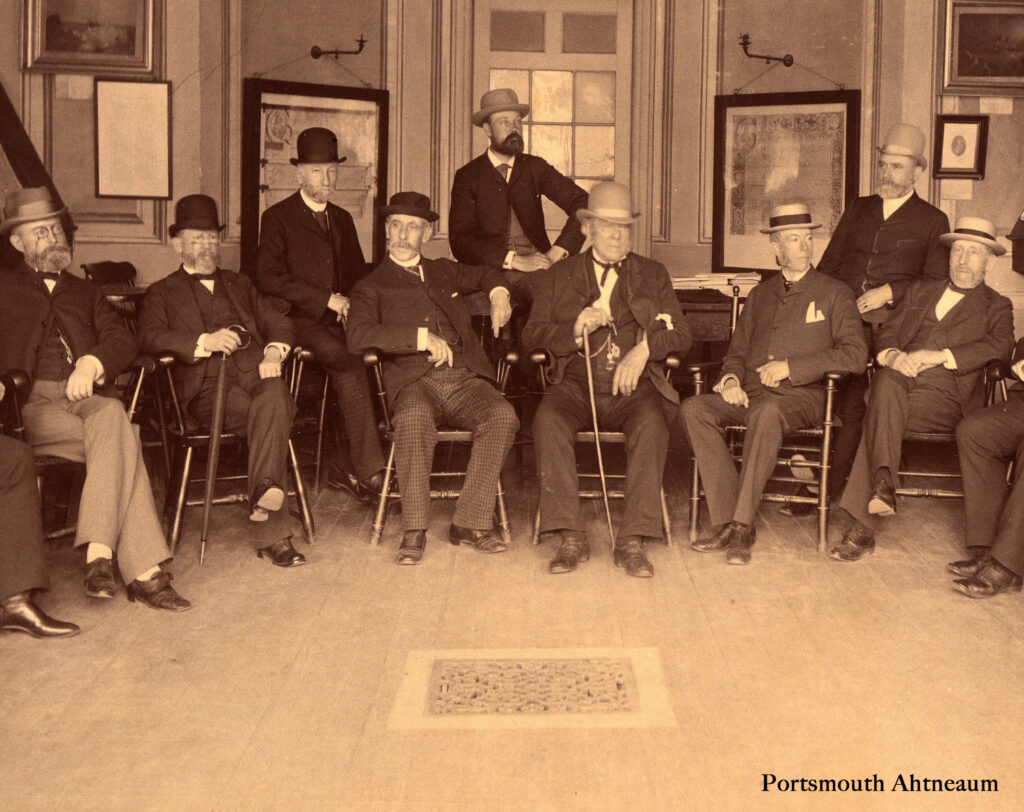
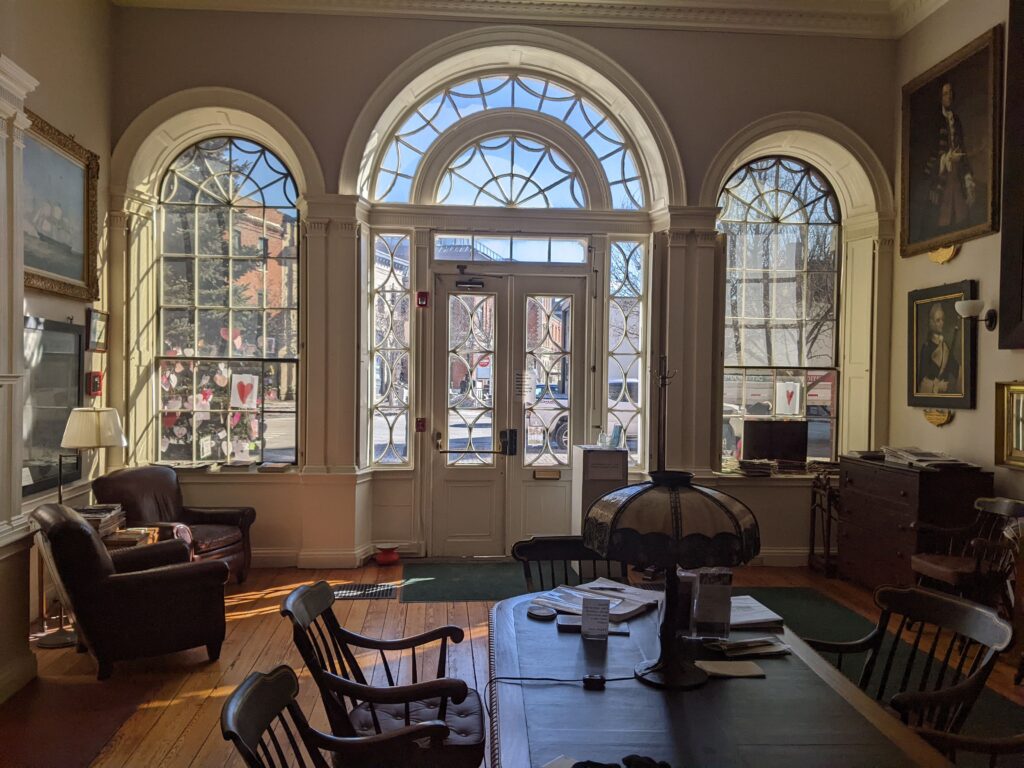
It might well be the most misunderstood space in Portsmouth. Step inside the ornate front doors at 9 Market Square and the hectic heartbeat of the city center softens to a restful hum. The muted sounds of traffic and street musicians fade into the background as you pick up a book or newspaper, settle into a chair, and do what the ancient reading room was designed for–READING. All around you, meanwhile, the portraits and artifacts of Portsmouth’s past are displayed.
Okay, you can’t exactly step inside. The doors between the two upside-down cannons are locked. The Portsmouth Athenaeum, founded in 1817, is a membership library. Some 400 “proprietors” and 150 subscribers support this thriving nonprofit organization. It is part research archive, part cultural center. Two centuries in operation, it remains one of the cities oldest and least understood organizations.
The Reading Room
In 2017, the group completed a $40,000 renovation to the reading room, a go-to Portsmouth destination since the 1820s. A team of skilled artisans uncovered the hardwood floor, repainted the curved walls and ceiling, restored the antique shutters, installed track lighting, and added custom bookshelves.
Karen Bouffard, then Athenaeum president, spearheaded the renovation that stripped away a 20th-century linoleum checkerboard floor to recover the 1850s vibe.
“Things were looking a little tattered and torn,” Bouffard admitted. “We wanted to put our best face forward for the [Athenaeum] bicentennial. The Reading Room is a delightful space, and it has always been about networking. It still is. We wanted to show that, 200 years on, the Athenaeum is alive and well.”
A quick history
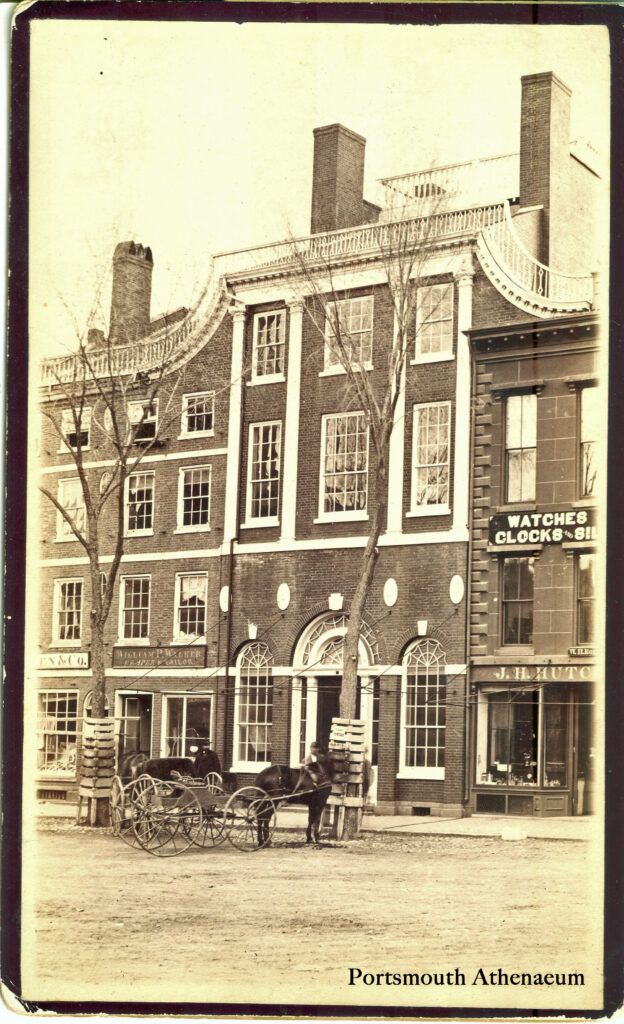
The striking Federal-style brick building, risen from the ashes of the devastating downtown fires, originally housed an insurance company. Meanwhile, fraternal clubs were popping up all over town. Portsmouth merchants, ship owners, sea captains, and insurance agents needed to stay on top of world conditions. They gathered in English-style coffee houses to exchange data on trade routes, politics, and pricing. They pooled their funds and subscribed to key newspapers and journals. Think of a modern library periodical room, plus coffee and spittoons, but without the Internet.
The front of the Fire & Marine Insurance Company served as an influential reading room. But Portsmouth’s shipping industry crashed soon after the War of 1812 and the business went belly up. Another coffee-style club, the Portsmouth Athenaeum, purchased the Market Square space. This group was different. It catered to professionals like doctors, lawyers, and ministers. It shared mostly literary, medical, and religious publications. The fledgling Portsmouth Athenaeum stored its books in other downtown buildings. Eventually, they were moved to the second floor of the former insurance company.
Members bought shares to pay for the building, books, and periodicals. The Reading Room evolved into a cultural center where the city’s movers and shakers exchanged ideas and made deals. The 1823 bicentennial of the founding of New Hampshire kicked off interest in the city’s history. Early Athenaeum records show the Reading Room was once lined with wooden booths, similar to modern library study carrels. Beside them were high wooden tables, like today’s “standing desks,” for reading newspapers and maps. There were stools stacked with archived papers, comfortable armchairs, and a welcoming winter fire. Long before the city’s first historic house museum, the Athenaeum third floor became an exhibition room for curios brought back from around the globe.
Soon nine of the city’s 10 wealthiest men were members of the Portsmouth Athenaeum. Although one report claims the men (there was one little-known female member) never sunk to idle gossip, but they certainly did. A circulated memo requested members to spit in sandboxes, not on the floor. A sign warned that NO BOYS were allowed unless accompanied by a proprietor. Although the Athenaeum included a fairly wide spectrum of Christian members, including Unitarians and a Baptist, it was not always beloved. Newspaper editor and political activist Thomas Laighton, before he moved permanently to the Isles of Shoals, claimed that Athenaeum members were a bunch of “loafers’ who were trying to rule the city.
Fading glory
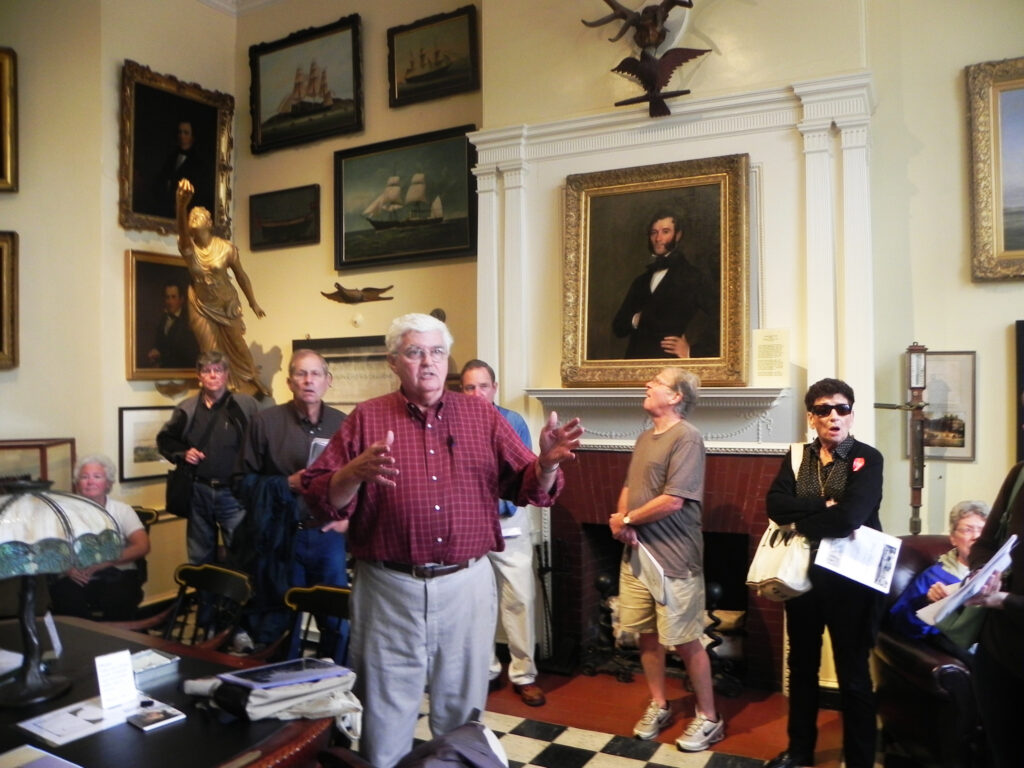
Athenaeum members were not initially focused on preserving the past. Ministers wanted to save souls and live comfortably. Lawyers and doctors wanted to keep their careers profitable. But wealthy members continued to build the library collection, donating books, paintings, documents, and eventually photographs. The life-sized portrait of Sir Peter Warren, recently restored, has been hanging in the reading room since 1828.
READ ABOUT: HMS America
But as the city’s economy flagged, wealthy proprietors died off and the Industrial Age dawned, the Athenaeum became associated with the past. Even in a city sprinkled with colonial mansions, the Reading Room gave off the musty scent of “old fogeydom.” In 1855, a badly needed renovation saw the walls frescoed in Italianate design. Stoves replaced fireplaces. Gas lighting replaced oil lamps. Windsor chairs replaced the study booths. Prior to the Civil War, the second-floor library ceiling was opened to expose a third-floor gallery. A furnace was added to the basement. A water closet, installed in 1889 in what had been the early insurance company offices, replaced the outdoor privy. An 1892 “restoration committee” created the elaborate front door that the newspaper christened “the finest in the city.”
Why it still matters
The Reading Room, anchored in time, became more of a shrine and a showplace in the 20th century. The arrival of the city’s free public library (now the Portsmouth Historical Society) and the dawn of the Internet Age a century later created a paradigm shift. Preservationists turned their attention to saving nine historic house museums and the 10-acre Strawbery Banke campus. The Athenaeum and its proprietors, the city’s history research hub, played a significant role in Portsmouth’s current economic renaissance as a heritage destination.
Although still a membership-supported organization, the new, improved Athenaeum welcomes visitors (Tuesday-Saturday afternoons, 1-4 pm) to share its resources. Authors, students, scholars, genealogy fans, and local home owners can reach the second-floor Research Room through a separate building at 6-8 Market Square. The Athenaeum offers special exhibits, lectures, and concerts to the public. There is a relatively new elevator and a climate controlled walk-in vault for the rarest items. A rich digital database of its extensive collections can be searched online.
“We’re really the opposite of the stuffy, dusty, conservative institution many expect,” said volunteer president, Karen Bouffard. “We’re the place where people make connections, and the Reading Room remains the perfect place for that.”
Nothing about the past has been lost, Bouffard adds. The most recent Restoration Committee did its homework. The restoration painters and carpenters worked with reverential care. But the almost invisible new lighting better illuminates the familiar collection. Sir Peter Warren and Sir William Pepperrell still loom over visitors, King George’s proclamation on the New Hampshire border, with its ponderous wax seal, still hangs near the door.
“We asked–what can we realistically do with our budget,” Bouffard said. “I called in a few favors. Visitors say it’s breath-taking. I think it will appeal to the next generation of new members, who will keep the Athenaeum alive and lively as we enter our third century.”
The upstairs library may still look like Edgar Allen Poe just stepped out to visit the water closet. Archivists still sort through ancient documents. The front door is still locked and the old sea captains are long gone. But in Portsmouth, one of only a dozen American athenaeums, doesn’t just survive, it thrives.
“With a nod to the past, and our eye on the present, we’re ready for the future,” Bouffard says, and she means it.
KEY SOURCE: “The Portsmouth Athenaeum Reading Room: The Biography of a Space,” by Michael A. Baenon, 2004. For more information, visit PortsmouthAtheaneum.org or call 603-431-2538. A weekly tour ($10) is available by reservation.
Copyright © 2016-2026 by J. Dennis Robinson, all rights reserved. Dennis is a Portsmouth Athenaeum proprietor.
 Portsmouth Seal Depicts Largely Forgotten City