

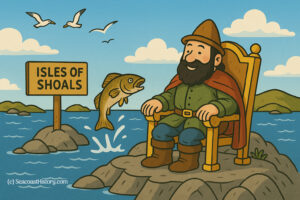

( Art by SeacoastHistory.com)
SEACOAST POETRY
Contemporaries called him the “emperor,” but his life story is sketchy. Visitors who ferry to the Isles of Shoals aboard the M/V Thomas Laighton today may not give a thought to the enormous man who is buried there. His gigantic hotel is gone, but his influence looms over these nine rocky islands. We have no photograph of the historic Thomas Laighton, but legend says he was a large man, so large that he was buried sitting up in a chair wedged into a cleft in the rocks on Appledore Island. The anonymous poem transcribed below appeared in the Portsmouth Journal just before the Civil War.
About Thomas B. Laighton (1804-1866)
With the exception of Capt. John Smith, no figure has impacted the history of the Isles of Shoals more than Thomas Laighton (also spelled Leighton). A Portsmouth-born writer, grocer, entrepreneur, editor, and politician, Laighton was disgruntled over a lost election. Or perhaps it was his poor health that drove him to the fresh, sea air. In 1839, Laighton packed up his wife Eliza, four-year-old daughter Celia, and his newborn son Oscar. He left for the Isles of Shoals, never to return. A NH senator and former newspaper editor, Laighton became the isolated lighthouse keeper on bleak White Island in New Hampshire, a daunting task for a heavyset man with a leg crippled since childhood.
He purchased Hog, Smuttynose, Malaga, and Cedar islands in Maine and then took over the old Haley Cottage (still standing) and the Mid-Ocean Hotel on Smuttynose. After experimenting with an island grocery store (locals said he was really selling liquor to the fishermen of Gosport on Star Island) and raising sheep, Laighton built his first hotel on Hog Island, appropriately renamed Appledore in 1847.
Thomas had the energy of two men, one early visitor pointed out, and expanded the hotel to accommodate up to 400 summer guests. Influential Boston families and artists fell under the spell of the rocky, accessible islands off the New Hampshire and Maine coasts. We have not a single photograph of Thomas Laighton who, like his wife, was considered “morbidly obese” by 19th-century standards. Comedian Henry Clay Barnabee described Thomas this way: “He was ponderously obese, as befitted a landlord; and, planted immovably in an armchair in his office, entered the surnames of his guests on a slate, after asking — What denomination? — which, it transpired, was a question of sex, and not of creed.”
Laighton, by all accounts, was highly intelligent and highly opinionated. His Shoals’ library of 700 books tended toward science, but he charmed literary greats the Hawthorne, Whittier, and Richard Henry Dana with tales of the sea. Laighton was also an ardent believer in Spiritualism. He died in 1866, too soon to see his home-schooled daughter Celia Thaxter become the “Poet Queen” of the Shoals. He lives on in legend as the king (sometimes “lord” or “emperor”) of the Isles. This 1860 poem (below) appeared in the Portsmouth Journal. — JDR
As published in the Portsmouth Journal
Saturday, September 1, 1860
ORIGINAL EDITOR’S NOTE. On the island of Appledore, one of the Isles of Shoals, there is a Public House, kept by Hon. Thomas B. Laighton. Those who have viewed these Islands, will understand the subject of the following lines:
The Lord of the Isles
By Viator
The Isles of Shoals, the Isles of Shoals,Those children of the sea,I love their sight, I love their air,I love their billows free.
Lord of the Isles, I love him too,He taketh care of all,–His look is quick, and ranges far—He answers every call.
His will is law, o’er all his realm;The timid watch his eye;Both men and brute obey his call,And rapidly they fly.
No noisy gong awakes the morn,–The trumpet’s gentle tonesCall sleeping maidens from their dreams,And harkens all their sons.
Lord of the Isles, he goeth notTo an other land; No wintry winds can move his soulTo leave his rocky strand.
His children love their ocean home,Hearts are anchored here,And when they wander to the world,They leave it with a tear.
The wife and mother bless his lot,In quiet there they live; No storms can fright the happy home,Nor terrors to it give.
The lord as editor was onceAnd many lines wrote he,An in the legislative hallsYou his round face could see.
But he left them in his wisdom,And all their labors too,–He sought the sea, the glorious sea,And bid them all adieu.
A farewell to the noble lord, And all beneath his care.A blessing on his name and race.—And all his friendship share.
Research by Richard Winslow III and transcribed by Maryellen Burke. Text and robot-aided illustration by SeacoastHistory.com
—————————
BONUS FEATURE
Henry Clay Barnabee on Thomas Laighton
NOTE: Henry Clay Barnabee was a famed comic and light operetta star from Portsmouth, NH in the days before film. This excerpt comes from Barnabee’s memoir My Wanderings (1913). /
An unknown friend, who must have known of my deep-seated partiality of such scenes, sent me an engraving of Whaleback Lighthouse, which has braved the elements that threaten the lower harbor of Portsmouth for many a long year. For years the picture has been with me in all my homes, and in its guardianship of the entrance to Piscataqua’s swift tides, the beacon has been a constant reminder of my youth and many happy hours in the city by the sea. The engraving is now in the Public Library at Portsmouth, and I am very glad that it has, at last, found an abiding pltt”Off soundings”—or to be explicit, about nine miles from the outer harbor of Portsmouth, lies a small group of islands called “The Shoals.” Many years ago, a Portsmouth editor, Thomas Laighton by name, after long years of unrewarded political service, grew sick and tired of the ingratitude of republics, bought himself one of the islands for a hermitage, and dwelt there ever afterward. His daughter, born in this isolated home, became Celia Thaxter, the poetess.
Laighton erected a building of rambling design, which he dignified with the title of hotel, and conducted as a chowder resort and miniature Coney Island. He was ponderously obese, as befitted a landlord; and, planted immovably in an armchair in his office, entered the surnames of his guests on a slate, after asking, “What denomination?” which, it transpired, was a question of sex, and not of creed. He ran his house on the autocratic plan, ringing a bell on the roof as a signal for meals, regulating all accounts, and maintaining a general attitude of
“I am monarch of all I survey
My right there is none to dispute.”
And may I add that one of the occasional visitors at the Shoals was the Rev. Dr. Parkman, a well-known divine, and a brother of Professor George Parkman, whose sensational murder by Professor Webster of Harvard College sent a thrill of horror throughout the world a few years previous to the time of which I am now writing. It was on Dr. Parkman that Laighton, the “Emperor of the Isles,” used to tell one of his best stories.
It appears that the reverend gentleman’s teeth were bad, so he went to Boston to a “gum architect.” This dentist happened to be one of the pillars of an orthodox church, though neither he nor his patient knew of each other’s religious calling and election. After the dental operation was over, the patient picked up a hand-mirror, looked at his devastated mouth, made a variety of facial contortions, then deliberately and more than once uttered aloud the sacred name of the Saviour.
The dentist strode up to the patient and said sternly:
“Sir, if the work I have done on your teeth is not satisfactory, say so, and I will make it right. But let me tell you that your blasphemous profanity I cannot and will not tolerate on my premises.”
“My good friend,” cried the mortified cleric, “I was not swearing. This is the first time in thirty years that I have been able to pronounce the name of our Blessed Redeemer without whistling.”
 Driving Off Corrupt Royal Governor Cranfield