

New Hampshire’s only seaport was created to make money. At a bicentennial speech delivered on May 21, 1823, newspaper publisher Nathaniel Haven Jr. laid it on the line. Portsmouth, he said, unlike its Massachusetts neighbor, was not settled by Pilgrims “seeking asylum for their persecuted church.”
New Hampshire was founded in a “commercial spirit,” by “merchant-adventurers,” Haven told his all-male audience. Men and boys filled all 90 pews and both galleries of the North Church during the speech.
“Our ancestors were of humbler rank,” Haven said of the Portsmouth founders. They were men to be honored, but not idolized. Many were Puritans, but they desperately wanted to own land and wealth and possessions first. Only then did the “Piscataqua Planters” turn their attention to freedom and religion.
The city’s hastily planned 200th anniversary was a game-changer for Portsmouth citizens. Three years earlier, in 1820, Plymouth, Massachusetts had staked its claim as the birthplace of America, and stamped 1620 as the nation’s birth date. It was a marketing ploy, of course, the beginning of what we now call “heritage tourism.” Dozens of other United States locations could claim seniority. But the “holy” Pilgrim myth caught on.
New Hampshire quickly copied the idea, grabbing 1623 as its founding date. But the “religious freedom” concept was taken. Unable to outdo the Plymouth story, Portsmouth adopted the “merchant-adventurer” brand. Our founders, Haven told his listeners, had transformed “a wild and tangled thicket” into a thriving seaport.

Parades, poems, and prayers
Timed to match the supposed spring arrival of fisherman David Thompson in 1623, the 1823 bicentennial was a badly needed ego boost for the city. Portsmouth’s maritime economy had faded and its citizens faced an uncertain future. Many of the state’s top politicians and intellectuals, including Daniel Webster, attended the Portsmouth celebration.
Festivities began earlier that morning with an enormous formal procession. “Heaven seemed to smile propitiously on the occasion; for the weather was delightful,” one local newspaper reported. The parade passed through the principal roads of the town. The route included the expanding, elite neighborhoods along Middle and Pleasant streets, the commercial Market Street, and the evolving North End, as well as the central Parade, now “Market Square.” Conspicuously absent from the parade route was the old waterfront area, now commonly called Puddle Dock.
Masons in colorfully decorated aprons and full regalia marched to beating drums, escorted by two light-infantry companies. Then came the Merchant’s Association, followed by members of the clergy, military officers, prominent citizens, and schoolmasters with their students.
At the North Church a capacity crowd listened to three hours of speeches, prayers, and poems honoring the founders of New Hampshire. The Handel Society of Portsmouth sang. Gangs of enthusiastic boys set off so many “India crackers” that the day felt like the Fourth of July.
That afternoon 200 invited dignitaries dined on every known variety of fish at two long tables stretching the length of the second floor at Jefferson Hall above the brick market building. They toasted great men, most of them now forgotten, and sang patriotic songs that grew louder and more jubilant as the wine flowed. At the 400th celebration in 2023, locals set up tables in the middle of Congress Street downtown and consumed 700 labsters in honor (orparody) of the original fish dinner.
Defining the first Yankees
It was okay, the struggling merchants of 1823 told one-another, to strive for wealth and success. It was what New Hampshire founder John Mason, himself a former merchant, had done in the 1630s, although he died in 1635 having never seen his colony. Accumulating land and property had been the goal of the city’s “First Planters” in the 17th century.
That goal had reached its peak in the 18th century as a small aristocratic class of merchants evolved. The fishing and lumber industries, the East India trade, shipping and ship building businesses turned Portsmouth, briefly, into one of the most profitable ports on the Atlantic coast. One only had to look at the fine mansions on the Piscataqua to measure their success.
Nathaniel Haven made no apology for European settlers driving aboriginal people off the land they had inhabited for millennia. He made no mention of enslaved and impoverished Africans who served the wealthy and influential families of the region. In 1823, Portsmouth’s white citizens were worried about their own survival in a new nation not quite half a century old.
(Portsmouth Athenaeum Collection)
The region’s first European settlers had made mistakes, Haven admitted, without being specific. New Hampshire’s founders were flawed men and women. They were not the sharpest knives in the drawer, Haven implied, but they were hard working, God-fearing, and unbreakable. Many were Puritans, members of the Great Migration to the New World in the early 1600s. These were, essentially, the first Yankees, chiseled from sturdy British stock. In 200 years, Haven admitted, Portsmouth had yet to produce any great writers, poets, or painters. But they would come, he promised, in future generations.
A merchant aristocracy
The great contradiction of Portsmouth history for Haven and his contemporaries was that many of the city’s rich and famous had been Loyalists, not patriots. Sir John Wentworth, the last colonial governor, was driven out of town in 1775, never to return under penalty of death. While proud of the city’s role in the Revolutionary War, locals also carried a torch for its lost merchant aristocracy. Portsmouth’s Golden Age, they feared, had come and gone.
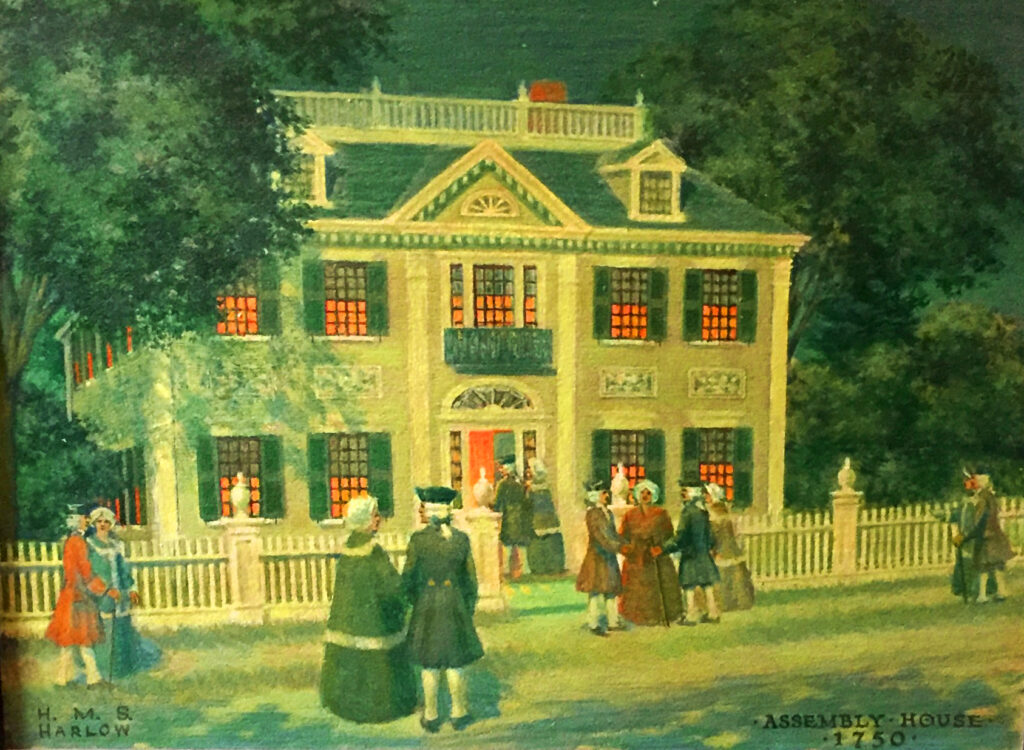
Yet the most important part of the 1823 bicentennial may have been the “superb ball” held that same evening. Some 400 ladies and gentlemen gathered at Franklin Hall further down Congress Street, site of the Franklin Block today. The highlight of the event was a unique exhibit of about 30 portraits collected from local families. The newspaper reported:
“The walls of the room were entirely covered with portraits of eminent persons who flourished in this state before the revolution–the Wentworths, Jaffreys, Warners, Sparhawks, and Atkinsons of old times.”
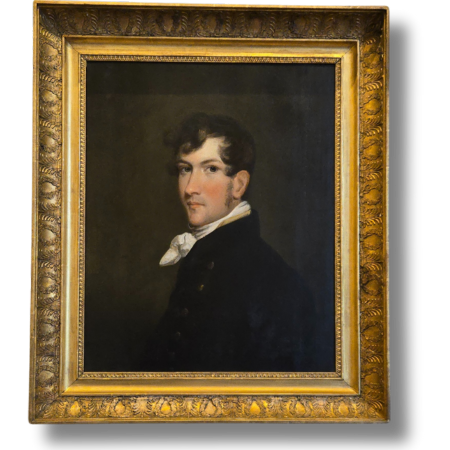
The exhibit included merchant John Moffatt and his wife, whose home is now a museum, and the scandalous Frances Atkinson Wentworth, who, like her husband John, had been banned to a life in Halifax, Nova Scotia after the Revolution. There were three men all named George Jaffrey, owners of the mansion that once stood on Daniel Street.
Visitors saw the noble figures of Henry Sherburne , two Wibirds, and two Waldrons. Among them was Rev. Samuel Haven, Nathaniel Haven’s grandfather, who had chatted with George Washington at what is now Haven Park. One portrait, painted in 1623, had been shipped here by family descendants. Another had been painted in Scotland in 1555.
For the first time ever, citizens of the 19th century came face to face with the wealthy leaders of the faded merchant class. These were the men, most all of the Harvard graduates, who razed the timber forests, built great ships, and fought at Louisbourg, Nova Scotia. Here were the families from the era of the great Wentworth oligarchy, families that wielded political power, amassed fortunes, and built the grand mansions along the Piscataqua.
These were English citizens of another age. Dressed in fine clothes, striking noble poses, and surrounded by painted finery, they appeared to live in a better time that was as distant and magical as Camelot. It was up to their descendants, Haven said, to keep the grandeur of these aristocratic days alive.
Daniel Webster had made that point perfectly clear when he spoke to celebrants at Plymouth three years earlier. “It is wise for us to recur to the history of our ancestors, ” Webster had said. “Those who do not look upon themselves as a link connecting the Past with the Future, do not perform their duty to the world.”
Still a merchant town
Portsmouth-born historian John Lord was less impressed with Portsmouth’s puffed-up image of its past. “No town in New England,” he later wrote, “claimed to be more aristocratic. In no town was there greater pride in ancestors who were generals and merchants. In no town was society more exclusive and pretentious.”
Portsmouth is still about the money, as anyone who rents or owns a home in town will attest. Portsmouth is still a city of merchants. And, in a way, the city still longs for its lost fame, fortune, elegance, and power during the days of English rule. But for the first time in two centuries, a renewed wealthy class has begun to settle into the ancient homes and newly-built condominiums along the Piscataqua River. They have come for the culture, the history, and for the quality of life. Talented generations of writers, poets, painters, performers, and craftspeople have also moved in–just as Nathaniel Haven predicted. And we are still confused about our adopted heritage. Portsmouth remains both the faded colonial capital of New Hampshire and a patriotic revolutionary seaport.
The portrait gallery at Jefferson Hall was so impressive in 1823 that it was briefly opened to the general public. Even the city’s “lower classes” were given the chance to gawk at the colonial portraits. The 1823 bicentennial also inspired the New Hampshire Historical Society, a nonprofit group, now located in Concord, dedicated to preserving artifacts, documents, and stories of the past. The bicentennial event also helped launch the city’s future as a destination point for tourists.
Most of the portraits exhibited in 1823 still survive. You can see the Moffatts at the Moffatt-Ladd House, for example, or Samuel Haven at Strawbery Banke Museum. Or visit the Reading Room of the Portsmouth Athenaeum in Market Square where a gallery of local luminaries still decorate the walls. It is the closest one can come to imagining the gala banquet and exhibit in 1823.
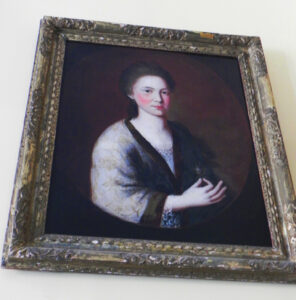
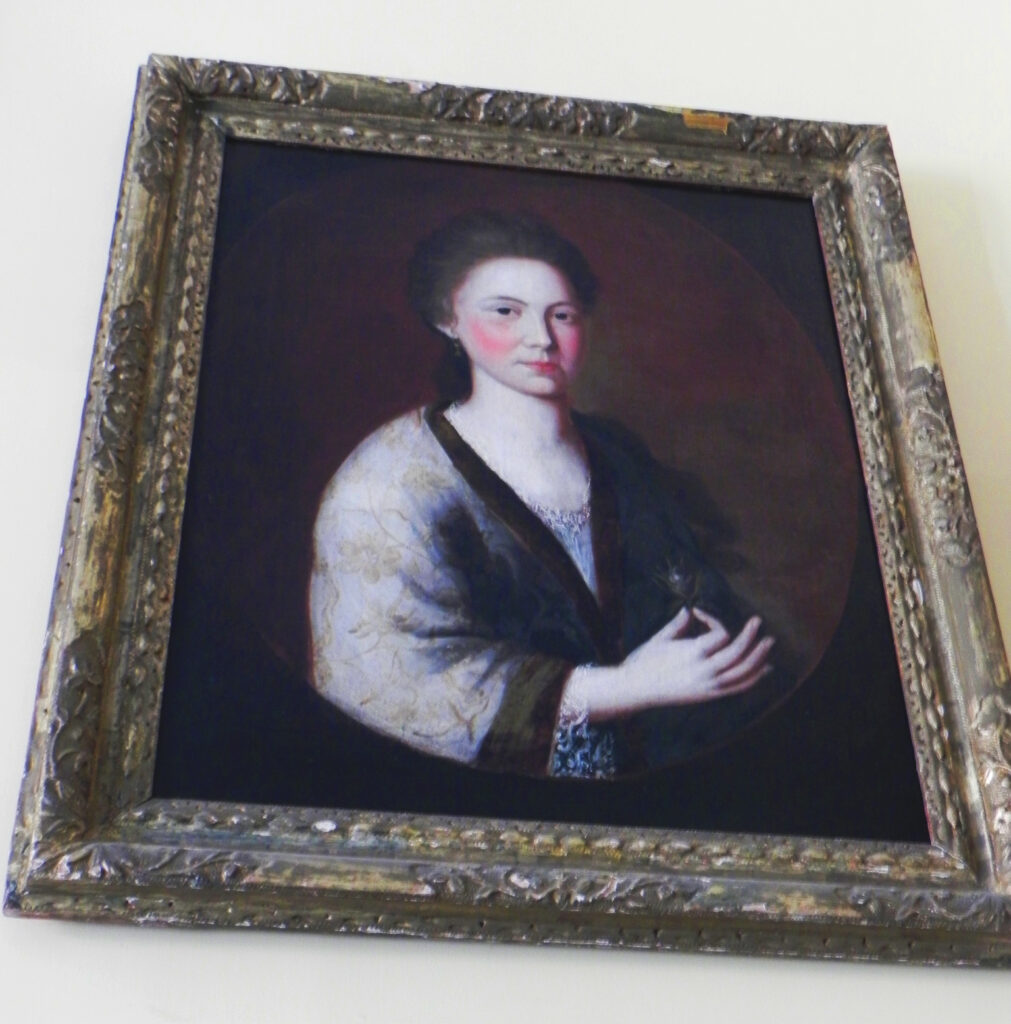
High on the Athenaeum wall, to the right of the life-sized portrait of Sir William Pepperrell (a copy of the original), is a portrait of his sister Mary Pepperrell Frost. We can’t be certain, but this may be the same painting that hung at Franklin Hall, just a couple of blocks down Congress Street in 1823.
Born in Kittery, Maine, Mary (1685-1768) was a member of a wealthy merchant family. Her young Mona Lisa smile reveals little, but records show that she was married three times and had 17 children. She lived in New Castle and in Peabody and Boston, Massachusetts. She died with no knowledge of the coming American Revolution or the long strange trip Portsmouth has taken in its second 200 years.
Copyright © 2015 by J. Dennis Robinson, all rights reserved.
 Paul Revere’s “Other Ride” Poem