


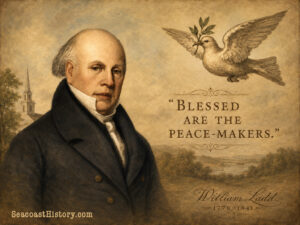
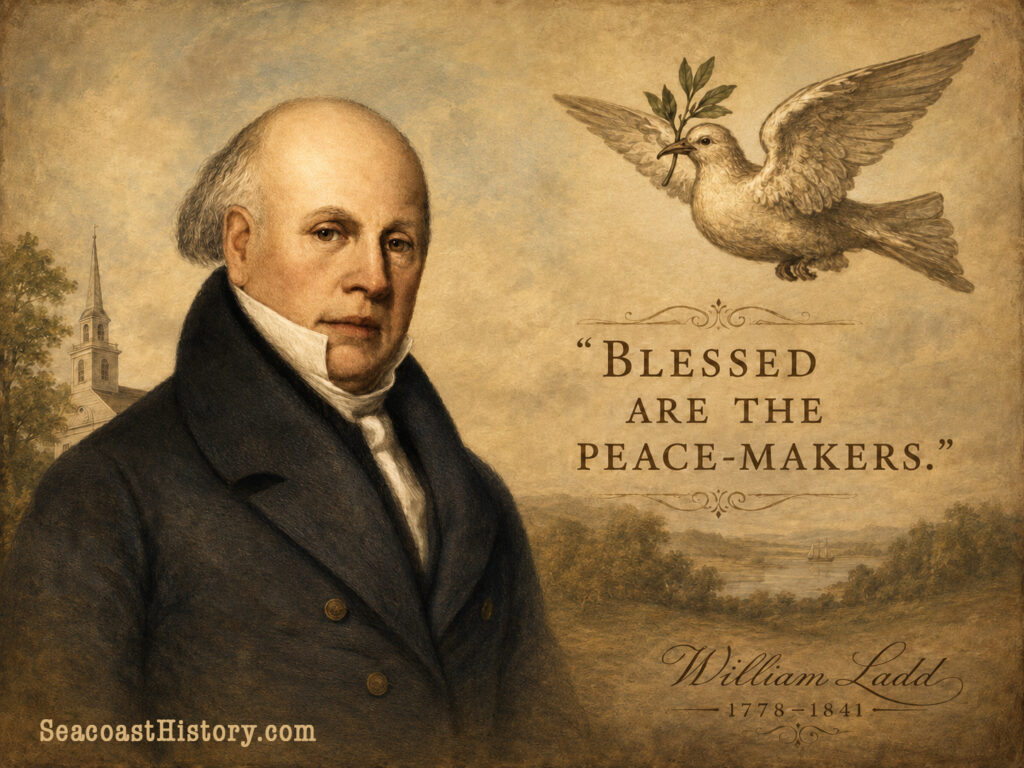
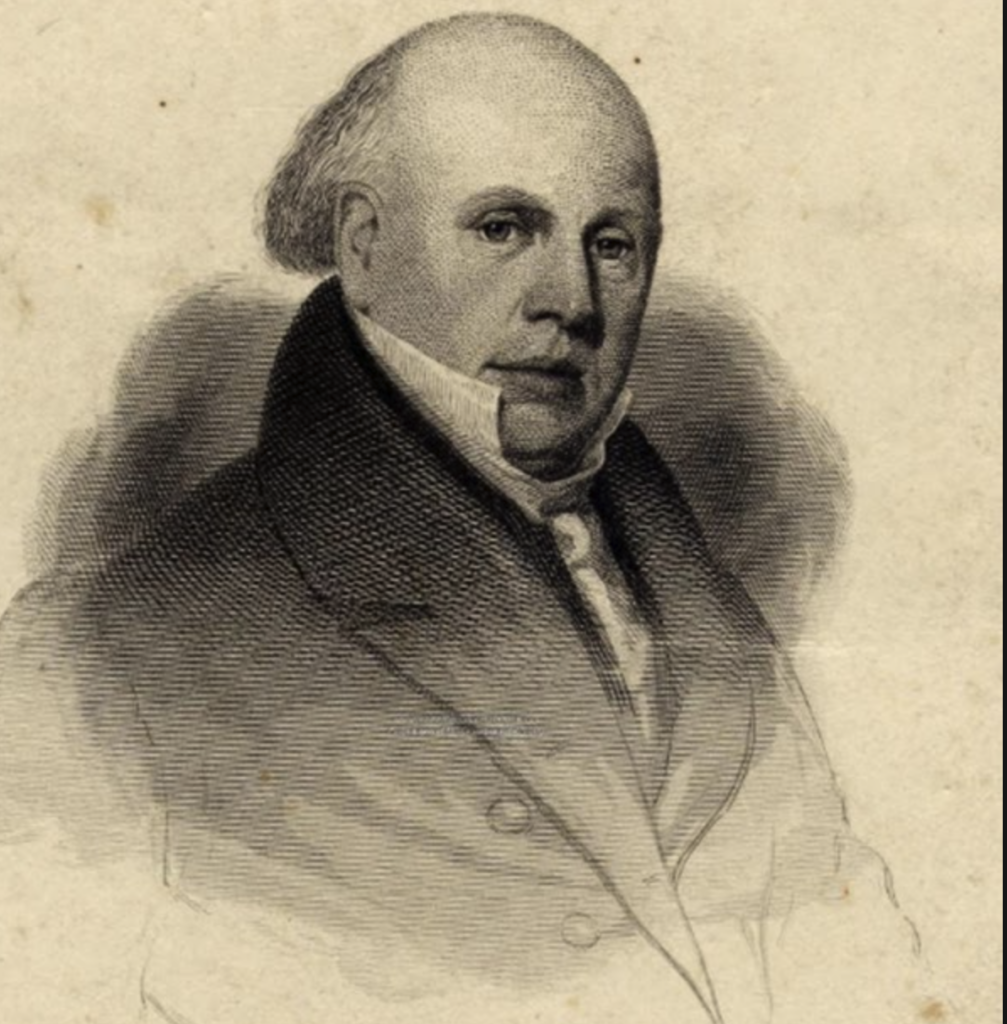
The contrast is striking. William Ladd, the “Apostle of Peace,” was the son of a Portsmouth privateer. The father, Eliphalet Ladd (1744–1806) of Exeter, made his fortune as a shipbuilder and merchant. During the American Revolution, Eliphalet operated privateer ships, including the White Oak and the General Sullivan, which brought in profitable prizes. Ladd had 10 children with two wives, both named Abigail.
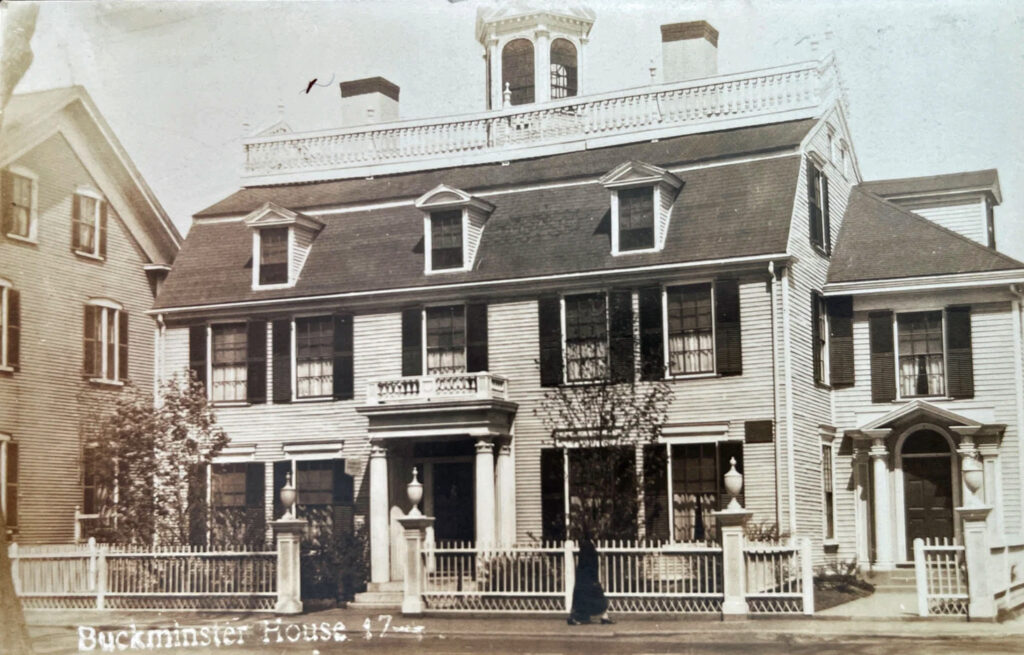
Our hero, William Ladd, was born in Exeter, NH, in 1778. He was 14 when his family moved to Portsmouth, NH in 1792. They lived at 7 Islington Street, a 1720 Georgian mansion, still standing. When Eliphalet died, his widow married Rev. Joseph Buckminster, a popular minister who served at North Church for 33 years. The building is best known today as the Buckminster House.
From his days at Harvard, William opposed the glorification of war. After graduation, he went to sea, working for his father, and letting the salt water wash away his college studies. Married at 21, he tried farming in Georgia, then Florida. He briefly used enslaved workers, a practice he abandoned and, with great emotion, regretted having tried.
William was drawn back to Portsmouth in 1806 by his father’s death. It was poor timing. The following year, the Embargo Act under President Thomas Jefferson effectively shut down local harbors by blocking exports and preventing merchants from trading with foreign nations. But his father had also owned 600 acres in Minot, Maine, where, during the War of 1812, William Ladd raised sheep, horses, and cattle and planted apple, plum, and cherry orchards. He found religion in 1819 and soon after established the Minot Peace Society.
Ladd’s pacifist writing, published in a Christian newspaper, was collected into a book entitled 32 Essays on Peace and War. “Let the turpitude and brutality of those who seek for glory in blood and tears and groans be so exploded that the Alexanders, the Caesars, the Frederics, and the Napoleons shall cease to be objects of emulation,” he wrote. Ladd opposed the building of the Bunker Hill Monument in Boston as a glorification of war.
READ ABOUT Rev. Peabody’s anti-war sermon
Inspired by Ladd’s writing and lectures, anti-war groups sprang up from New England to North Carolina. Fifty groups united in 1828 as the American Peace Society. In the 20th century, the group would oppose the creation of a Jewish nation. “The day of race separation has gone by,” the Society argued in 1907, “that of race intermingling and friendly association is upon us.”
Curiously, William Ladd was passing through Portsmouth, NH, in 1841 when he died at age 63.
“He had been absent on a lecturing tour on Peace six months and was on his way to his home in Minot,” Charles Brewster reported in the Portsmouth Journal. “He paused at the house, which was the home of his youth, and thence his spirit took flight to the mansion of rest above.”
“Mr. Ladd was one of the most eminent philanthropists of our country, and his name will be held in lasting remembrance by al the friends of humanity… It affords us a mournful satisfaction that his remains rest in this city,” the newspaper added. William Ladd, “The Apostle of Peace,” is buried in Proprietor’s Cemetery on South Street in Portsmouth, NH.
Assembled from various sources by J. Dennis Robinson, 2026.
 Murder at the Home of NH’s Founder