


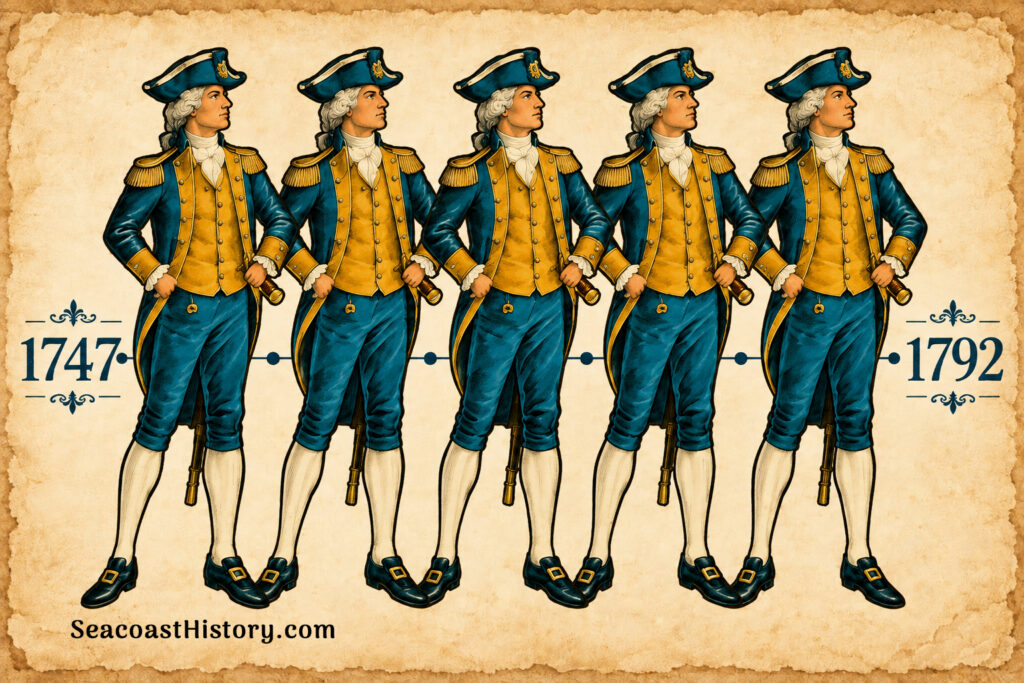
NOTE: This is a working outline from historical records. Please cite sources when offering additions or corrections through our Contact page. –JDR
SEE MORE John Paul Jones
July 1747
John Paul was born in Kirkcudbrightshire, Scotland to John Paul, gardener at Arbigland and mother Jean Duff of the MacDuff clan. His birth was not registered.
1759
Apprenticed aboard Friendship to Fredricksburg, VA, Some biographers speculate he served a period in the Royal Navy, but unlikely.
1764
Third mate on the slave ship King George
1765
His father dies.
1766
First mate on the slave ship Two Friends
1768
Unlikely, but may have toured with a theatrical company in the West Indies. Shipped on brig John. Navigates it home when the captain and mate die of yellow fever. Made master and supercargo. Orders sailor Mungo Maxwell flogged. Maxwell later dies while on another ship and John Paul is arrested for homicide. He is released on bail and obtains documents proving Maxwell died of yellow fever, not of his wounds. But the rumor dogs him for life.
1773
As captain and possibly owner of The Betsy, he chooses not to pay crew members while in the West Indies. When one attacks in anger, John Paul kills him with a broadsword, claiming self-defense. With no admiralty court in session to hear his case at the time, he flees incognito to America as John Jones, leaving his money behind in Tobago. His whereabouts for the next 20 months is speculative.
OUR INTERVIEW with Jones biographer Evan Thomas
A FRESH START IN AMERICA
1774
Arrives back in Fredericksburg, VA. As a Mason, now John Paul Jones, he meets many influential Virginia revolutionaries. Possibly considers a career as a Virginia farmer. Short engagement to Dorothea Dandridge, who soon after marries Patrick Henry. Jones’ brother, tailor William Paul, dies, but leaves nothing to John.
1775
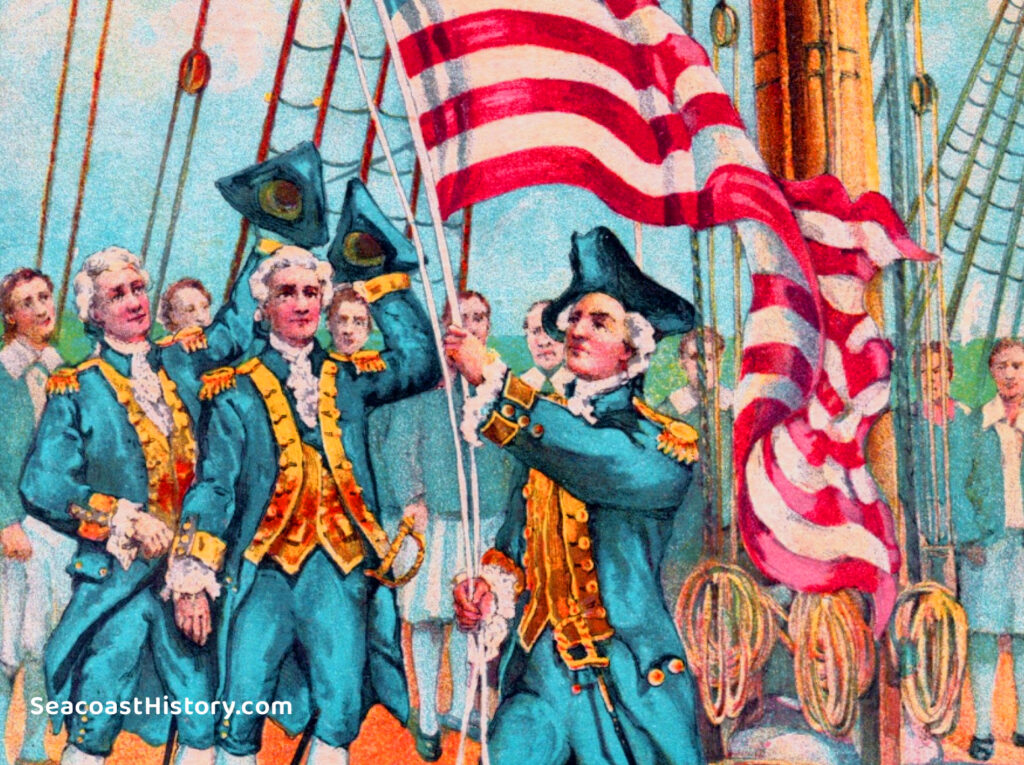
Writes to Joseph Hewes, John Morris, and Thomas Jefferson, requesting a naval appointment. His request coincides with the birth of the Continental Navy in October 1775, and the Marines are created in November. First officially signs as John Paul Jones in Philadelphia. In December, Jones is the first to raise the “Grand Union” liberty flag (not the Stars and Stripes or Gadsden flag) and is the first-ever to be commissioned as lieutenant in the Continental Navy in December. He is given command of Alfred, which, as part of a fleet, seizes a shipload of British munitions.
April 1776
Alfred is among Commodore Hopkins’ fleet as Jones engages HMS Glasgow to protect captured prizes
May 1776
Given command of Providence, used to escort merchant ships. Writes to Joseph Hewes with ideas for modernizing the Continental Navy. Meets John Hancock and gains the status of Captain.
August 1776
Captures eight British prizes and destroys eight other ships while eluding larger warships in seven weeks aboard Providence.
October 1776
Despite having the best sea record among candidates, Jones is 18th on the list of captains commissioned by the Continental Navy. He is unhappy.
November 1776
As Captain of the Alfred, he captures prizes in a northern campaign. Mellish, the key prize, contains winter uniforms intended for the British army in Canada.
Early 1777
Two planned missions are scrubbed and Jones goes to Philadelphia to discuss problems in his commission papers with Alexander Hamilton. Assigned to command the French ship Amphitrite arriving in Portsmouth, NH, but the arrangement falls through due to a miscommunication.

RANGER, BONHOMME, VICTORY & FAME
June 14, 1777
Jones is reassigned to the Ranger being built in Portsmouth. Gets his assignment on the same day that the US flag design is adopted. Struggles with builder John Langdon over building and equipping his ship in Kittery, Maine.
November 1777
Ranger sets sail for France with plans to pick up a new heavy frigate L’indien being made for America in Holland. Jones is given a full choice of British targets to attack. Takes two small prizes en route.
1778
Meets Ambassador Ben Franklin in France and discovers the ship L’Indien is not available. Ranger becomes first US ship recognized by a foreign power. Piscataqua, NH crew desires to return home.
April 1778
Sinks, burns, and captures ships along the Irish coast in the Ranger. Attack at Whitehaven, England, and “raid” on Selkirk mansion near Jones’ birthplace, where the family silver is taken. Ranger captures British man-of-war HMS Drake. Jones takes 200 British prisoners to France for exchange. He waits nine months for relief. Plans further British raid with Franklin.
February 1779
Receives command of Bonhomme Richard which he staffs with 380 crew including just 75 Americans and a mixture of British, Scotch, Irish, Portuguese, etc.
September 23, 1779
British Capt. Richard Pearson struck his colors after the ferocious sea battle off Flamborough Head. Jones’ crew and wounded were removed to the HMS Serapis; 36 hours later the last man left the Bonhomme Richard. At 11 am, Jones watched her sink, “Even though she sank, she was victorious…” he wrote. Sails with his surviving crew and prisoners to Holland aboard the embattled HMS Serapis.
December 1779
Given command of Alliance and sails to France where he is the toast of French society. He now holds 500 prisoners of war.
October 1780
Given command of the loaned French ship Ariel, which is nearly destroyed in a storm, but skillfully saved. After a long repair period, sails to Philadelphia. Although, as yet unpaid for all his years of service, he receives commendations from Congress and is cleared of all charges held against him.
June 1781
Given command of ship America in Portsmouth Harbor on the Piscataqua, which he finds only half built. Pushes builder John Langdon to complete work while studying and enjoying social life in Revolutionary New Hampshire
September 1782
After more than a year of work, Jones is told by Congress that he will not receive command, that instead, America will be given to France. He complies with orders.
December 1782
Receives permission from Congress to join French fleet’s planned invasion of Jamaica; leaves on Triomphante.
May 1783
Returns to Philadelphia quite ill after the invasion was cancelled. Petitions Congress unsuccessfully for advanced rank and back wages.
November 1783
War ends. Sails to France as official US Congress “prize agent” to recover unpaid income from prizes won in battle. Spends years in France and gets some promised reparation for himself and past crews. Romantically involved with mysterious “Madame T.”
1787
Returns to the United States to collect settlements, but still cannot improve his military rank. An offer of Major General rank in the Russian Navy is received.
March 1788
Makes a secret journey to Denmark for payment of overdue prizes. Unsuccessful there, but accepts the Russian Navy offer. Sails from Stockholm.

RUSSIA & DEATH
April 1788
Arrives in St. Petersburg requesting the rank of Rear Admiral with full command power. However, in an assault on Turkish forces, he finds his ships in poor repair and manned by Russian serfs who are beset by diseases. Jones’ reports of the siege are blocked from reaching Catherine the Great by her own military leaders. He is later banned from court at St. Petersburg and is reportedly framed in a sex scandal by military leaders. When the promised commissions do not arrive, he resigns.
1790
Returns to Paris during the French Revolution. He is offered a military commission by George Washington. In ill health, he does not accept.
July 18, 1792
Dies in Paris at age 45 and is buried in a small private ceremony. In 1905, his body was discovered under the streets of Paris and transferred with parades and a fleet of ships to the US Naval Academy in Annapolis, Maryland.
Compiled by J. Dennis Robinson
Please email us with sourced corrections and added info.
 Evan Thomas on John Paul Jones
