

SEE ALL of our John Paul Jones blogs
NOTE: Dozens of historians have tried to capture John Paul Jones. In 2004, journalist Evan Thomas published what remains, over two decades later, the most accessible Jones biography on the market. Thomas distilled the latest scholarship and the elusive personality of the well-known, but rarely understood Revolutionary War naval hero. I interviewed Thomas by phone in June 2003, before he visited Portsmouth, NH, to complete his final research for John Paul Jones: Sailor, Hero, Father of the American Navy (Simon & Schuster, 2004). Thomas, then 51 and an assistant managing editor at Newsweek magazine, took a short sabbatical to complete the book. It was the first major analysis of Captain Jones since the classic work by naval historian Samuel Eliot Morison in 1959. –J. Dennis Robinson
A CONVERSATION WITH EVAN THOMAS
JDR: Why John Paul Jones?
EVAN THOMAS:
Really for notions of childhood romance. When I was growing up in the 1950s, he was a very romantic figure. My father had been a lieutenant JG in the Navy (in WW2) and to his generation, Jones is a romantic. So that created a lifelong curiosity in him. It was a book I’d always wanted to write, and I finally got a chance to write it. Until recently, we’ve not seen books about the American Revolution on the bestseller list.
My publisher used to tease me and say — Why don’t you wait for your retirement for that one? The weather changed a couple of years ago…because of David McCullough’s book on John Adams and because of Joseph Ellis’s book Founding Brothers, the movie The Patriot with Mel Gibson, and just a general resurgence of patriotism.
JDR: But isn’t that ironic? Was Jones, a Scottish soldier of fortune, really an American patriot?
EVAN THOMAS:
I would argue that he is mostly interested in himself. He’s a very very self-absorbed glory seeker. But I wouldn’t totally discount the patriotism, because he saw America as a place where you could be self-made. He was a gardener’s son. I think he was condescended to by Royal Navy Captains when he was in London in the early 17000s and the lord of the manor was snotty to his father. He has a lot of patriotic language in his letters — about being proud to raise the American flag on the deck of the Alfred when the first ship was commissioned.

JDR: Didn’t Jones get the same treatment when he was in Portsmouth, NH?
EVAN THOMAS:
He certainly got the same treatment in Virginia and I think the first time around in Portsmouth. He and John Langdon fight, but Jones ingratiates himself with the local gentry. I gather from reading other books that Portsmouth had a very big-time gentry. Gordon Wood, a very good colonial scholar, writes that outside of Virginia, it had the most established colonial aristocracy. By the time Jones returns to Portsmouth for the [warship] America, he was a big deal. He’s wined and dined. There are references in his letters to staying up late and having a big time and flirting with the ladies.
JDR: Jones took the tall ship Ranger from Portsmouth in 1777 and attacked at Whitehaven, England, near his childhood home. The raid made him famous.
EVAN THOMAS:
One of the points I try to make in the book is that he was an early terrorist. He understood psychological warfare the way nobody else did. The Continental Navy was pitiful and didn’t do much, mostly lost ships to the Royal Navy. He understood the impact that his raid would have on the British. He causes a sensation in England by his raids. You can read the local papers that are still around and they get very bent out of shape about the Pirate Paul Jones and what a buccaneer he is.
JDR: And yet there’s a sort of grudging excitement in those accounts, almost a respect for Jones by the British.
EVAN THOMAS:
Right. There’s a bit of a Robin Hood thing. And also when Jones takes the Serapis, [the English] are relieved to know that it was at least done by their cousins. They didn’t lose to Frenchmen or Spaniards. There’s some feeling that at least they lost to their quasi-equals. Interestingly, Captain Pearson, when he’s handing over his sword to Jones, asks him about the nationalities of the men on the Bonhomme Richard. He wants to reassure himself that he lost to Americans. And Jones lies and tells him that it’s mostly an American crew when it was a crew of mixed nationalities.
JDR: Very unlike the Portsmouth-area crew of the Ranger. The diversity and ethnicity of the Bonhomme crew would make an exciting movie.
EVAN THOMAS:
It was a Tower of Babel, I’m sure. He had Irish marines and French marines. I list them in the book. He had Hindus aboard and a core of American sailors, but it was a league of all nations.
JDR: We see none of that in the only film of John Paul Jones from 1959. In that Cold War-era film, Jones was portrayed by Robert Stack as a tall, dark Eliot Ness character.
EVAN THOMAS:
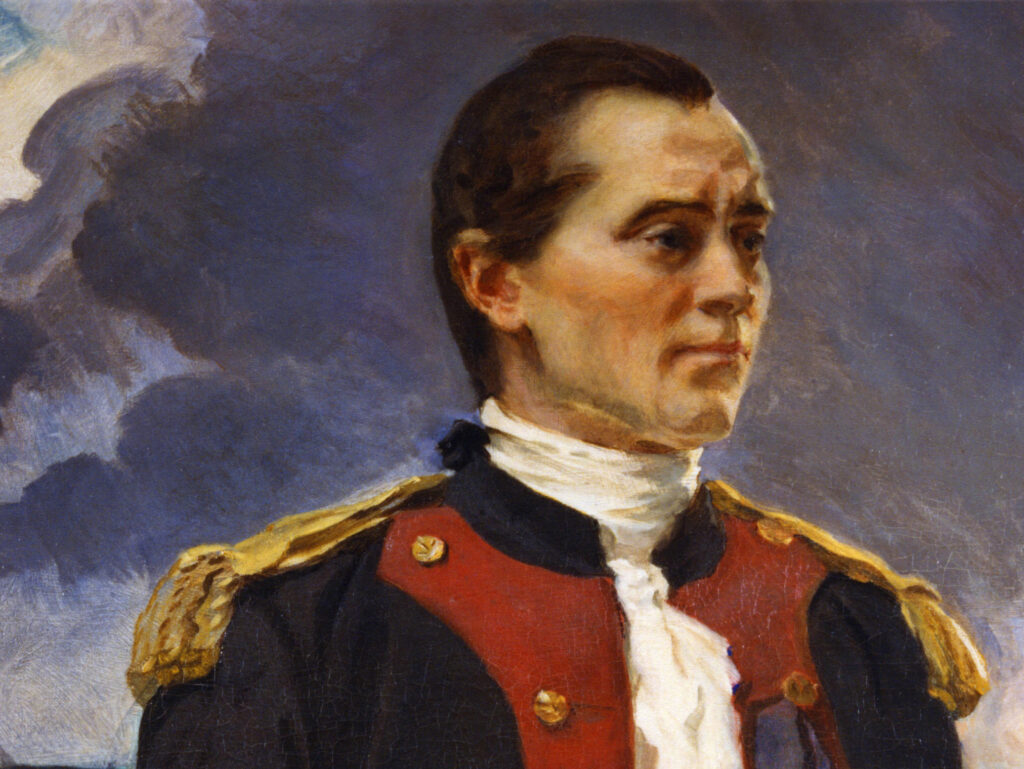
The Houdon bust of him, which I think is pretty close to life, shows him as a handsome man. His eyes are vaguely troubled, but as you know, he was a big ladies’ man. He writes a lot of letters when he’s a big hero in Paris, after the Serapis engagement, where he’s got pretty high-born French women swirling around him.

We’re lucky that, as a self-promoter, Jones left an awful lot of his papers that are reasonably accurate, although, like most self-promoters, he gilds the lily a bit. Compared to other naval and Revolutionary figures — that’s a lot of paper — and that’s one reason why his legend has survived.
JDR: In American history though, doesn’t it all come down to who wins the bloodiest battle?
EVAN THOMAS:
Well, sure. His battle [with the Serapis] was not just the bloodiest battle. In a single ship action, to have fifty percent casualties was a very high number. There was a gentlemanly code that you could throw in the towel if it was getting out of hand. To fight gunwale to gunwale for three hours and have that kind of casualty rate was unusual and ferocious. If you read accounts of the Continental Navy, it was a joke, except for John Barry who fought a few actions.
JDR: Beware. You will get a lot of letters from Barry fans who claim he deserves the title “Father of the American Navy” instead of Jones.
EVAN THOMAS:
There’s a whole Irish-American entourage. The Hibernians have claimed Barry and also the naval historical centers claim Barry. He’s their candidate for Father of the American Navy.
JDR: What about the mysterious 20 missing months in Jones’ life, the wandering in North Carolina or wherever he was?
EVAN THOMAS:
There is this whole legend of him becoming a pirate, but there’s just nothing to prove that.
JDR: And another legend says he joined a theater company!
EVAN THOMAS:
Right. Morison did a pretty scrupulous job on all that.
JDR: Is the lasting success of Samuel Eliot Morison’s 1959 biography of Jones the reason no one else has attempted a major biography since?
EVAN THOMAS:
Morison is a giant rock in the road because he was the great naval scholar and he was a thorough researcher. I have to work around that. I do more gritty detail of the naval battles themselves. Morison did the whole Serapis action in about five pages. The other thing I did was try to get into Jones’ head.
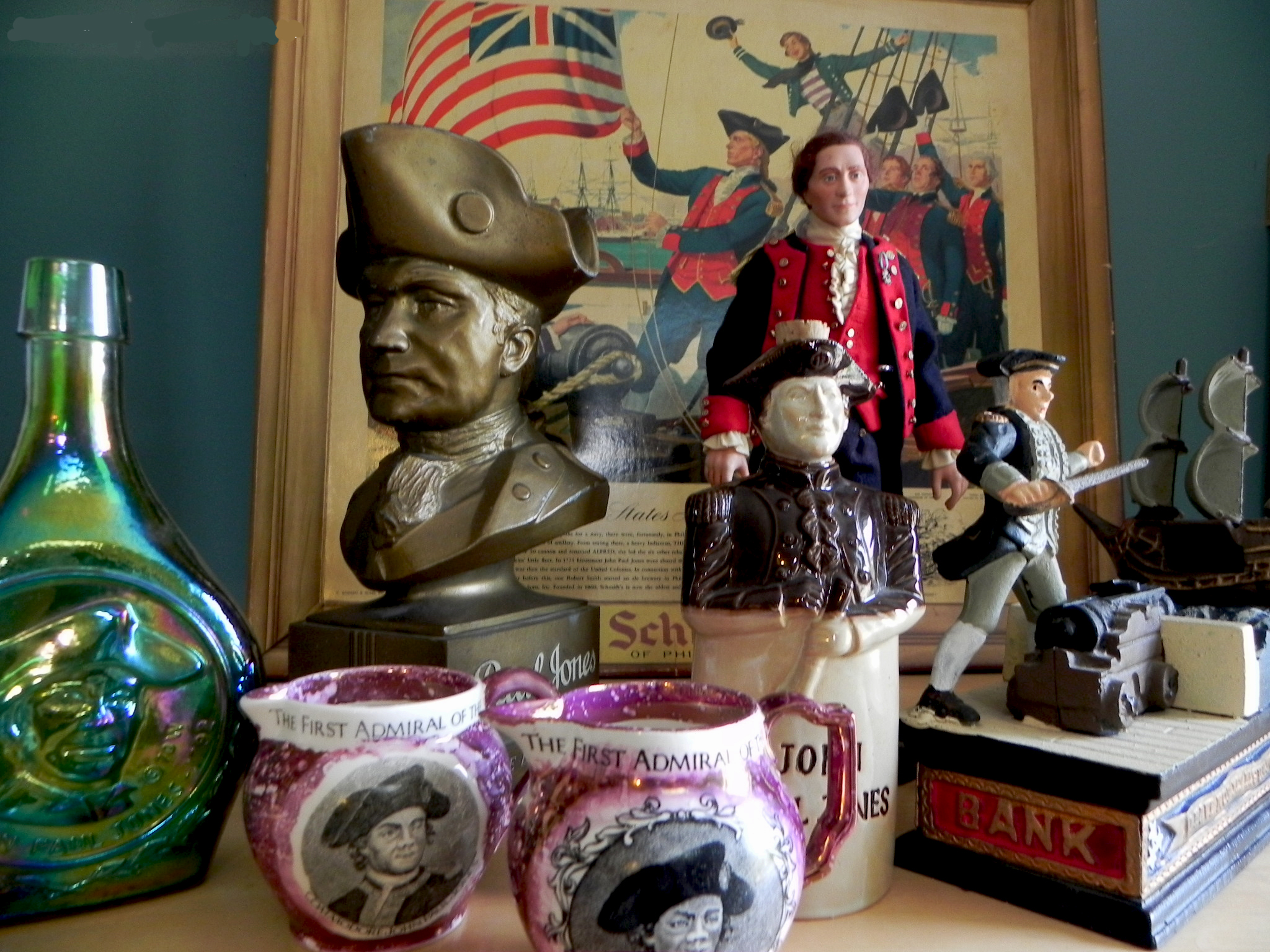
JDR: Wasn’t Jones a very early American superhero? He lived larger than life, designed his own costume, even had a sort of secret identity by changing his name, like a sort of Spiderman?
EVAN THOMAS:
He created himself, right down to his name. I look at this whole tension he has. He knows he shouldn’t be too prideful, and he knows he shouldn’t be hurtful, and he knows that he should be good to his fellow officers and his men, but he can’t help himself. His hubris keeps overcoming his better instincts. And so he’ll make declarations and statements of what a great officer should be and then he can’t live up to it. He never would have been a good fleet commander. He just didn’t have the personality or the temperament.
JDR: It must have been hard for him sitting around during his two visits to Portsmouth, NH. He spent 18 months just waiting to get the Ranger and then the America under sail.
EVAN THOMAS:
He sure did. He was a real restless soul. There are moments when you think he’s cracking up. When he was in France after Ranger and before he gets the Bonhomme Richard, he goes a little crazy. He starts sounding a little like Captain Queeg [in “The Caine Mutiny”]. He has enemies everywhere. He’s been neglected and forgotten and abused and tricked and badly treated, and it’s everybody’s fault but his own.
His men are always mutinying. It happens again and again. That’s not entirely Jones’ fault. Your crowd from Portsmouth [on the Ranger] wanted to have a town meeting. They weren’t ready for British naval discipline. They wanted to vote before they went out.
JDR: And then they did what they wanted anyway.
EVAN THOMAS:
Ranger officers Thomas Simpson and Elijah Hall were pretty disrespectful, to put it mildly. They openly mutinied.
JDR: You wonder how different history would have been had the crew from Portsmouth just abandoned Jones in Whitehaven as they planned. But ultimately Jones has one big monster bloody battle. To his credit, when it comes, he handles it, standing in the thick of battle with the bullets flying.
EVAN THOMAS:
When he was high, he was really high. Today we’d probably say he was bipolar. There seems to be a kind of euphoria about him. You look at his diaries and his letters around the time of battle and he’s cocksure and talks about his hairbreadth escape and knight’s errant. When he gets away from a British man-of-war, he fires a kind of taunting salute.
JDR: So that’s what we’re missing from Morison — the personality of Jones,. Morrison writes, to my mind, like he’s describing a painting.
EVAN THOMAS:
Morison was a Boston Brahmin and a true Yankee snob. There’s a faint air of mild contempt for Jones. Morison was truly a gentleman of the old school, and he thinks that Jones was not, and he’s right. Jones was not. I’m interested in his whole aspect as a self-made man. My psycho-theory is that Morison was sort of disapproving of Jones. He saw him more as a low-born troublemaker who was a good seaman and a good fighter, but not that interesting a character because he was conceited and vainglorious and didn’t have command of himself.
JDR” Isn’t that depth of personality and heroic nature exactly what keeps the Jones story alive? He’s breaking through social class barriers, testing himself at sea, writing poetry, speaking multiple languages, wooing women, railing against the machine.
EVAN THOMAS:
I think he’s very 21st century. You’ll have to be the judge of whether I’ve succeeded at this.
JDR: For a man incognito ducking a murder trial in the West Indies, Jones appears to have assimilated quickly among the “founding brothers” of the Revolution.
EVAN THOMAS:
He was a historical Zelig. He knew everybody. Jefferson still has John Paul Jones’ bust on a shelf at Monticello. Franklin had a real relationship with him as did John Adams.
JDR: Yet, despite his fame as a character, he rarely rates more than a paragraph in the textbooks. He seems to have fallen out of American history.
EVAN THOMAS:
One of the things that fell out is that we’ve stopped studying military figures. My kids, who are now a college junior and a high school senior, you can be sure, did zero studying of military figures — none. That’s a function of the post-Vietnam era; academics are all to the left, and they don’t particularly like or value the military, and so that’s gone. You’ve got to go to West Point to get a course on military history.
JDR: Following 9-11 we should be more able to understand the impact that a single raid can have on a population. Jones only attacked military targets, and ended up doing very little damage. Local historians tend to think his effect on the Revolution was significant.

EVAN THOMAS:
I think it was not tiny. The correct term is psychological warfare. He “gets” it. He writes a lot of letters laying out his vision of this. By bringing the war home to the British people he helped show the cost. He’s not out there trying to kill civilians.
JDR: Let’s go further psychologically. Do you think Jones was making a point to his father, a gardener on a Scottish estate?
EVAN THOMAS:
I did a lot of research on William Craik, his father’s boss [at Arbingland, Scotland]. Morison paints Craik as being a good guy. Well, Craik was not a good guy. Craik was a wild man who sired bastards and who put peasants into jail. He was an overbearing character. Jones’ father, who was a proud guy, had to kowtow to Craik.
JDR: Bending to authority was something his son John Paul could not do well. He had a real hard time with authority figures.
EVAN THOMAS:
Jones was born into a deeply stratified world where everybody knows where they stand in the great chain of being. He was welcomed into this new world where you can create yourself, where you can make yourself into a gentleman. He’s a very American story, this self-invention. Gatsby — who knows who he was? Most Americans came from nothing and nowhere and they created themselves, and that’s what Jones is doing — that’s part of the American tradition.
Herman Melville even says so. He describes America as “the Paul Jones of nations.” He wrote about Jones as, and I quote: “Intrepid, unprincipled, reckless, predatory, with boundless ambition, civilized in externals but a savage at heart.”
Copyright © 2003 by J. Dennis Robinson. All rights reserved.
ABOUT THE AUTHOR from the Hachette Book Group website
Evan Thomas is the author of several bestselling works of history and biography, including The War Lovers and Sea of Thunder. He was a writer and editor at Time and Newsweek for more than 30 years, and he is frequently a commentator on television and radio. He teaches at Princeton University and lives in Washington, D.C.
 Helen Dore Boylston: Caregiver, Author, Adventurer
