



“Tory Refugees on Their Way to Canada,” computer-enhanced version of a popular 1901 Howard Pyle illustration
NOTE: Between 1760 and the end of the American Revolution, an estimated 40,000 New England residents moved to Nova Scotia. Reader Mark Wilson of Toronto, Canada offers this northern perspective on American history. – JDR
In 1760, Sylvanus Cobb packed up his Massachusetts home, quite literally, and hightailed it across the Gulf of Maine. He dismantled the house, threw it on a ship, and then reassembled it when he reached the relative hinterland of Nova Scotia. Or so the story goes. This house stood for nearly 200 years before it was destroyed by fire in the 1940’s.
While its loss is regrettable, several similar homes have survived. These structures are reminders of necessity, enterprise, and, in the case of Nova Scotia, empire. They grace the streets of seacoast towns. They remind us of the borderless conditions of the mid-18th century, visible remnants of New England’s influence in this region.
SEE: New England invades Canada
Mr. Cobb was an able mariner from Plymouth, Massachusetts, who plied his trade most frequently in the waters of the North Atlantic. If he wasn’t organizing New England troops to fight at Louisbourg, then he was acting as a hired gun for the British and transporting supplies and New England settlers to the new English colony. He was a notable figure. In his later years, Cobb built a home in the new town of Liverpool, Nova Scotia, where he was given a land grant in July of 1759.
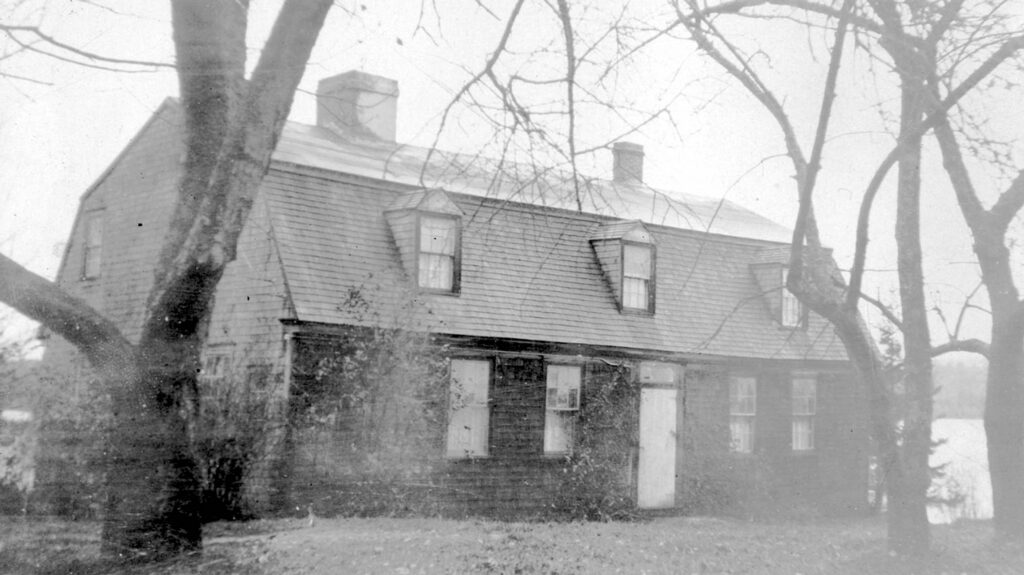
In The History of Queens County (1873), author James More wrote: “The house that was built upon this land, the materials of which were brought from New England, was owned by Sylvanus Cobb…” According to Library and Archives od Canada, “Tradition states that Captain Cobb demolished a house on Cape Cod and brought the materials on his own vessel to Liverpool, where he built his home.” This gambrel-roofed structure stood as the oldest building in town until its demise. More says Cobb was with William Pepperrell at the first siege of Louisbourg in 1745. Cobb, technically not a Loyalist, died in 1762 prior to the American Revolution.
The story of moving the Cobb house to the Maritimes is typical of those that would follow, largely for the lack of hard evidence that accompanies the legend. Modern house owners typically accepted the accounts without doing deeper research. In casual Maritime fashion, the word of their forefathers was enough for them.
ALSO: The three homes of John Wentworth
I wanted something more concrete, something to hang a hat on. There’s a time and place to move beyond folklore. I dug deeper. The result was a mixed bag of success and muddied waters.
The men who moved houses were men of means. They either had the ability to do it themselves, as in the case of Sylvanus Cobb, who had his own ship, or they had the money to pay others. These were people of enterprise and elevated stature. They were often the founding peoples in these new Maritime towns, whether that place was Liverpool, Chester, Shelburne, or St. Andrews. Often, these were among the first homes built in their respective areas in Canada.
Jonathan Seccombe, for example, was a colourful Harvard minister who moved to Chester shortly after founding in 1759. By 1763, he had built a house on the outskirts of town, a three-quarter cape that sits at the top of a hill. That surviving home was reportedly moved from New England. According to Atlantic Hearth (Mary Byers & Margaret McBurney), “the building’s framing was brought from Cape Cod, assembled and pegged.” Two or three other Chester homes reportedly share the same origin.
Why move a house to another county? It seems a matter of convenience and privilege. It was financially feasible. Milled lumber wasn’t always available in these new settlements. It was easier and quicker to rebuild one that had just been taken down. Besides, many land grants called for the grantee to build his house within a year of acquiring the grant. Time was of the essence.
In Yarmouth County, Nova Scotia, there is another home with New England roots. Known locally as the Clements House, it was brought by a master mariner. It sits on a crest with an ocean view from the back. According to a heritage information publication, “It was originally built in Marblehead, Massachusetts, but was taken down, towed here on barges, and re-erected on the present site in 1769 by its owner, John Clements.” The current owners were convinced of the legend. Writer Ruth Perry noted that, “It was built in Massachusetts, and then,…knocked down in sections, and floated here behind a boat, after the fashion of a raft.” Though unoccupied and in a compromised state of preservation, the house stands as a reminder of New England and of the ties that bind.
While these homes are scattered around the Nova Scotia coast, the same cannot be said for New Brunswick. There, the movement of houses seems limited to the town of St. Andrews, which saw a large influx of British Loyalists after the American Revolution.
They left the US for New Brunswick to avoid political persecution and to remain loyal to the British Crown. Of those who came north to St. Andrews, the majority were from Castine, Maine (formerly Penobscot). They brought their families, and occasionally, their homes.
According to the Ohio State University Bulletin (April 1914): “Some of the earliest houses erected in the town had been set up originally at Penobscot, only to be taken down for removal at the evacuation.” These people left Castine and headed for St.Andrews, a town that was non-existent before the Revolution.
Robert Pagan, a prominent merchant from Portland (formerly Falmouth) and later of Castine, was among the new settlers. Like others who migrated to New Brunswick, Pagan brought his house. Only the front of the house remains. Little is known of how it got to St. Andrews, but Mr.Pagan’s was, aaain, a man of stature, wealth, and access to the shipping trade.
According to the current owner of this historic home, timbers and other wooden parts were inscribed with identifying numbers. Parts of the frame, for instance, were numbered “1A West.” Other imported homes showed similar rebuilding codes. Although not conclusive proof, odds are, they came from New England. Further evidence is seen in the architectural framing and in the methods of construction. The direction of the roof beams, for example, was an indicator of its origins. In Castine houses, the roof boards are likely to run vertically rather than horizontally. The Pagan–O’Neill house is one such structure.
The most interesting example, sadly, no longer exists. The small St. Andrews Coffee House once served as an inn. It is notable for the surviving documentation. The structure was purchased in Maine, dismantled, and shipped to St. Andrews by the former owner, who produced an invoice for this work. The well-respected historical journal, Acadiensis (July 1907), reproduced a “true copy” od rhi bill. this bill. Such a document, with its itemized breakdown of charges, represents one of the rare pieces of hard evidence, and one of the more detailed glimpses at this phenomenon.
The Castine Historical Society archives seemed like a natural place to look for evidence. But when this proved fruitless, I turned to a large quilt at their museum that depicts several historical periods of the town, including the arrival of Loyalists to Canada in the American Revolution. They left for New Brunswick and a new life down the coast. Shown quite clearly on one of the quilt’s seven panels were the houses being moved down to the water, and the ships that carried them away.
The quilt, though not proof, demonstrates longstanding belief in the legend. Physical evidence, family legend, town oral history, and observed patterns are strands that, woven together, bring the legends to life.
© Mark Wilson, all rights reserved.
 The Other John Paul Jones House