



Now and then, the local newspapers like to throw their readers a bone, and that happened in a big way a few years back. It started in the fall of 1999 when seven-year-old Lucas Raymond and his buddy Ryan Frysalis were doing what boys do best, playing in a pile of dirt in a lovely little colonial town here called Newfields. That’s where they found a “coconut” that turned out to be a piece of a human skull.
Within hours, the dirt pile in the family yard had turned into a full-blown crime scene with yellow tape, police, forensic detectives and the whole nine yards. According to Fosters Daily Democrat, Officials of the New Hampshire Major Crime Unit sifted through 18 yards of fill and came up with 100 pieces of human bone from what appeared to be three separate bodies.
Bones mean dead people and dead people are news, so the media clung to the story all week. By Tuesday the two boys were beaming proudly from the front page of the Portsmouth Herald, and were even allowed to offer their own theories. By Wednesday Richard Boisvert, a state archeologist, had presented a pretty likely theory: the skeletons had been delivered in the soil Lucas’ dad had ordered to fill around a new chimney. Although never confirmed, the bodies appeared to be from an unmarked pauper’s cemetery yard from the 19th-century “poor farm” in Brentwood.
Corpses-to-go. Sounds like a ready-made horror flick. Shades of the film Poltergeist, where the family swimming pool turns out to be an old burial ground. Shades of Edgar Alan Poe. Shades of the graveyard scene in Shakespeare’s Hamlet. And shades of my own childhood, if I’m forced to pry open long-repressed nightmares.
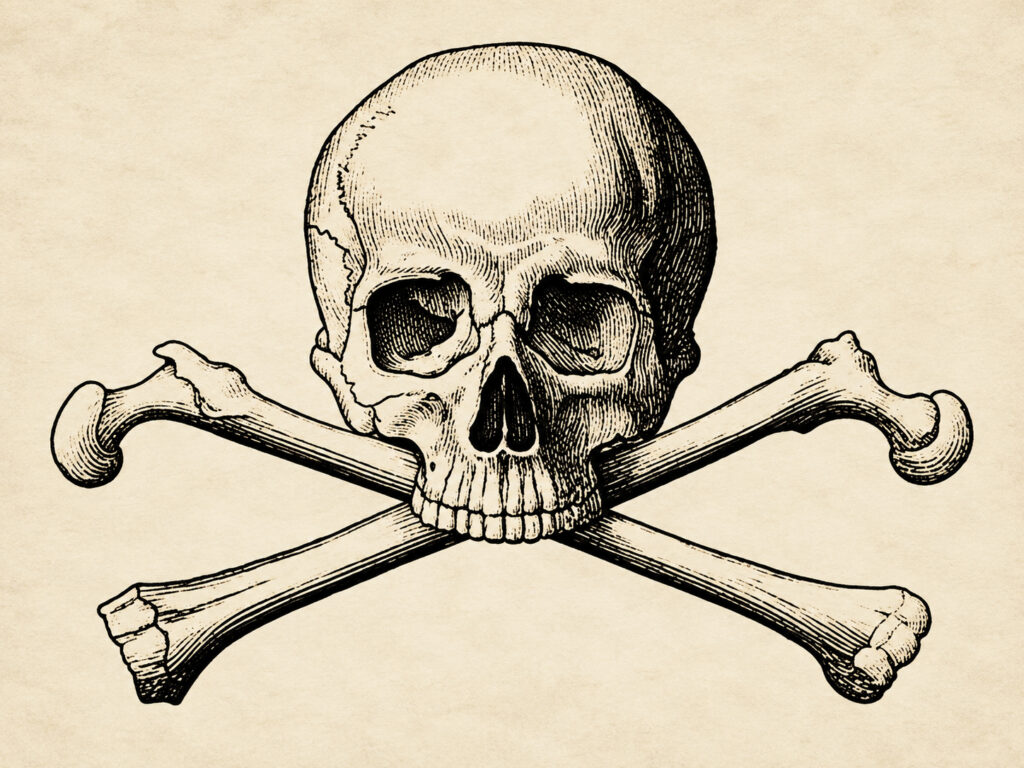
You see, every family has skeletons in the closet, but ours was real. In my bedroom closet, resting in a wooden box with a metal hinge was a smooth, white skull of a young woman. The upper cranium had been neatly cut and the top could be lifted off like the top of a teapot. Two little metal eye-hooks held the cover in place and the jaw moved smoothly on a silvery hinge.
My younger brother Brian, you see, wanted to be an archeologist. He knew this practically from birth, and even at the age of eight he knew all good archeologists studied bones up close and personal. So the bedroom we shared became a sort of museum with my plastic monster models on one side and his skeletons on the other. It was a cool bedroom in the daylight, less friendly in the darkness.
Stephen King tells the story of a little boy with a dead pet turtle. The kid’s heart is half broken with the loss of the thing, so his parents assuage his grief with a good Christian funeral. They wrap the reptile in a handkerchief, toss in a few pieces of the turtle’s favorite food–red licorice, as I recall — place it reverently in a cigar box. They dig a nice hole in the back yard and make a cross from some sticks and twine, but just as they are placing the thing in the ground, there’s a scraping sound from inside the box. The box is opened and the little pet, no worse for wear, is shuffling about inside. The boy’s eyes bug open with surprise, his expression turns to dismay, then rank evil as he looks up from the turtle to his parents. “Let’s kill it!” he whispers.
Things were never so gruesome at home. Our pets had full lives and died of natural causes. Some did return from the backyard family pet cemetery, reborn as little white skeletons, wired expertly back together and posed on a wooden platform. Brian did the work himself, tossing in the occasional roadkill. I remember the skeleton of a bird of some sort, a squirrel or hamster, maybe a turtle, all glaring across the room with empty eye sockets and yellow teeth or beaks.
And then there was the human skull. It arrived one Christmas when my brother was eight or ten. It came from Ward’s Catalog, probably from the Orient, I was told. As I said, he was a budding archeologist. When it came to ancient artifacts or dead stuff, he had the calling. It was a sort of “Sixth Sense,” like in that movie with the boy who sees dead people.
Even as a kid, Brian sensed the past in a way I’ve never seen before or since. I remember sitting with him on a hillside near a lake somewhere when we were little. He leaned back, dug his fingers into the ground, and came up with a perfectly formed arrowhead. A decade or more later, when diggers had all but given up on an ancient burial site nearby, I saw him do it again. He had a power for sensing the way early people reacted with the land. He imagined where they would feel safe, where they would hunt, find water now long gone, where they would bury their dead.
READ my book Point of Graves
He was always drawn toward the past. It pulled him like a force. He went there, willingly, digging, studying, measuring, and contemplating. Sometimes he had to drag himself, with effort, back to the present. And even then, in the middle of a conversation, you could see him slipping down into the rocks and bones and rituals of another time. He wondered, perpetually, who we all are and where we all come from. It was Brian’s passion for the past, I’m sure, that started me studying early English literature and eventually writing countless history stories.
If the bones in Newfields had come from a wealthy family, or a murder scene, we’d be talking about them for a long time to come. But they were, like the skull in our closet, the remains of poor, forgotten people. Now they’ll be forgotten again.
Death may be forever, but cemeteries change, age, and go missing. Marking stones or sticks, if there ever were any, get lost. Maps are inaccurate. If John Paul Jones’ body could get lost under the streets of Paris for 114 years, it can happen here. Charles Brewster told us in the mid-19th century that there was a forgotten slave cemetery in the middle of Portsmouth. No one seemed in a hurry to find it. Then a few years ago, lo and behold, it was uncovered beneath a downtown street, right where Brewster said it was. The poor are often lost both in life and in death.
We’re all still breathing dinosaur air. The water that runs through us, making us flesh, has been around since the dawn of time. But bones, dried old bones, that’s another thing. They hold a human shape that is all too familiar. That shape is us.
Decades ago, when my brother worked on an archeology dig on the Seacoast, he showed me bones in the limestone-impregnated soil that had held their shape for 5,000 years or more. Almost nothing was left, but a powdery outline like a chalk drawing in a murder scene. To touch it would have made the image disappear and so it was returned to the earth.
Disappearing bones I can handle. But those bones in the closet linger in my deepest sleep. Sometimes I find myself outdoors in the dark, in a hole in the Earth. I’m burying something; I don’t know what, something that belongs to someone else, something that belongs underground. I have an object in a box. It could be a skull. I dig frantically deeper. Then I feel the dirt falling. I look up from deep in the grave to see the shovels, feel the weight of the dirt falling, and realize, too late, that my own time underground has come. Kicking and clawing, I swim to the top of the heavy soil, burst through, and wake myself with a muffled scream.
And yet, come daylight, we dig again. We read another murder mystery novel, download another podcast. We see a horror film. We pose plastic skeletons from Home Depot on the front lawn and dress our kids for the Halloween Parade. We too are drawn toward those dry old bones, both by fear and fascination. The past is speeding towards us, and we cannot look away. Everyone, eventually, is drawn into the dark bedroom closet where the silent bones wait. We stare into the empty eye sockets, like a dog with a mirror, seeing something familiar, but not quite clear. Then we rise, all 205 bones of us – and move on, propelling that skeleton of ours through another living day.
VISIT Grave Matters
Copyright © 2005, 2026 by J. Dennis Robinson, all rights reserved.
 Is This Really Lady Wentworth?
