


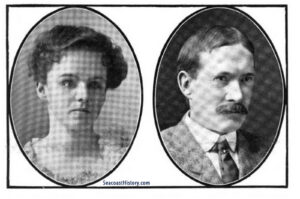
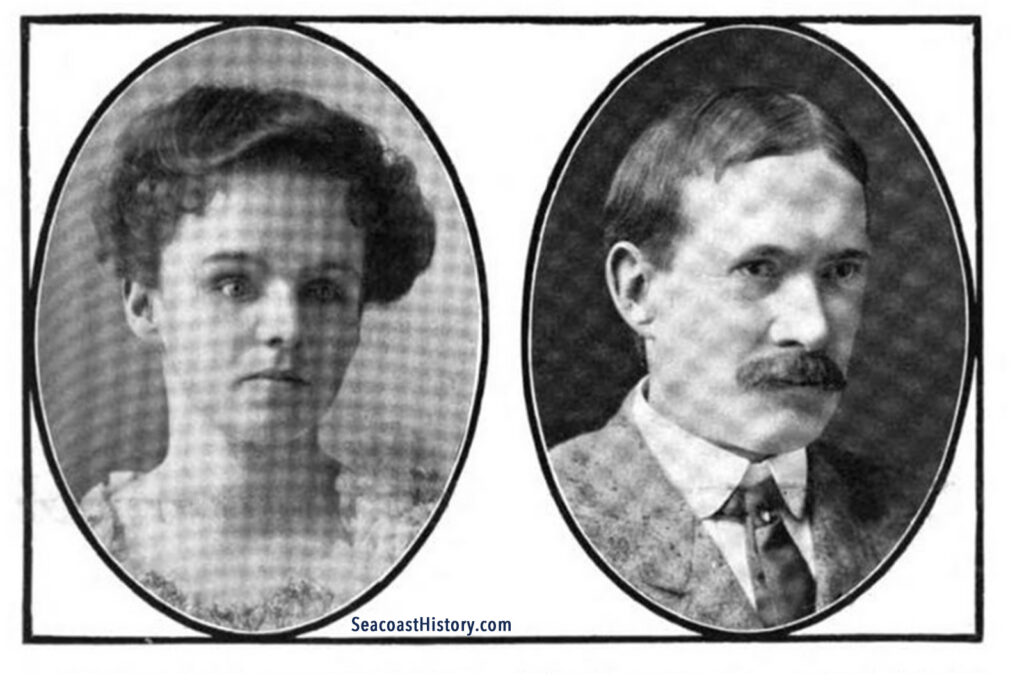
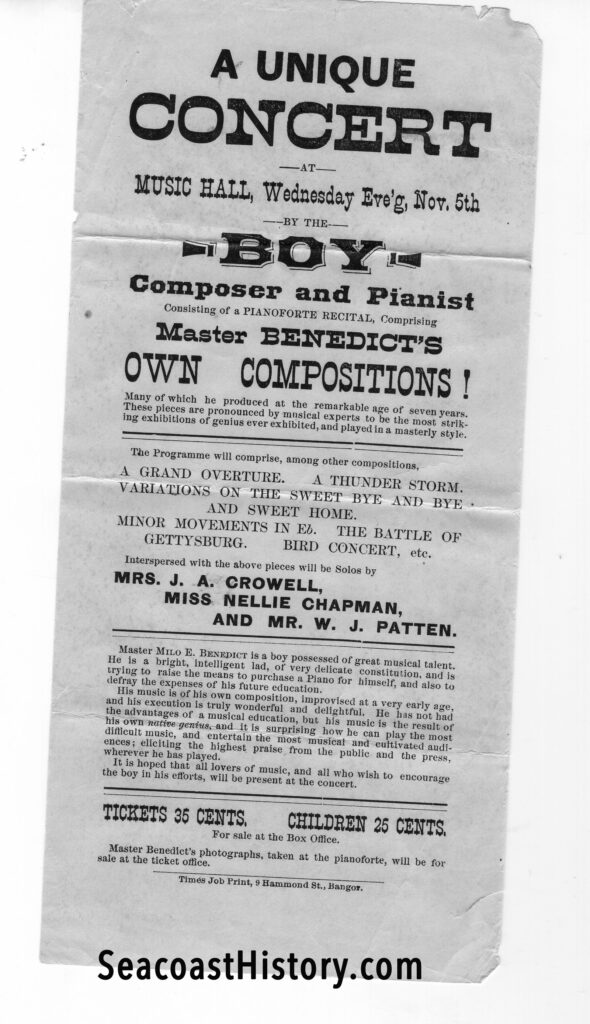
According to the flyer posted around Portsmouth, NH, Milo E. Benedict (1866-1931) was a genius. By age seven, he had composed original music and performed concerts on the piano. When he came to Portsmouth as a teen in the 1880s, Milo gave a recital at the Music Hall. His concert, the announcement claimed, would be “the most striking exhibition of genius ever exhibited.” His unique musical compositions included crashing thunder, the sounds of battle, and bird songs transformed into melodies for the pianoforte.
A fragile paper flyer, discovered in an online auction (see below), offers the following details:
“Mr. Milo E. Benedict is a boy possessed of great musical talent. He is a bright, intelligent lad, of very delicate constitution, and is trying to raise the means to purchase a piano for himself, and also to defray the expenses of his future education. …He has not had the advantage of a musical education, but the music is thesult of his own native genius, and is surprising how he can play the most difficult music, and entertain the musical and cultivated audiences; eliciting the highest praise from the pubic and the press, wherever he has played.”
Tickets to the Music Hall concert were on sale for 35 cents, and 25 cents for children. Photos of the performer at the piano were available at the box office.
Milo married Gladys Perkins Fogg of Boston in 1905. A “colatura” concert soprano, Gladys had an extremely high or “colored” vocal range. “The press in all the large cities of the country have spoken [of her] in the highest terms,” an early 20th-century newspaper reported.
ar“The spell her singing cast over us all was one of suppressed rapture,” Milo Benedict wrote of Gladys when he first heard her sing.
Gladys had lost her sight at age 15, yet carried on a successful stage career, according to National Magazine (1910), with “superb self-poise and absolute accuracy of tone. [She] revealed the mastery of a painstaking artist with a soul and a spirit that surrounded what, under ordinary circumstances, would have been insurmountable.”
Milo Benedict taught at St. Paul’s School in Concord, NH, and wrote What Music Does to Us (1924), a study exploring the power of music on memory, emotion, productivity, and physical health. A headline in the Portsmouth Herald trumpeted the arrival of the famous couple to town in 1910. Milo and Gladys offered an advanced summer workshop for music teachers. They also welcomed a limited number of students beyond the second grade for special music classes. The fee was $5 for one lesson per week during the summer months to be held at 22 Pleasant Street downtown. Gladys died in 1930 and Milo passed away the following year.
© 2026. J. Dennis Robinson/ Harbortown Press. Based on research for the book MUSIC HALL: How a City Built a Theater and a Theater Shaped a City.
 The Skeleton in My Closet was Real
