


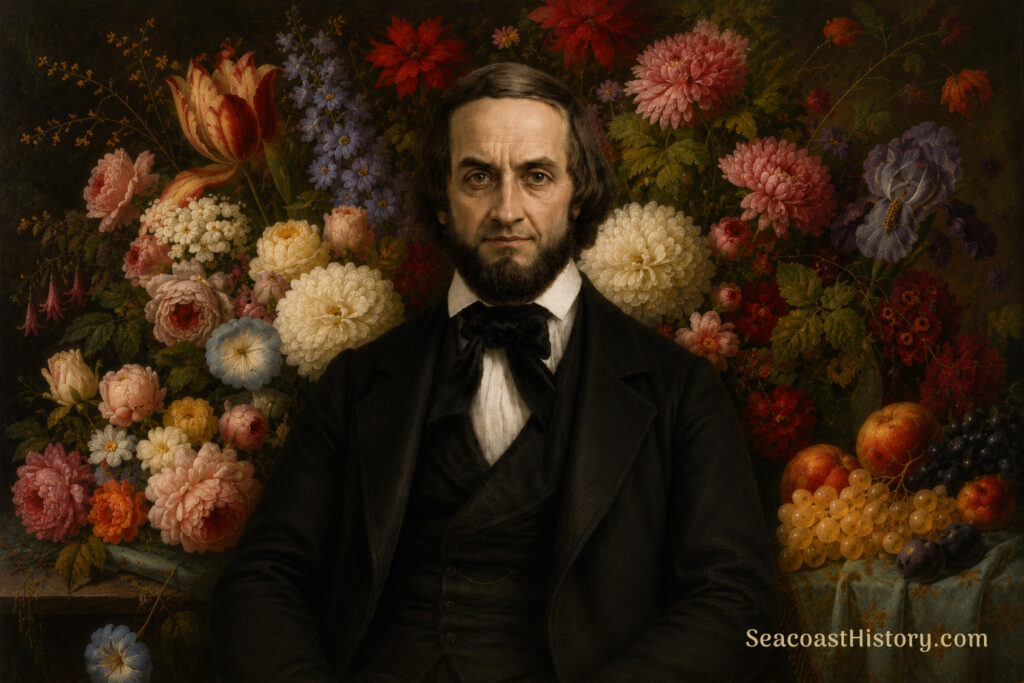
Raising the dead is hard work. Local historian Richard Candee knows. He spent almost two years breathing hot life into the dusty memory of Thomas P. Moses (1808-1881), a 19th-century Portsmouth artist. Moses was a minor maritime artist in a sea of popular local painters, another name in a catalog of men who scratched out a living depicting grand sailing ships against blue water and sky. Moses was also a forgotten poet with one obscure book of verse to his credit. He had been a musician too, the composer of tunes and lyrics long unsung in an era little understood.
Thomas Moses is back; his paintings displayed, his music played, his life portrayed, perhaps better understood than in his own time. Using every medium at hand–from print and radio to video and live performance, Candee has fleshed out a fascinating man, almost gone to dust in the boneyard of Seacoast history. Today, Moses even has his own historic plaque.
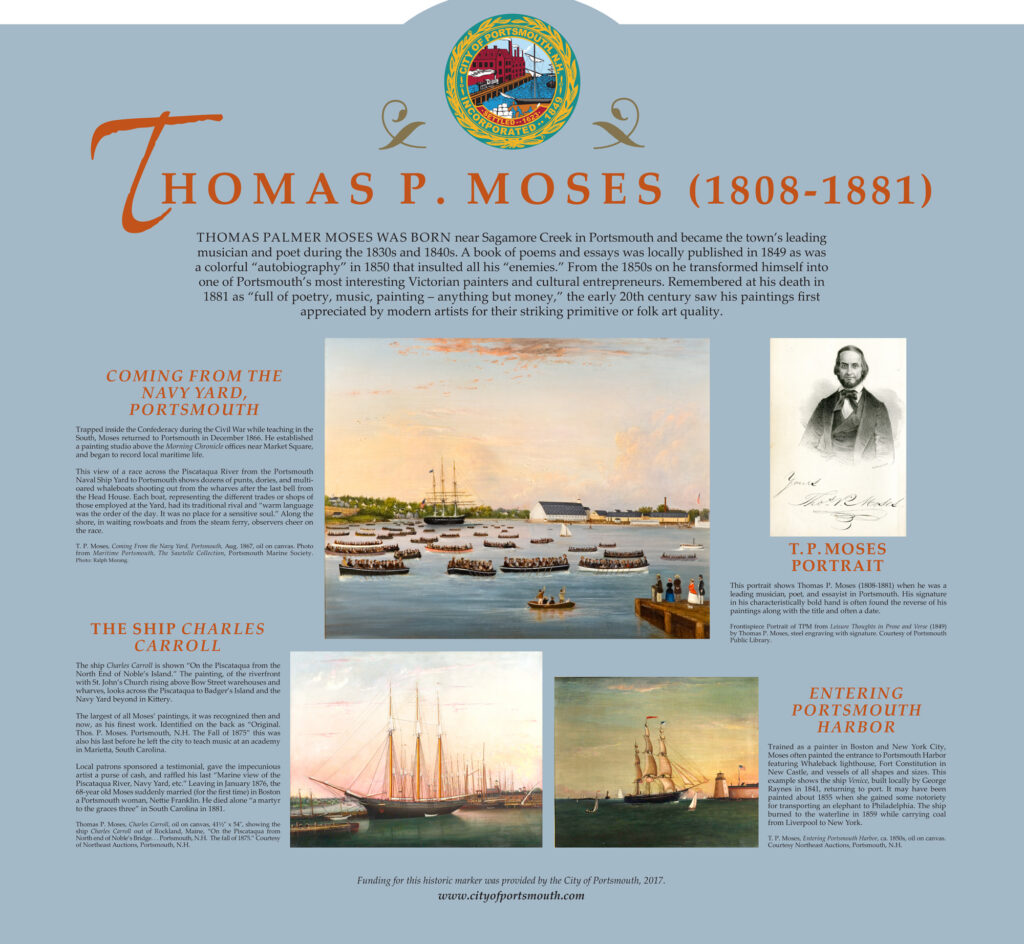
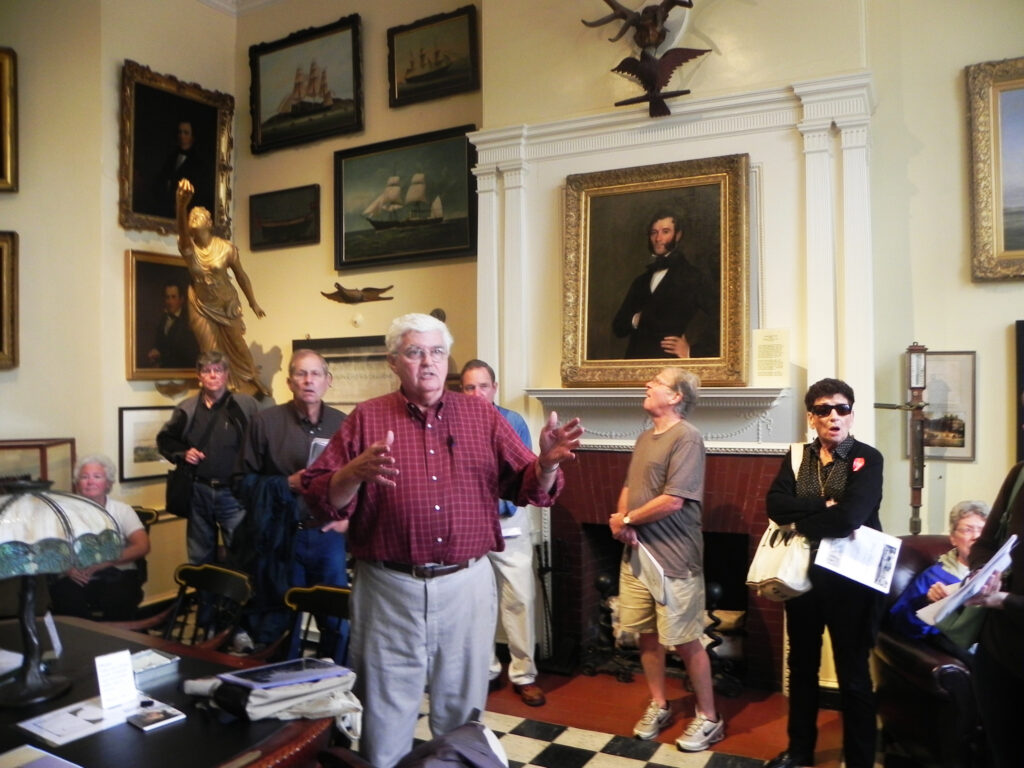
It began as a traditional gallery exhibit called “The Artful Life of Thomas P. Moses.” Candee, the curator and an American studies professor emeritus at Boston University, planned to memorialize the artist. He gathered a rare collection of maritime paintings by Moses, largely depicting tall ships on the Piscataqua River. Candee’s research unearthed references to nearly 250 paintings, of which a couple of dozen survive. Pulling from private collections, the Salem Peabody Museum, and other sites, the display filled the Randall Room at the Portsmouth Athenaeum and packed in visitors for months. The 2002 exhibition has long ended, but a complete color catalog of Moses’ work and the story of his life remains. Candee’s portrayal of Moses appeared recently in the prestigious pages of the American Art Review.
“You know me,” Candee recalls. “I can’t leave well enough alone and just hang twelve paintings. I kept going and going.”
Thomas Moses provided Candee with much to keep going on. A sometimes sulking, often sickly, frequently explosive, and deeply sensitive character, Moses carried on a lifelong love affair with Portsmouth. Indeed, by re-inventing himself as an artist time and again, Moses appears to have been trying every means possible to stay solvent and stay creative without leaving his native town. Many contemporary writers, artists, and musicians know that story well. It’s a town too attractive to leave, but too small to provide a living wage. Like so many creative souls since, Moses chose to remain a big, but impoverished fish in a small, but lovely pond.
As a boy, Moses served briefly as a seaman’s apprentice, but jumped ship and walked hundreds of miles home. As an adult, he left once to teach in South Carolina and was trapped there throughout the Civil War. But he returned.
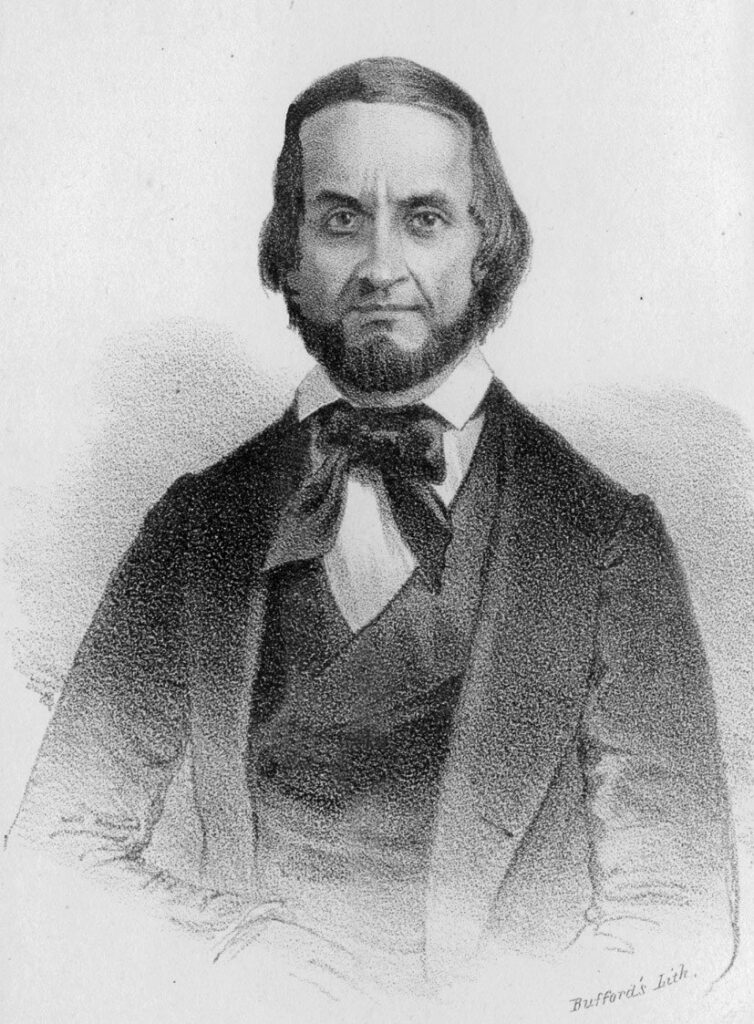
His territoriality sometimes led to conflict. A largely self-taught musician, Moses worked his way from reed flutes, through most instruments of his day, to the coveted position as organist and choirmaster at North Church in Market Square. In 1849, after a bitter battle with church officials, Moses was fired. He complained that the choir loft was messy and that an adversary had thrown filth on his business sign. He was accused of passing notes to women during choir practice, and of firing a gun, a toy pistol, he explained, at an inattentive member of his chorus. Moses compared the voices of a competitor’s choir to no better than the croaking of frogs in a nearby pond.
The dismissal deeply wounded his already fragile self-image. Thomas Moses took his battle public, reporting his version in the newspapers and writing an autobiography, assailing his enemies, and bemoaning his subsistence income. Every snub, for Moses, was a personal attack and further evidence that the upper classes were determined to block him from rising above his station as the son of a local carpenter. Conspirators, in his mind, lay around every corner.
A master of public relations, but a miserable entrepreneur, his poetry and large advertisements appear in all five of the local newspapers of his day. He left his paintings in shop windows and wrote glowing anonymous reviews about them in the press. In one grand scheme, he advertised 100 of his paintings for sale, worth from five to $100 each, he noted. Unwilling to endure a lengthy sales process, Moses sold lottery tickets for $5 each, awarding a painting, chosen at random, to all 100 contestants. Every entrant would be a winner, he explained, and some would win a prize worth 20 times the value of a ticket. Sales were sluggish, and most of the costly paintings were removed from the final drawing and auctioned time and again.
SEE ALSO: Portsmouth loves a pageant
His greatest achievement was a series of Juvenile Floral Concerts performed whenever Moses was most in need of cash, by up to 100 of his young female singing students. Horticulture was then on the rise among Americans. Moses drummed up attention by wheeling his students through the streets on a flower-decked cart in an era long before the Rose Bowl parade. He placed gigantic ads in newspapers, trading space for submissions of poetry, promising stunning floral arrangements, heavenly music and decorated arches. Flocks of caged birds, in more than one case, were paraded into the hall to accompany the young choir.
Richard Candee could do no less. With the aid of local musicians like Rich Spicer, the Portsmouth Garden Club, and the Sandpiper juvenile chorus, the scholar transformed words into action. In an age of computer-animated film stars, hundreds of Portsmouth citizens packed Portsmouth’s South Church to experience a Thomas P. Moses floral concert. It was, for those who attended, a genteel and hauntingly authentic event, held in the very vestibule where Moses himself had once performed. Accompanied by piano, organ, and flute, local children marched to the stage carrying banners and singing “Huzzah! Huzzah! Sons of the free!” The stirring anthems Moses had promised stirred again. Captured on videotape, the mood of this sublime Spring concert survives.
Portsmouth actor Greg Gathers, portraying Thomas P. Moses, read from the artist’s one published volume of poems and recounted his hardscrabble life as an artist. Once more, the almost-forgotten artist described his struggle to stay financially afloat in a seaside town with a rocky economy.
“Portsmouth!”Moses scolded the capacity crowd from the pulpit of the old Greek Revival church, again festooned with greenery and flowers. “Portsmouth, diminished by artlessness and cupidity!”
Moses railed agai:,“Poverty! That corroding and soul-freezing trial to intelligent and soaring minds.”
It was the howl of a poor and frustrated man, full, as one of his creditors once wrote, “with poetry, music, painting, anything but money. Although Moses had no family of his own, he was forced to support his ill and aging parents, and a niece abandoned him.
He argued that artists, like clergymen, because of their higher calling, should be supported by the community. At the very least, when the artist sells his work, the community should buy. He wanted the money, but then railed against the pursuit or riches above the holier pursuit of Beauty, the appreciation of Nature, and the love of Art. It was a tough sell in a working-class town,
“We shall waste our existence,” the reincarnated Moses preached, “Idly hoping for a permanent prosperity, until we wheel about and become a more liberal and brotherly people. Never, while we show a disposition to crush or underrate native talents and virtues, can we be respected abroad.”
Poor Thomas Moses, a big league ego in a minor league town. In 1875, Moses created his largest and most stirring painting of a wooden ship on the North Pond docks looking toward Portsmouth at sunrise. After auctioning off shares in his remaining paintings at $1 per ticket, Moses held a final lottery for his finest work. In 1876, he left Portsmouth forever to serve as a music teacher in a South Carolina high school. Former patrons contributed toward a purse, perhaps to help the aging artist afford his train fare.
Never conventional, before leaving town, the 69-year-old bachelor announced his marriage to Nettie Lawrence, a woman half his age. The marriage, it appears, lasted only months. Just before he died in 1881, Moses made the long trek home to Portsmouth, NH, intent to sail one final time on his beloved Piscataqua River. Even then, his music, his poetry, and his painting were passing out of fashion.
“I always knew that, no matter how many paintings I found, the story itself was going to be fascinating,” Richard Candee says in retrospect. There was so much about Moses, Candee discovered, “that was never going to hang on the wall.”
The painter, it turns out, is more interesting than the painting, the singer, more amazing than the song. The fleshed-out Thomas P. Moses, courtesy of Candee and his talented friends, is the new household saint of small-time artists. Moses is the hero in the fable of The Big Fish in the Small Pond. He reminds us why so many creative souls choose to live in a scenic city that, even today, cannot feed its starving over-sized community of artists. Small fame, as many have discovered, is better than no fame at all.
Copyright © 2002 by J. Dennis Robinson. All rights reserved.
 Selling the Singers of Yesteryear