


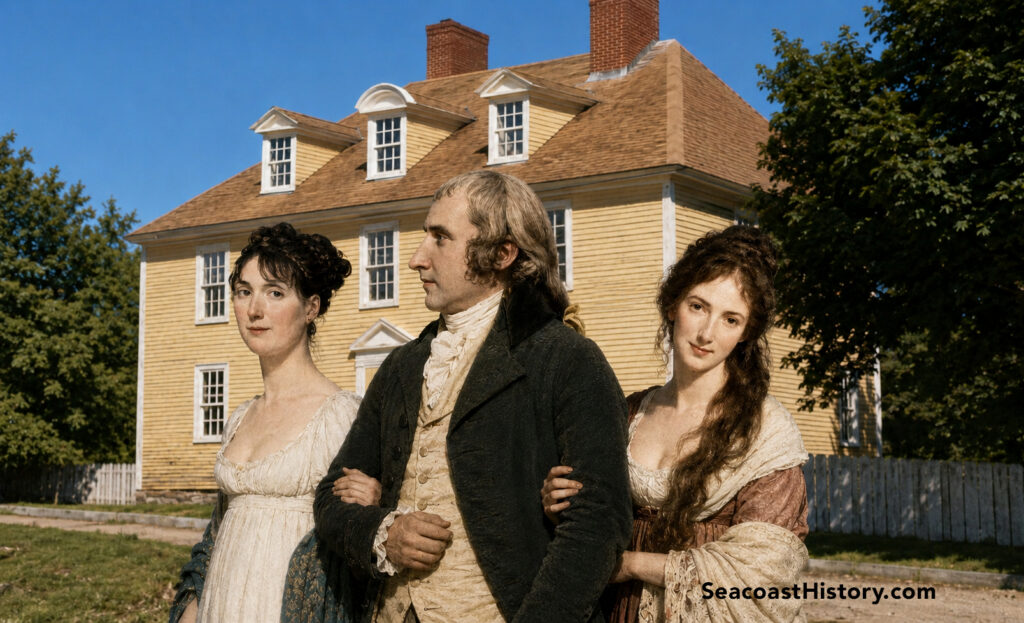
Why was Tobias Lear in such pain? Why did George Washington’s former secretary kill himself with a pistol in his garden a block from the White House in 1816? No suicide note was found, and the man who dedicated his life to scrupulously keeping government records did not even leave a will.
Lear certainly had reason to be depressed. He suffered under debts left by his father, a Portsmouth, NH shipbuilder. He lost a fortune speculating on real estate in the founding days of the capital city at Washington, DC. He watched his hero George Washington, die. Lear was vilified for destroying some of George Washington’s private papers. He barely escaped losing his head to the Barbary pirates while an ambassador to Algeria. He was working as a scribe in the War Department when the British burned the capital city in the War of 1812. And he lost two wives.
Pretty Polly
While we can never know the demons that haunted Lear’s mind, we can explore the angels that guided his life. The first Mrs. Lear was Mary Long, known as “Polly,” a childhood sweetheart from Portsmouth. Tobias was fresh out of college when he was recommended for the job of bookkeeper and secretary to the most important man in the new United States at his farm at Mount Vernon, Virginia. Lear was invited to share the Washington family table and was treated as an equal.
Polly, by all accounts, was a welcome addition. By the time she arrived, Washington had come out of retirement and grudgingly accepted the position of President of the new United States. The temporary American capital was first in New York, then in Philadelphia. The Lears lived in their own apartment smack inside the first “white house” where Polly gave birth to Benjamin Lincoln Lear. Baby Ben’s godfather was the president himself.
Mighty Martha
Martha Washington doted on the Lear baby and loved Polly. The two women planned the very first formal functions of the nation’s first family, literally inventing the social structure of the new country. The wealthy and powerful Martha Washington, also the nation’s largest slave-owner, was even close to Lear’s mother.
Martha was a tough lady, worldly wise and influential. Originally, Martha Custis, her first husband had died, leaving her with two children. Martha’s only boy “Jackey” Custis, had four children of his own, and then he promptly died, leaving the Washingtons and Lear to care for the kids during the volatile Revolutionary era.
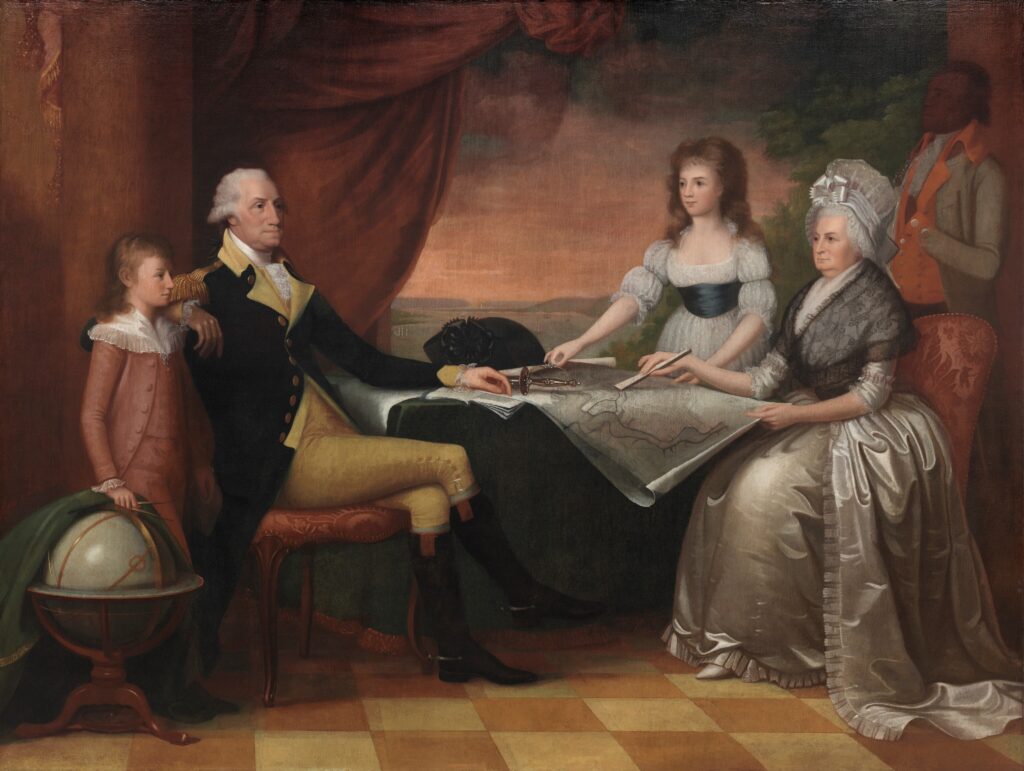
There is a famous painting of the “Washington Family” from this era by Edward Savage. It’s huge and hangs in the National Gallery, depicting an elderly George and Martha Washington posed stiffly across a table with two small children with their black servant. These are the Washington grandchildren, “Nelly” Custis and George Washington Parke Custis. The “Father of the Nation” never had children of his own, but became very close to his employee Tobias Lear.
Serving George
One of Lear’s many tasks was to tutor these children, and his early letters are rich with the details of domestic life among the Washingtons. Lear fretted over the task of getting Nelly to school. One moment he was writing a critical letter for the president, and the next moment he was off buying stays for Nelly’s dress, or picking out a fob for her new watch. In another letter, Lear reported to Grampa George that “Little Washington” was doing badly in school.
Lear also influenced the President directly. It was Lear, years earlier, who had convinced Washington to tour New England so that his citizens could meet their hero in person. The two men traveled great distances together, forging their bond as father and surrogate son. Their four-day stop in Portsmouth in 1789 is one of the city’s finest moments. Washington insisted on visiting Madam Lear, Tobias’ mother, in her home on Hunking Street. According to local legend, crowds hovered around the hip-roofed house, peering in the windows as the president kissed the head of the Lear grandchildren, including a boy christened “George Washington.”
The Lears were living with the Washingtons in Philadelphia when Polly Lear contracted Yellow Fever. Polly died at age 23. Though unknown at the time, mosquitoes on ships from Barbados were the likely cause. Polly’s death may have come from a stroll in the presidential garden, or from a shopping trip along the docks with the First Lady.
Tobias Lear was devastated. George Washington broke tradition and attended Polly’s funeral, an act he could not repeat for fear of offending others who begged his presence at family events. Lear’s mother took over as caretaker for young Benjamin as the former secretary left the security of the Washington household in an attempt to establish his own fortune and reputation. On his own, Lear found little success.

Farewell Fanny
Then his life hit a brief updraft. Two years after Polly’s death, Lear married Frances Bassett Washington Lear, “Fanny” for short. Fanny had also been recently widowed, left with a small child named Mary. Fanny’s first husband was none other than Augustine Washington, a nephew of George Washington. Fanny was also Martha Washington’s niece. As a wedding present from the Washingtons, the couple received lifetime use (but not ownership) of a gorgeous Virginia property nearby called River Farm. Lear was suddenly related to both sides of the Washington family.
But Fanny, who may have contracted tuberculosis from her first husband, died within months of the marriage. We do not know what impact Fanny’s death had on Lear. The marriage may have been a way of providing a father and family for Fanny’s young son who came under Lear’s care.
“I think it is something noble that Lear did,” re-enactor David Kozisek says. “Lear had been friends with Fanny’s husband and he knew she was sick.”
Tourists who encountered Kozisek as Tobias Lear at Mount Vernon met a man at roughly age 35. The year presented was 1799 and Lear, twice widowed, was currently unmarried. This is the same year that George Washington died, but as far as the characters at Mount Vernon are concerned, Washington is still alive and well.
Fanny 2.0
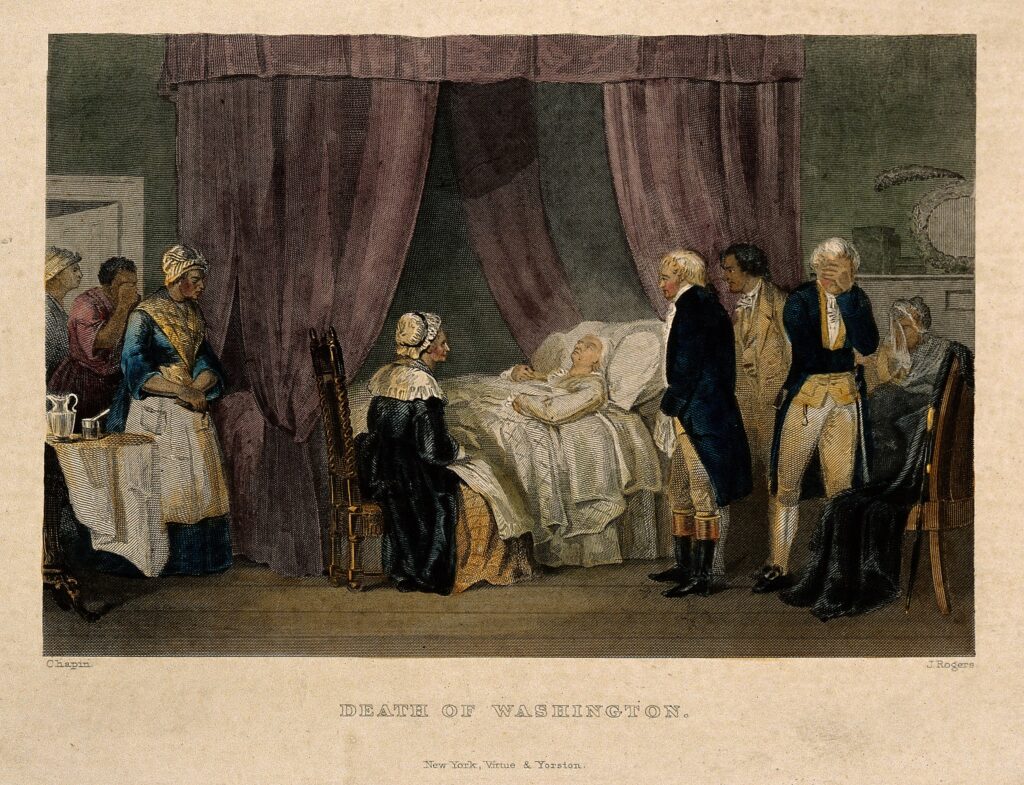
When George Washington died suddenly in 1799, the nation mourned. For Lear, who was at the former president’s bedside as he died, it was also the loss of a surrogate father.
A new scandal soon arose over some missing presidential documents. Lear was accused of misplacing or destroying important letters relating to Thomas Jefferson. But each time Lear’s life turned hellish, a new angel appeared.
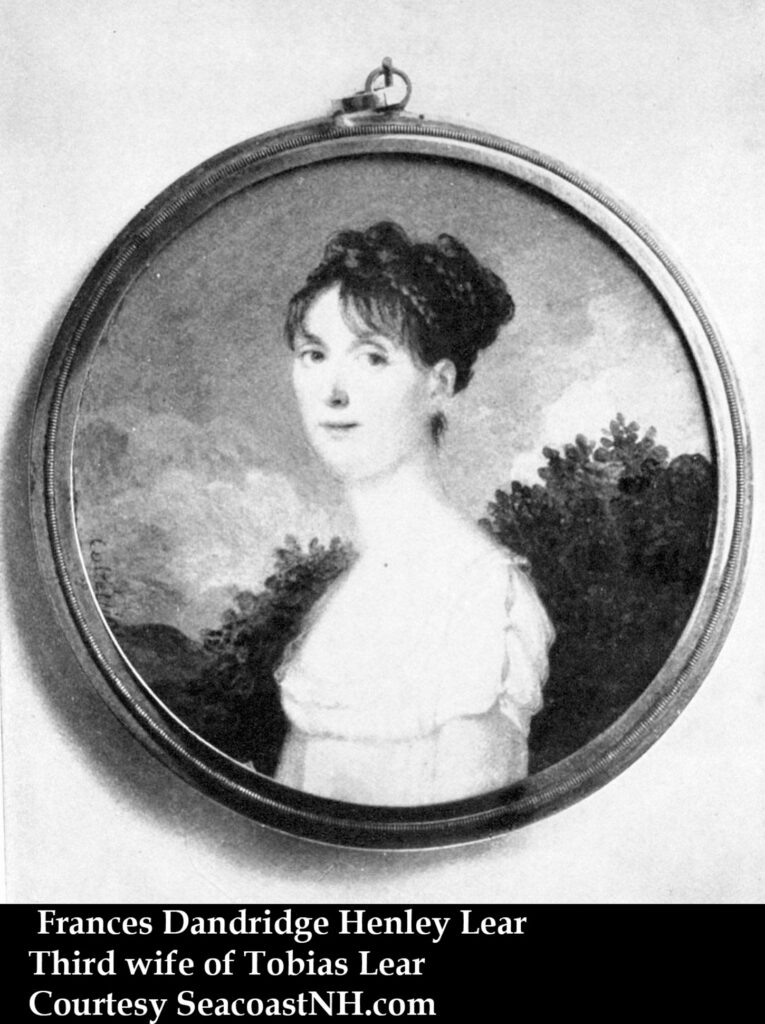
Martha had another niece, also named “Fanny.” So Lear was married for a third time to a young Frances Dandridge Henley Lear. Thanks to the new President Jefferson, Lear was appointed consul to Algeria. Leaving young Benjamin Lear behind, the newlyweds spent their transatlantic honeymoon aboard the USS Constitution, the ship that would eventually come to be known as “Old Ironsides.” They were gone for nine years.
Lear negotiated the famous treaty on the “shores of Tripoli” which effectively paid bribes to the infamous “Barbary Pirates” to keep them from attacking American vessels. Another scandal arose when he was accused of taking a percentage of the fee, which he probably did, since making a commission was then considered a perk of the consul’s job.
When the Algerian leader demanded even more money, the Lears were forced to flee back to the United States or risk losing their heads. They arrived in a nation on the brink of war with England. Lear took a job with the War Department just as the British burned the Capital City to the ground. Soon after the War of 1812, leaving a stricken wife and son, Tobias Lear took his own life on October 16, 1816. Portsmouth, too was shocked and saddened.
With the exception of Martha Washington, no historical character is better equipped to tell the story of George Washington than his secretary Tobias Lear. And yet when re-enactor David Kozisek introduced himself to visitors at Mount Vernon, the name Tobias Lear usually evoked a blank stare. And while he played a character who, in 1799, still hoped to attain fame and fortune, Kozisek knew sad times were coming for Lear.
Which is why, Kozisek said, he was thrilled to visit Portsmouth a decade ago where the memory of Lear is strong and his birthplace still stands. For one public appearance, at least, Lear did not have to play second fiddle to Washington.
Stepping inside the Tobias Lear House on Hunking Street in the city’s South End, Kozisek said, “made me realize that, if you’ve done enough that people are re-enacting your life, then you really have left your mark on the world.”
Copyright © 2013 by J. Dennis Robinson, all rights reserved, edited 2026.
 The Two Loves of Annie Fields