


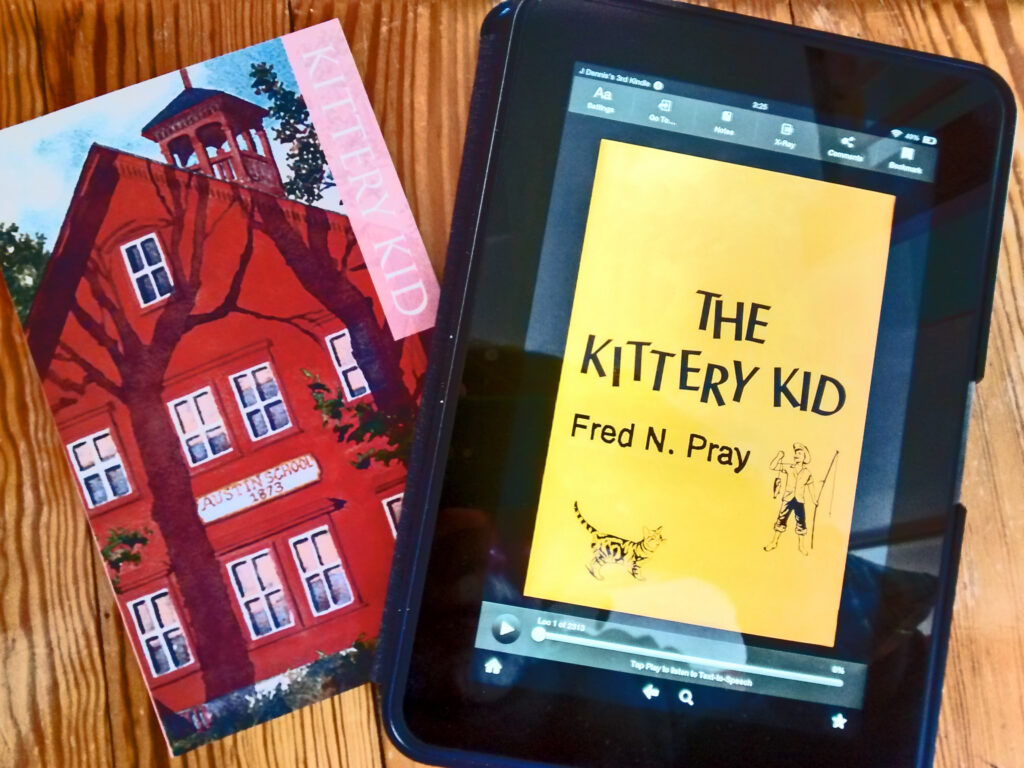
The next time your 10-year-old complains that his Wi-Fi is buffering too slow, make him read The Kittery Kid. But be warned, this action-packed memoir about growing up on the Piscataqua at the turn of the 20th century is powerfully, totally incorrect. Author Fred N. Pray (1885-1973) tells it like it was more than a century ago. There were still horse carts. There were no movies, TV, or radio in his childhood. But there were a lot of boats, books, brawls, guns, girls, pranks, and heart-stopping adventures.
“A cat is a hard thing to paint,” Pray wrote in The Kittery Kid. “The body isn’t hard, but the head is, for you have to be careful about the eyes, ears, and nose. The tail is a cinch. Just dunk it in the paint pot.”
Fred’s sister was horrified by his feline beautification project. What happened next to the poor cat, painted blue, would put Fred and his sister on the SPCA’s “most wanted” list these days. Fred got a severe spanking when his father got home from his shift at the Navy Yard, but that was nothing new. Fred was a hellion through and through.
As the Kittery Kid opens, Fred is roughly seven years old. He lived in the former Skipper Billie House near the river on the lower Kittery Foreside in Maine. (“I never knew what side this was, or what it was aside of, so skip it,” Pray wrote.) The family included his parents, five older sisters, his younger brother Zeek, and a housekeeper. The kids were largely untended, and the boys roamed the great outdoors. Fred looked after Zeek “more or less– and it was mostly less.” So when Zeek painted his bare buttocks or sank to his armpits in the oozing mud flats, Fred was to blame.
Fred Pray was small for his age and often bullied. So he bullied back. In one scene, he was knocked unconscious trying to sneak into the hayloft to molest his sister’s paper dolls. He made bolos out of large horse chestnuts and flung them around the legs of girls. He once tied 13 live snakes together by their tails and gleefully watched them struggle, until his mother chopped them up with a hoe. When the family moved to “Skunk Alley” near Locke’s Cove, Fred engineered the greatest skunk massacre in Kittery history.
School day pranks
Much of the opening action takes place at the old Austin School. Fred and his best friend John cut most-of-the-way through the rope that hung from the bell that called the neighborhood children to school. When the janitor yanked the rope in the morning, it snapped, and the kids got a delayed opening. In another scene, the boys shimmied along a perilously high rooftop in order to block the school chimney with boards and bricks. The smoke-filled classroom was closed for two days.
The boys routinely smuggled live bees, frogs, beetles, turtles, and other creatures into class to set the girls screaming. (“The girls enjoyed the confusion as much as the boys.”) Their beautiful young teacher, Miss Crawsby, who washed her face with milk, had no discipline. On good fishing days, Fred and John simply excused themselves and left to haul in their fishing trawls.
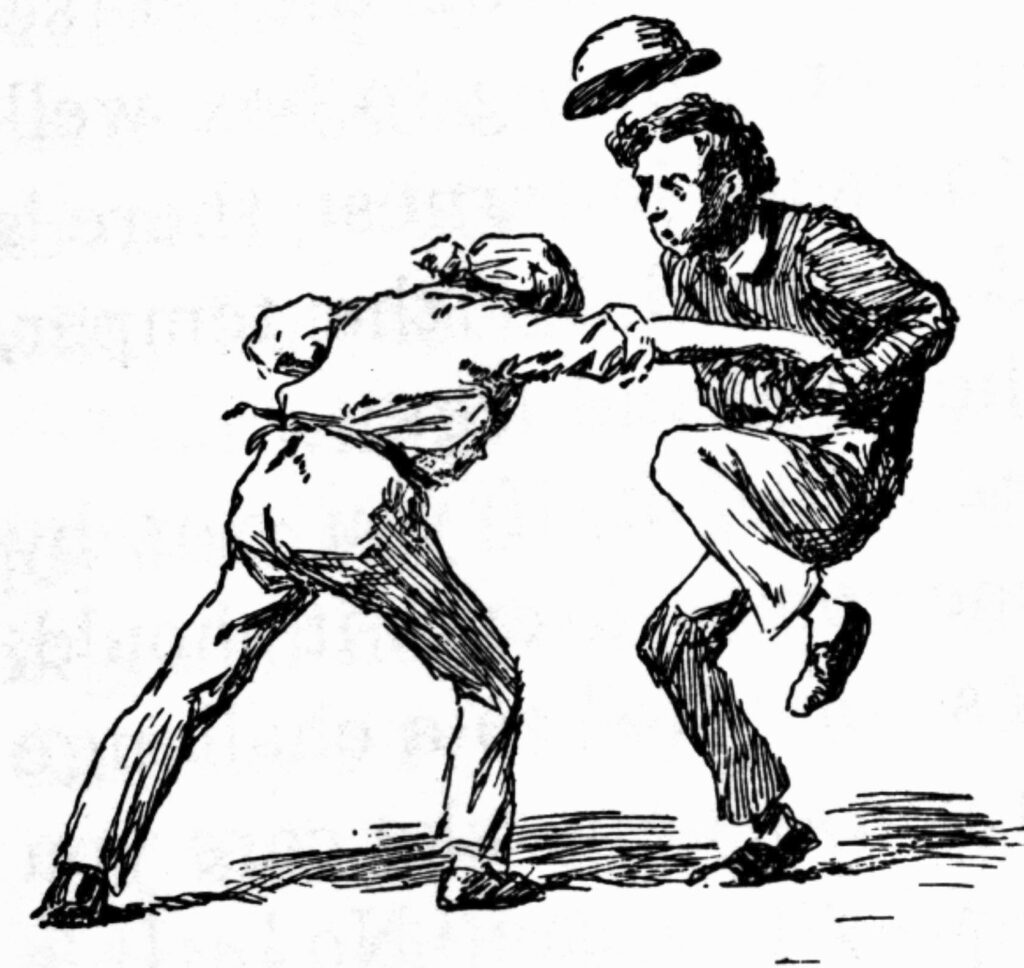
Kittery town officials replaced Miss Crawsby with a male teacher, and instructed him “not to spare the rod.” At recess, the four biggest, toughest boys planned to ambush the new teacher, and teach him a lesson. As little Fred watched, a boy named Howard began the attack. “The teacher punched [Howard] in the stomach,” Pray wrote, “and when he bent over, gave him an uppercut to the jaw. Down he went.”
As the dust cleared, “there were three of the boys knocked out cold on the floor.” The teacher dragged the gang by their collars to the front of the room and dowsed them with water. “We all knew he was smarter than we were,” the Kittery Kid sulked, “and we didn’t like it at all.” In revenge, Fred managed to smuggle a huge black and white adder into the classroom. He wrapped the dead snake twice around his tiny waist beneath his coat, and planted it in the teacher’s desk. Again, he got a licking, but later agreed that the teacher was “a good scout.”
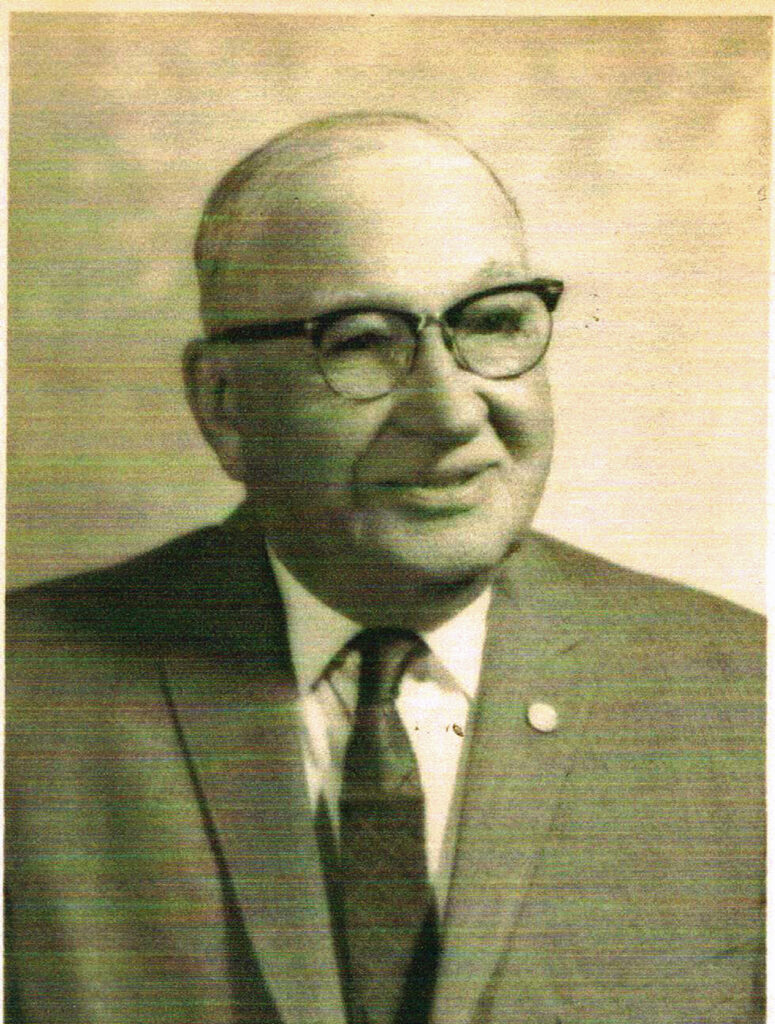
Who was Fred Pray?
Fred Noble Pray was short in stature, scarcely 5’3” with a wife who towered over him. His love of boxing, well documented in his book, began as a survival technique. As a boy, he was beaten three times a week by bullies, he wrote, until he grew strong and skilled enough to defeat all opponents, including his father. Fred’s uncle, Isaac H.M. Pray of Portsmouth, had served in the 13th NH Regiment. Isaac Prays: Four Tattered Journals of the Civil War have recently been made available online.
Fred was in his “dotage,” he noted, before he set pen to paper. His only book was self-published in 1959 under the pseudonym “Yarp N. Derf,” his name spelled backwards. By then he had retired from the Portsmouth Naval Shipyard as a master machinist and moved Downeast. During World War II, legend says, Fred was small enough to crawl into the torpedo tubes during test dives to check for leaks.
His granddaughter, Elaine Estes Sandoval, formerly of Rangeley, Maine, and now living in Alaska, remembers him as a great storyteller. Grampa Pray loved to play cribbage and enjoyed his nightly “toddy” of rum and honey. He was a master target shooter, and Elaine has inherited his .22 caliber Winchester rifle. The barrel was cut short to fit Fred’s diminutive frame. Elaine’s husband, Antonio Sandoval, is a retired police officer and Vietnam veteran. He too is a writer.
“I was simply crazy about firearms, and still am,” Fred Pray wrote. And while this may offend some modern readers, we need to remember that, back in the day, learning to hunt and fish and fight and sail were rites of passage for many boys. Boys cursed, experimented with alcohol and cigarettes, disobeyed adults, explored their sexuality, build clubhouses, fell in the water, nearly drowned, and took terrible risks.
The Kittery Kid, sneaking in silently by boat, stole stuff from the dump at Portsmouth Naval Shipyard. He dared the marine sentries to shoot him, and led them on a merry chase. When the prisoners of the Spanish American War were encamped on at the Navy Yard, Fred stole some of the excess building supplies. His most profitable day fishing brought a $10 bounty, paid by the York County constable, when Fred found a floating human body, half eaten by fish, and hauled it in to shore.
A “bad boy” masterpiece
Fred Pray clearly emulated and occasionally outstripped other local works in the once popular “bad boy” genre. His writing is not as well-crafted as A Story of a Bad Boy (1869) by Portsmouth’s Thomas Bailey Aldrich, or the juvenile fiction by Exeter’s Henry Shute, or by Kittery’s William Dean Howells. Unlike his skilled literary colleagues, Fred Pray was truly unschooled.
Yet his rambling “bad boy” memoir is chock full of authentic characters who might make Mark Twain jealous. We meet kindly Mattie, the hunchbacked girl who fell down the stairs. We weep with the housekeeper who falls in love with the doomed sea captain from Gloucester. There’s Albert Whitehouse who, after fishing all day with the blasphemous little boy, turns out to be an Episcopalian minister. There’s Grammy Love, the quiet 80-year old, who secretly smokes “the strongest pipe tobacco on the market.” Fred meets summer tourists, captains of ocean liners, and lawyers too. He falls hard at age 13 for a cute girl whose father works at the shipyard. Fred teaches her to fish and sail as good as any boy.
Fred is ultimately a good boy. When he “does wrong,” he accepts the consequences. He eats or sells the creatures he kills. He does chores for elderly neighbors, refusing payment. Despite adolescent lapses, he usually obeys and respects his parents. And unlike most of his male friends, he prefers books to booze, honors the rights of women, and would rather dance than brawl.
Along the way, through 145 pages, Fred teaches us. We learn, not just about Kittery history, but how to build a lobster trap, mill a gun barrel, repair a wherry, organize a dance, catch a skunk, clean a fish, court a girl, pilot a trawler, make a dollar, tame a bully, and yes–paint a cat.
The Kittery Kid, in the words of another Portsmouth author, is a true “human boy.” Benjamin P. Shillaber, the father of “bad boy” books as early as 1848, had a theory. “The boy,” Shillaber wrote in the introduction to his first novel, “has but little plan, purpose, or intention in what he does, beyond having a good time.”
Being bad, Shillaber said, is how boys learn to be good. They cannot be effectively whipped, goaded, or trained by adults, because they live in a world of their own making. A boy is no more like a man, he implied, than a caterpillar is like a butterfly. He requires no assistance in his metamorphosis. No pampered boy, Shillaber insisted, should be trusted as an adult. And no grown man should be judged by the wild and terrible things he did in his youth.
READ THE BOOK: Original copies are hard to find, but “The Kittery Kid” is now available as a Kindle ebook on Amazon.com, courtesy of Elaine and Antonio Sandoval. Ken Fellows, a retired radiologist turned watercolorist, edited a shorter, more politically correct version of The Kittery Kid for very young readers. The revised version features a watercolor by Ken Fellows.
Copyright © 2016 by J. Dennis Robinson, all rights reserved.
 The Simple Art of Uncle Oscar