



In 2014, the New Hampshire Senate came within a single vote of abolishing capital punishment. With only one man on death row, and with no one executed here since 1939, we are the last New England state with the death penalty still on the books.
Just across the Piscataqua River, Mainers made up their minds on this hot topic in 1876. Then they changed their minds and hanged three men. Maine abolished capital punishment again, seemingly for good, in 1887.
Opposition to capital punishment in Maine had been brewing since the largest state in New England gained its independence from Massachusetts in 1820. The harsh Puritan penal system, created by the state’s founders, was deeply embedded in Maine history. In the 17th century that punitive system could sentence its citizens to death for a host of crimes, including idolatry, blasphemy, public rebellion, witchcraft, bestiality, buggery, bearing false witness, rape, “man stealing,” and burning a house or ship. Technically, a child subject to early Puritan law could be executed for failing to obey his parents. By 1829, while creating its own more lenient laws, early Maine state legislators had reduced the number of capital crimes to treason, murder, and arson.
Did Sager poison Phoebe?
Then, in 1834, Joseph Sager poisoned his wife Phoebe. Or so the county prosecutor claimed at Sager’s murder trial in the state capital at Augusta. His housekeeper testified that Mr. Sager had left the breakfast table to make an “egg pop,” a mixture of wine and egg, and served it to his ailing wife.
She also drank a cup of tea. Sager urged Phoebe to drink up, because “all the best of it, the sugar, was at the bottom.” Phoebe and the housekeeper noticed that there was a white powdery substance on the milk pitcher. Phoebe became terribly ill, and while lying on her death bed with her neighbors gathered around, she chastised her husband. “You are the whole cause of this, now,” Phoebe told Joseph. “Be an honest man and confess it.”
Joseph Sager did not confess. Investigators found traces of arsenic on the milk pitcher, but an autopsy team could not absolutely confirm the poison had killed Sager’s sickly wife. A neighbor testified that the Sagers had marital problems and that Joseph, who was 15 years younger than his wife, had licentious urges. The evidence was strictly circumstantial. The jury could make Sager an innocent man, his attorney declared, or “You may fix the fatal cord around his neck, and behold him swinging in the air, a blackened corpse.”
The jury did exactly that. Sager was promptly executed outside the Augusta jail in January 1835. As many as 5,000 spectators showed up despite a heavy winter snowstorm the day before. After waiting two hours for a governor’s reprieve that never came, Joseph Sager was hanged before a festive crowd. His friends immediately took the body to a nearby town where they attempted, in what sounds like a scene from Frankenstein, to revive his corpse using unspecified “galvanic means.”
Sager remained dead, but his execution reanimated the debate over capital punishment. That same year an “anti-gallows” governor was elected in Maine. Some legislators wanted only to move the spectacle out of the public eye, putting an end to the drunkenness, revelry, and pick-pocketing that inevitably occurred at public hangings. Proponents of the death penalty, drawing from Puritan roots, offered the longstanding argument that such horrible displays were designed to chasten the audience and discourage similar behavior.
They quoted the familiar biblical passage from the Book of Genesis, that “whoever sheds man’s blood, so shall his blood be shed.” Opponents countered that Maine residents were not bound to the ancient tenets of the Old Testament but observed the Christian principles of forgiveness, love, and mercy. If the public spectacle was a crime deterrent, they pointed out, then why had there been four new murders in Maine during the months following Sager’s hanging?

Chipping away at the law
Unable to ban executions outright, abolitionists, predominantly Quakers and Unitarians, managed to chip away at the process. In 1837 Maine passed a law requiring a one-year grace period between the final sentencing and execution of the condemned criminal. Capital prisoners were required to reside in solitary confinement at the state prison at Thomaston, and work at hard labor. After a year the governor was required to review the prisoner’s case and sign a death warrant. Most governors balked at this added step, not wanting to act in a judicial capacity, especially with public sentiment running against hanging.
One governor did sign off on the execution of Valorus P. Coolidge, a Maine doctor who killed a man who owed him money. But Coolidge managed to commit suicide in his cell before he could be hanged.
Two sailors, Abraham Cox and Peter Williams, were hanged publicly for murder and piracy in Auburn, Maine in 1858. Theirs was a federal case, however, and did not impact Maine’s 30-year record as a state soft on capital punishment. But there was no leniency for Francis Couillard Spencer. While serving a five-year sentence for assault, Spencer inexplicably stabbed the Thomaston warden in the neck, puncturing his carotid artery. Spencer was hanged in the prison yard in 1864 on the exact spot where he had killed the warden.
A cloud of racism
By 1867, under Maine’s post-war governor Joshua Chamberlain, one of the 10 men then living on death row at Thomaston had been there for 20 years. A hero of the Battle of Gettysburg, Gov. Chamberlain suggested that the legislature either abolish the death penalty once and for all, or repair the current law that he considered unconstitutional because it effectively made the governor the hangman.
And yet, Chamberlain himself signed off on one very controversial execution. Clifton Harris was convicted of killing two women in the town of West Auburn. The women were white and Harris was black. Maine was then, and according to the most recent US Census, still remains, the “whitest” state in the nation. The newspapers of the era clearly saw racial prejudice at work here. Harris’ partner in the crime, and likely the real killer of the two women, was white, and yet he was freed on appeal. And while Gov. Chamberlin commuted the sentences of three other white inmates; he issued a death warrant for Harris who was executed in 1869, as soon as his one-year mandated waiting period was over.
The son of African-American parents who had been kidnapped, sold, tortured, and enslaved, Clifton Harris was hanged behind prison walls at Thomaston. Only 50 witnesses were present. The Weekly Kennebec Journal described the scene for its readers, and for history, in horrific detail.
“As Harris dropped through the trap door of the gallows: “The hands commenced to twitch convulsively and there was an effort [by Harris] to pull them from the cords which bound them. The knees were drawn up and the body spun around and around. It was evident that the man was dying of strangulation. The struggle continued some two minutes with the exception of an occasional mighty effort of the chest. The body hung there for twenty-five minutes.”
The last men hanged
The inhumanity of this method of killing prisoners could not be denied. The state of Maine was losing its taste for blood revenge or “judicial murder,” as some called it. By 1873 there were 14 prisoners living out their lives on death row at Thomaston State Prison .
“The state occupies a false position,” one local newspaper editorialized. “Legally it professes to believe in a mode of punishment, which it has too much humanity to carry into practice.”
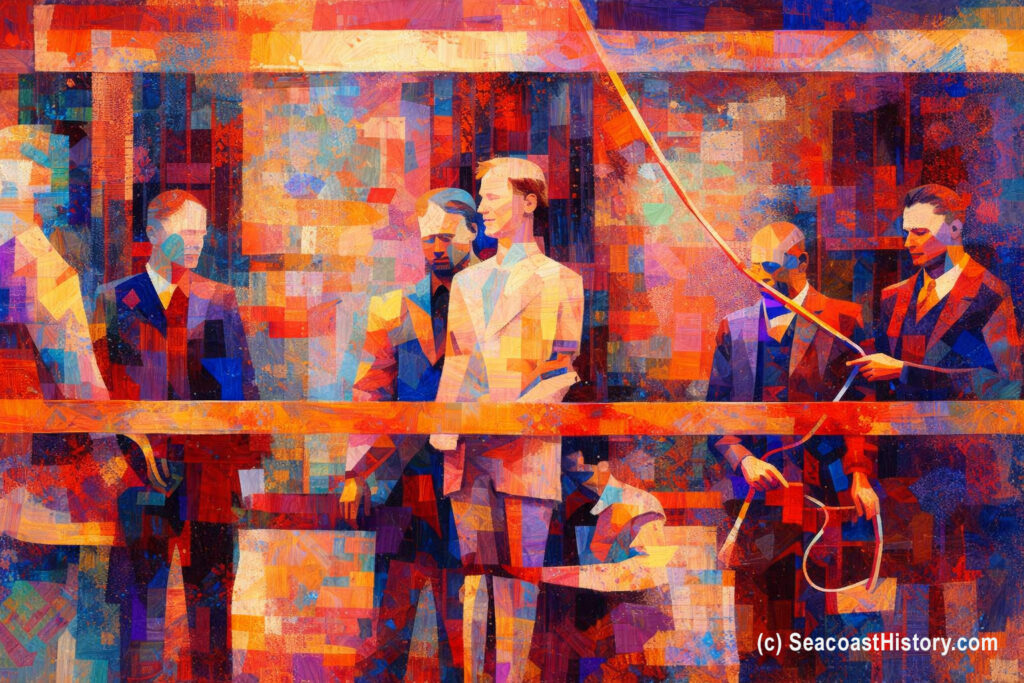
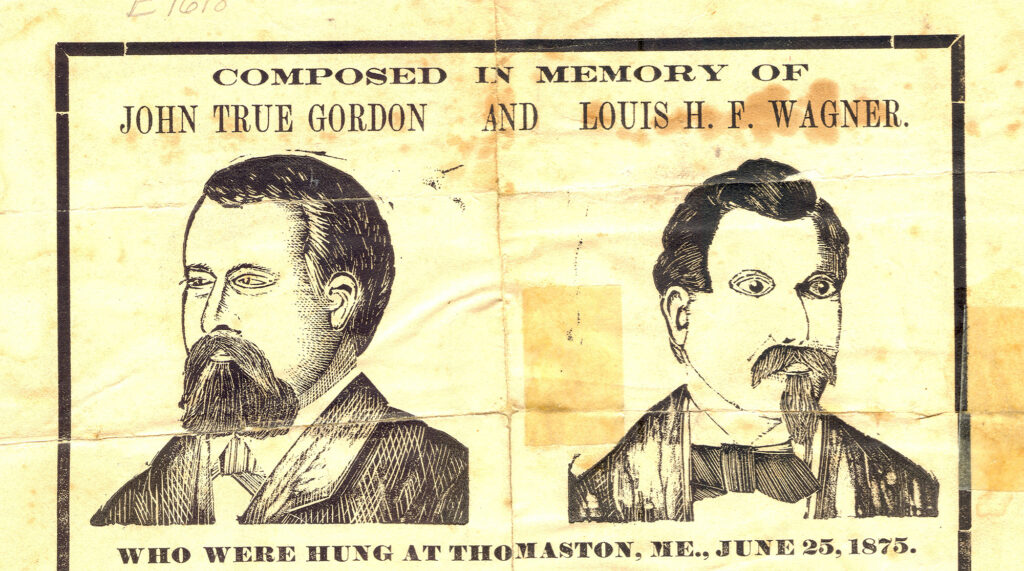
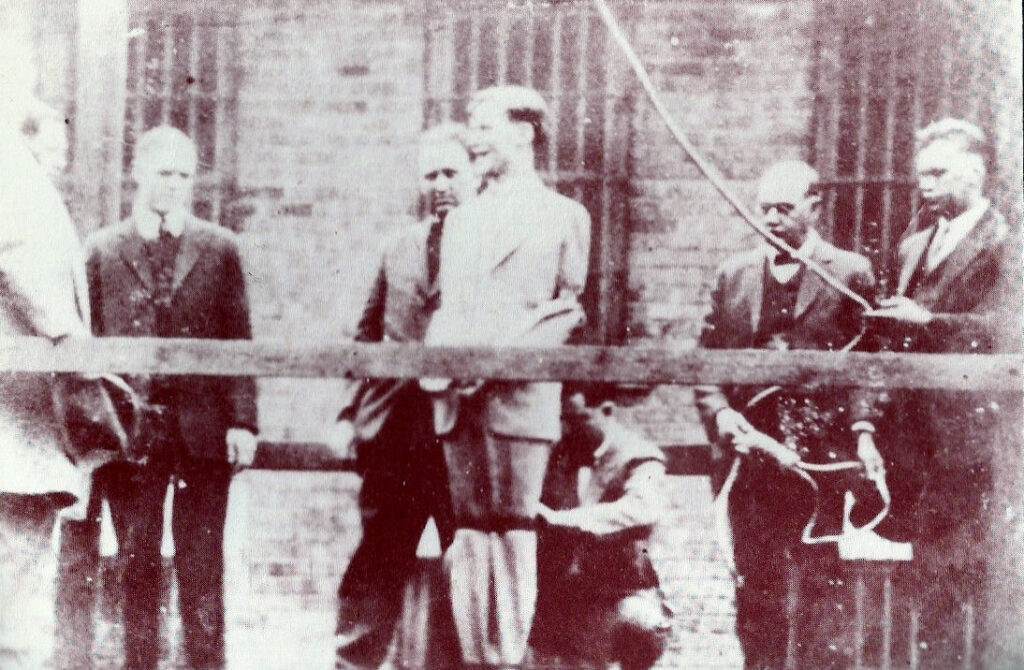
No condemned men would be hanged at Thomaston State Prison until 1875 when Louis Wagner and John True Gordon, two convicted ax murderers, mounted the wooden stairs of the scaffold. Wagner, the infamous Smuttynose Island killer, proclaimed his innocence to the end. Gordon, already half dead from a self-inflicted wound, had to be carried the last few steps and positioned over the trap door by four men.
The scene that followed came very close to ending capital punishment in Maine forever, but Wagner and Gordon were not the last men hanged in Maine as many still believe. A ban on executions was issued the following year in 1876. It lasted until 1883 when Raffaelle Capone and Carmen Santore, two Italian railroad workers, were convicted of robbing and shooting a co-worker. Capone and Santore were hanged from the scaffold in the Thomaston quarry on a fair, but chilly, April day in 1885.
Santore went to his death “head high,” the Boston Daily Globe reported. “Me no ‘fraid. Ready to die,” Santore announced. Capone, however, insisted that the building of the scaffold and the entire hanging ceremony was being staged in order to frighten him into confessing. He was certain, he said, he would not really be hanged.
Upon reaching “the drop,” the same trapdoor where all the others had stood, both men broke down. Capone and Santore repented their sins and forgave all their enemies, without exception. The sheriff tapped the spring with his foot and after eight minutes neither exhibited a perceptible pulse.
That same year a 37-year old escaped convict named David Wilkerson and two other men broke into a store in Bath, Maine. During their escape, Wilkerson shot a police officer in the head with his .32-caliber revolver. Things did not go smoothly with David Wilkerson in November. Due to a poorly tied noose, he strangled in a slow twisting agony.
Many of the men executed at Thomaston were “outsiders” and not representative of the general population. Some were recent immigrants and one was black. Two years Santore, Capone, and Wilkerson “Climbed the golden stairs,” Maine re-established its ban on capital punishment by a wide margin. Since 1887 there have been half a dozen attempts to restore the death penalty in Maine, but the lessons of history have been well learned. To date, 18 states have abolished capital punishment, while the debate in New Hampshire and elsewhere rages on.
Copyright © 2014 by J. Dennis Robinson, all rights reserved.
 My Life as a Cartoon