


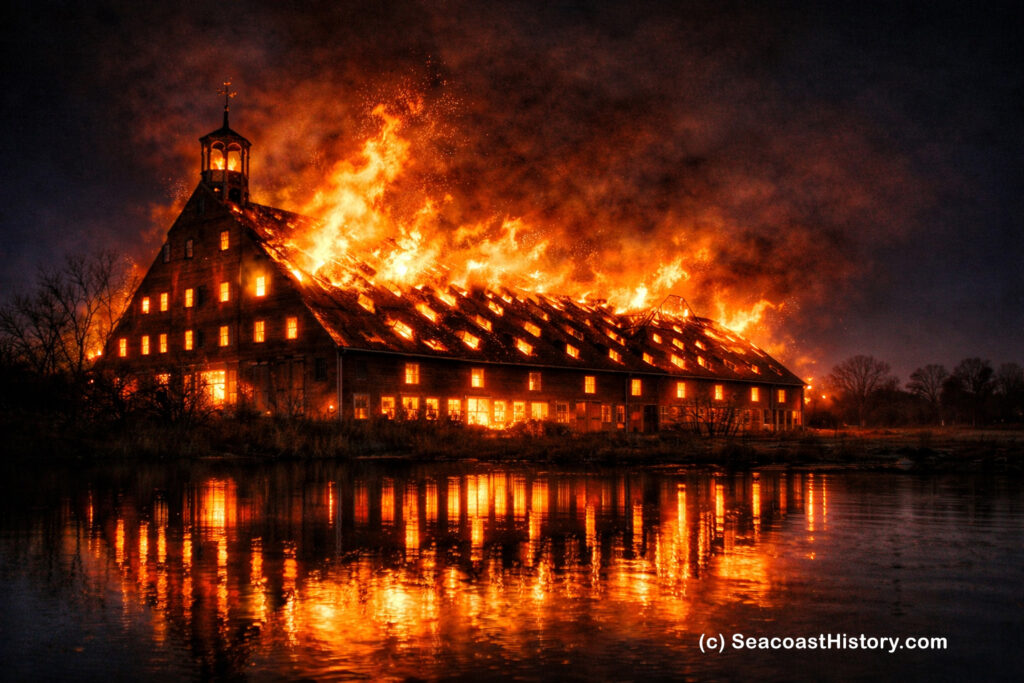
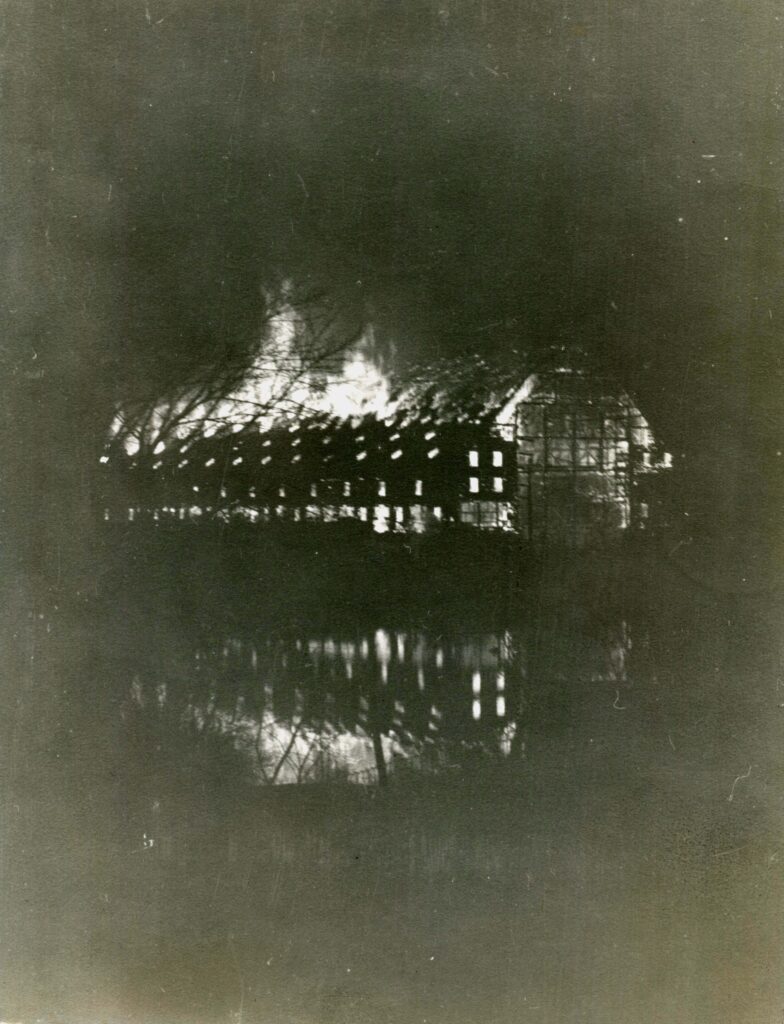
The Franklin Shiphouse at Portsmouth Naval Shipyard went up in a mighty orgy of flame and smoke on March 10, 1936. A local man, then a boy of 10, recalled the fiery scene as the most awesome event of its kind that he had ever seen. He watched the destructive flames from the safety of Pierce Island in a chilly dawn.
The Largest Shiphouse Fire Ever
March 10, 1936
Portsmouth Naval Shipyard, Kittery, Maine
By Raymond Brighton
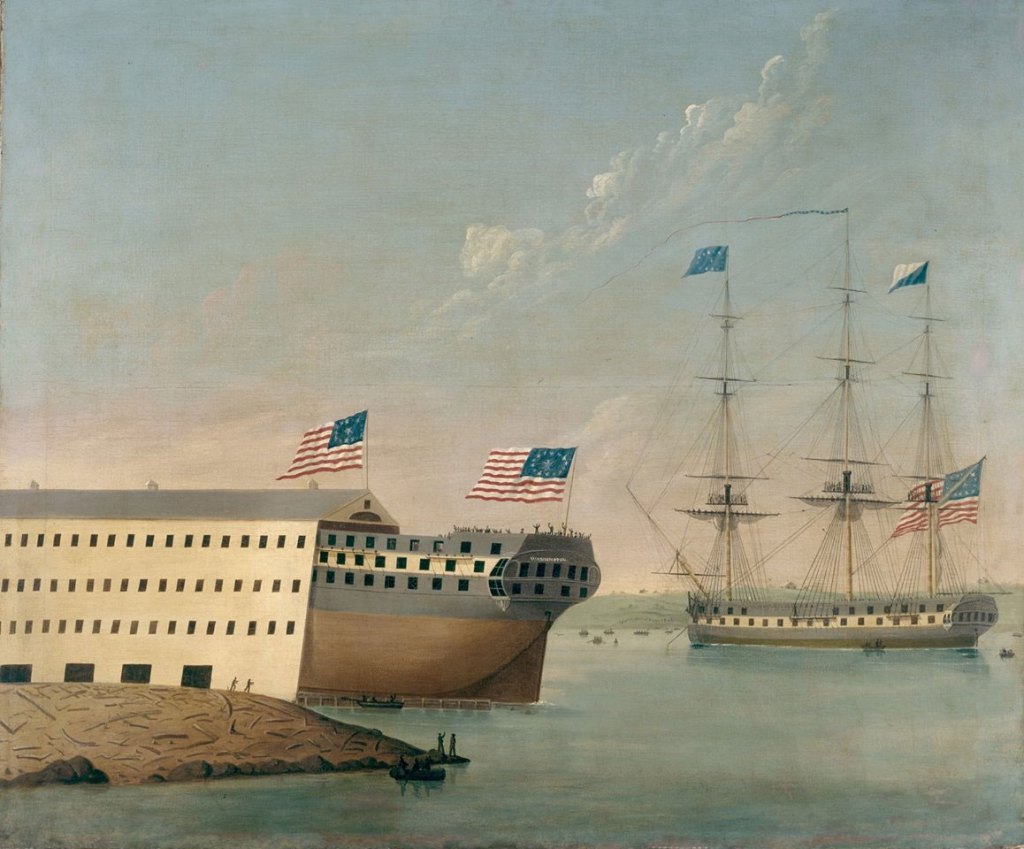
What was the Franklin Shiphouse? In its heyday, it was the most imposing structure on the old Portsmouth Navy Yard, one of what were once three such buildings, almost alike. Under its skylighted roof, many of the Navy Yard’s most historic events took place. As is the way of the Navy, the Franklin Shiphouse was long in coming into being. Shipbuilders on the Piscataqua had known for generations that the construction of vessels in the winter months was hard labor, and often unproductive when wind-driven snow, sleet and extreme cold prevailed. The private yards suffered too, but they didn’t have federal money with which to shelter their projects.

There was long talk about building such a gigantic structure as the shiphouse, but it wasn’t until 1820 that the concept began to take shape. But it was many years before it was completed. An item in The Portsmouth Journal of August 19, 1837, reports:
“The old frigate Congress, now condemned, was built at the Portsmouth Navy Yard about 38 years ago. Her place is to be supplied by another frigate of the same name, the keel of which was laid in the new house at the Navy Yard in this harbor, on Wednesday last, under the supervision of Capt. Thomas W. Wyman. The length of the keel is about 160 feet. The new Ship-house in which she is to be built, was completed a month or two since, and is one of the best to be found in the Union. It is 250 feet long, 130 feet base, and its roof is covered with about 150 tons of slate. . .”
Detailed specifications of some of the materials that were to go into the finishing construction of the shiphouse filled a column in a July, 1836, issue of the Journal. When they were all in place, the Franklin Shiphouse — at first unnamed — began a century of service. In 1854, the shiphouse was lengthened so that the keel of the Franklin could be laid in it. The Franklin was the biggest wooden warship built at the yard, but it was on the ways for ten years. And that long gestation period gave the shiphouse its name.
Blimps, Subs and Tall Ships
A full recital of all that went on under the roof of the old Franklin Shiphouse is impossible in this space. However, it was here in 1915 that the most significant keel-laying in the yard’s history took place. On February 24th, naval officials drove the first rivet in the keel of the submarine L-8, the first submarine built in a government shipyard. The L-8 was the first of about 130 submarines built at the Portsmouth Navy Yard, and dozens of others have been repaired or rebuilt there.
For one local man, she was the first submarine on which he worked. That was in 1921 when the L-8 came in for repairs. The late Wilfred L. Gillespie finished his yard career by working on the USS Albacore, now turned into a maritime museum in Portsmouth. Before the L-8, many vessels of all shapes and sizes were fabricated under the Franklin Shiphouse roof. Among these was the Boxer, the last sailing vessel built at the Navy Yard.
An off-beat event took place in the shiphouse while the L-8 was still on the ways. The Navy Yard built a balloon for the Imperial German Navy. Still another unique occurrence came in the 1840s when the largest temperance rally ever held in the Piscataqua Valley took place in the building. The temperance movement was then in full spate, and on hand to assail ‘Demon Rum” with great vigor was Elder Joseph Davis.
The Franklin Shiphouse had a narrow escape from destruction in the 1890s during an economy wave in government. The other two shiphouses, Alabama and Santee, were razed, but the Franklin was saved. One of the features of the old building were galleries high on its walls where spectators could watch launchings and the like. It was in the north gallery, then used for storage, that the fire started at 5:30 a.m. Within an hour, a century of service to the Navy had gone up in smoke – but it was a massive exit worthy of a massive building.
Edited by SeacoastNH.com from “Rambles About Portsmouth” by Ray Brighton, Portsmouth Marine Society Press, Peter Randall Publisher, 1994. Used by permission of the publisher. First appeared online here in 1998.
 NH Indie Authors Go Print-on-Demand