


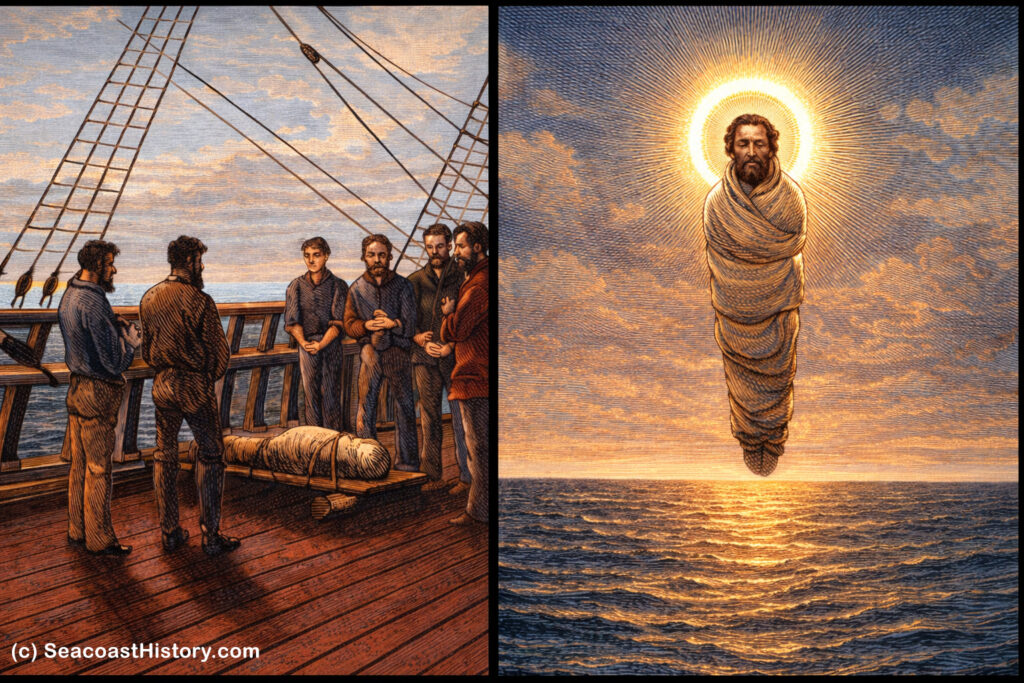
(Computer-aided illustration from SeacoastHistory.com)
SEACOAST POETRY
Jack Ringbolt was buried at sea, but that wasn’t the end of him. In this incredible poem by a handicapped author, Jack rises again. It is part horror story, part religious rapture. It is also one of the most interesting maritime ballads written locally until the arrival of Portsmouth laureate John Perrault.
We found this Seacoast ballad among rarely read poems in a local archive. Author James Kennard, Jr (1815-1847) died young of what may have been rheumatoid arthritis which struck at age 16 and tortured him for the second half of his life. Despite the pain and, eventually, the loss of the use of all his limbs, his vision and his hearing — he wrote on.
“The Ballad of Jack Ringbolt” appears to be a wholly original story by Kennard, whose father was a whaling captain and ship’s agent from Portsmouth.
Although he had no formal education beyond Portsmouth High School, Kennard’s seagoing ghost story is well written. He captures the feeling of the ocean, the horror of the floating corpse, and shows a facile use of seafaring jargon.
As far as we know, the poem has been published only three times — originally in the literary magazine “Knickerbocker” in December 1846, in Kennard’s posthumous biography and collected works printed privately after his death, and in the 1865 anthology Poets of Portsmouth. The ballad is arranged in three parts (1) the history and death of Jack Ringbolt; (2) The burial at sea in Portsmouth Harbor and return; and (3) the final burial 1,000 miles away. The goal here is to bring a wider readership to this powerful contribution to the small canon of New Hampshire seacoast literature. — JDR
—————-
THE BALLAD OF JACK RINGBOLT
By James Kennard, Jr. (1846)
JACK RINGBOLT lay at the Seaman’s Home,
And sorely afraid was he,
Lest he should end upon the land
A life spent on the sea.
He was born upon the ocean,
And with her dying groan
His mother gave him being,
Then left him all alone, —
Alone upon the desert sea,
With not a female hand
To nourish him and cherish him,
Like infants on the land!
The storm-king held a festival
Upon the deep that night;
His voice was thundering overhead,
His eye was flashing bright:
The billows tossed their caps aloft,
And shouted in their glee;
But, 0, it was for mortal men
An awful night to see!
Among the shrouds and spars aloft
A host of fiends were shrieking;
And the pump-brake’s dismal clank on deck
Told that the ship was leaking.
The ship was lying to the wind,
Her helm was lashed a-lee;
And at every mighty roller,
She was boarded by a sea.
The doom-struck vessel trembled,
As the waves swept o’er her deck
She rolled among the billows,
An unmanageable wreck.
To their boats they took for safety,
The captain and his men,
And the helpless new-born infant
Was not forgotten then.
A rough, hard-featured countenance
The storm-tossed captain wore;
But his heart for tender innocence
With love was flowing o’er.
He shall not perish here alone,
Upon the ocean wild !
But only God can nourish him,
The motherless young child!
But all in vain his kindness,
Had they not at break of day —
Glad sight ! — beheld before them
A vessel on her way.
They were rescued, and on board of her,
As the passengers drew round,
In woman’s arms the orphan boy
The needed succour found.
He lived; but to his inmost soul
His birth-night gave its tone;
The spirits of the stormy deep
Had marked him for their own.
He lived and grew to manhood
Amid the ocean’s roar;
His heaven was on the surging sea,
His hell was on the shore !
He joyed amid the tempest,
When spars and sails were riven;
And when the din of battle drowned
The artillery of heaven.
He often breathed a homely prayer,
That, when life’s cruise was o’er,
His battered hulk might sink
A thousand miles from shore.
And now, to lie up high and dry,
A wreck upon the sand !
To leave his weary bones at last
Upon the hated land !
The thought was worse than death to him,
It shook his noble soul;
Strange sight ! adown his hollow cheek
A tear was seen to roll.
“Could I but float my bark once more,
‘T would be a joy to me
Amid the howling tempest
To sink into the sea !”
Then, turning to the window,
He gazed into the sky;
The scud was flying overhead,
The gale was piping high:
And in the fitful pauses
Was heard old Ocean’s roar,
As in vain his marshalled forces
Rushed foaming on the shore.
Look now ! his cheek is flushing,
And a light is in his eye;
Throw up the window ! let me hear
That voice before I die !
“They’re hailing me, crested waves,
A brave and countless band,
As rank on rank, to rescue me,
They leap upon the land !
“T is all in vain, bold comrades !
And yet, and yet so near !
Ye are but one short league away, —
Must I — die — here ?
“No ! the ship that brought me hither
Is at the pier-head lying,
And ere to-morrow night she’ll be
Before a norther flying.
“Now bless ye, brother sailors !
If ye grant my wish,” he cried;
But curse ye, if —- He spake no more,
Fell back, and gasped, and died.
PART SECOND
THEY sewed him in his hammock
With a forty-two pound shot
Beneath his feet, to sink him
Into some ocean grot.
Adown the swift Piscataqua
They rowed with muflled oar,
And out upon the ocean,
A league away from shore.
“T was at the hour of twilight,
On a chill November day,
When on their gloomy errand
They held their dreary way.
The burial service over,
He was launched into the wave;
Now rest in peace, JACK RINGBOLT !
Thou hast found an ocean grave.
Down went the corpse into the sea,
As though it were of lead;
But it sank not twenty fathoms,
Ere it touched the ocean’s bed.
Then up it shot and floated,
Half-length above the tide;
A lurid flame played round the head,
The canvass open wide.
No motion of the livid lips
Or ghastly face was seen;
But a hollow voice thrilled thro’ their ears,
“Quarter less nineteen !”
Then eastward sped the awful dead,
While o’er the darkened sea
Upon the billows rose and fell
The corpse-light fitfully.
They gazed in fearful wonderment,
Their hearts with horror rife;
Then, panic-stricken, seized their oars,
And rowed as if for life.
Their eyes were fixed with stony stare
Upon the spectral light;
They rowed like corpses galvanized, —
So silent and so white.
They darted by The Sisters
They went rushing past “Whale’s Back”
With tireless arms they forced the boat
Along her foamy track:
But not a single face was flushed,
Not one long breath they drew,
Until Fort Constitution
Hid the ocean from their view.
PART THIRD
‘T WAS midnight on rnid-ocean,
The winds forgot to blow;
The clouds hung pitchy black above,
The sea rolled black below;
On the quarter-deck of the Glendoveer
The mate paced to and fro.
There was no sound upon the deep
To wake the slumbering gales,
But the creaking of the swaying masts,
And the flapping of the sails,
As the vessel climbed the ocean-hills
Or sank into the vales.
The mate looked over the starboard rail,
And saw a light abeam;
The lantern of a ship, mayhap,
A faint and flickering gleam:
Was it bearing down on the Glendoveer,
Or did the mate but dream?
A phantorn-ship on a breezeless night
To sail ten knots an hour!
Now on the beam, now quartering,
Now close astern it bore:
All silent as the dead it moved,
A light -and nothing, more !
No creaking block, no rumbling rope,
Was heard, nor shivering sail;
But, luffing on the larboard beam,
A voice was heard to hail,
That made the hearts of the Glendoveers
Within their bosoms quail.
It broke upon the still night-air,
A hoarse, sepulchral sound:
“What ship is that? ” A moment,
And the mate his breath has found:
“The Glendoveer, of Portsmouth,
From Cadiz, homeward bound !”
A livid glare, a ghastly face,
A voice, — and all was o’er;
“Report JACK RING’BOLT, sunk at sea,
A thousand miles from shore !”
Silence and darkness on the deep
Resumed their sway once more.
From: Memoir and Writing of James Kennard, Jr. , Printed for Private Circulation, Boston: William D. Ticknor & Company, 1849.
 The Day the Shipyard Burned