


Evening, March 6, 1873
Smuttynose Island was dead quiet. The bodies of the two murdered women had been lying half-clothed on the icy floor of the empty house for upwards of 17 hours. The killer had fled long ago and was still at large. Maren Hontvet, the surviving victim, had been rescued early that morning by a dory fisherman from a neighboring island at the rocky Isles of Shoals off the New England coast. Fragments of her horrific story had by now drifted back to the mainland and leaked into the late edition of the local newspaper, transforming the peaceful citizens of Portsmouth, New Hampshire into a frenzied, vengeful mob.
“The men who come from the Shoals are so excited that it is impossible to get many particulars from them,” the Portsmouth Daily Evening Times reported, “and this news reached us just as we go to press.”
So the first printed report was understandably flawed. The first victim was Karen Christensen, a Norwegian immigrant, not “Cornelia” as the newspaper called her. The second victim was her sister-in-law Anethe Christensen, whom the report listed as “Anetta Lawson.” The killer did not get away with “a large sum of money,” as reported, but stole a mere $16.
“They were killed with an axe by some person as yet unknown,” the Evening Times continued, “although the people who live there have no doubt in regard to his identity…. The suspected man is a Mr. Lewis Wagner. He is said to be a desperate character.”
It was early Thursday evening by the time the Portsmouth newsboys began shouting the headline “TERRIBLE TRAGEDY AT THE ISLES OF SHOALS.” Demand for the news was so great that copies quickly ran out.
Directly across the deep, swirling Piscataqua River, at the Portsmouth Naval Shipyard, a solemn group was filing onto a steam-powered tugboat to visit the murder scene. Despite its name, the historic Portsmouth Yard, founded in 1800, is located in Kittery, Maine. The Piscataqua, one of the fastest flowing rivers in the nation, divides New Hampshire from Maine. That invisible border extends three miles to the mouth of the river and another seven miles out to sea, where it splits the nine tiny Isles of Shoals.
It was 6:45 pm by the time the coroner’s jury got their grim mission underway. A team of at least 15 doctors, reporters, law enforcement officers, and observers settled in for an hour-long ride inside the large heated cab of the USS Mayflower. The iron-hulled tug, designed during the recent Civil War, pulled slowly away from the dock and into frigid waters. The trailing cloud of soot was all but invisible against the black sky and the black water. The 137-foot tug appeared in silhouette as it passed Whaleback Lighthouse in the center of the Piscataqua, and again as it chugged past Portsmouth Harbor Light. Then it faded to a spec of gaslight against the open ocean.
Aboard the USS Mayflower reporters representing six or seven newspapers, mostly from nearby Boston, clustered around one man. The Evening Times had mistakenly called him “Mr. Huntress,” but his name was John C. Hontvet. He was the captain of the fishing schooner Clara Bella. He was the man who rented the only occupied house on Smuttynose Island from the Laighton family, the people who owned the big tourist hotel at the Isles of Shoals. It was John Hontvet’s wife Maren who had survived the deadly attack and who had named Louis Wagner as the killer. And it was John, his brother Matthew, and his brother-in-law Evan who had first seen the bodies of the slaughtered women this very morning when they arrived home on Smuttynose Island from a fishing trip.
The coroner’s team was on a mission to gather the facts and uncover the truth. The Mayflower followed the route that the suspected killer had taken the night before as he rowed mightily in the dim moonlight toward the few flickering lights at the Isles of Shoals, following the invisible border separating New Hampshire from Maine. The steam-engine slowed to a crawl as the tug rounded Appledore Island, home of the famous poet Celia Laighton Thaxter and her family’s summer resort. The old hotel was dark, but there were lights visible in the poet’s cottage. A few lamps also glimmered on Star Island, to the right on the New Hampshire side of the cluster of flat islands, little more than rocks sticking out of the sea. The flame at the top of the lighthouse tower on White Island helped define Smuttynose Island, a gray shape floating like a drowned giant in the blackness.

The captain of the Mayflower, a man named Baker, settled his boat in the tight natural harbor at the center of the island cluster. The crew secured a mooring, lowered the tug’s wooden lifeboats, and the captain cut the engine. To the visitors familiar with the constant clanks, hisses, and squeals of Victorian city life, the silence of the Shoals must have been stunning. After a momentary sense of deafness, the human ear quickly tunes itself to more subtle sounds. The murmur of a gull, the distant clang of a navigation buoy, and the subtle slapping of water against the hull of the ship rush in to fill the emptiness. One feels, in the silence of the islands, that it is possible to hear everything for miles in all directions.
It was now 8 pm and, with the exception of the quarter moon and the tugboat lamps, it was fully dark. One by one the city reporters and members of the coroner’s jury climbed awkwardly over the railing of the sturdy tug and down into the boats that bobbed in the waves below. It was only a short pull of the oars from the mooring to the tiny sheltered cove, less than two hundred yards, yet one group of nervous reporters almost capsized their launch, filling the boat halfway to the gunwales with icy ocean water.
In the silence, the wooden boats screeched as the landing party hauled them across pebbles, fish bones, and broken seashells in the sandy cove. The men secured the boats against the dark stone pier slick with cold seaweed. No light shone from any of the dark ramshackle buildings that encircled the cove. There was nothing here, at first, but a billion flickering stars and the stench of rotting fish.
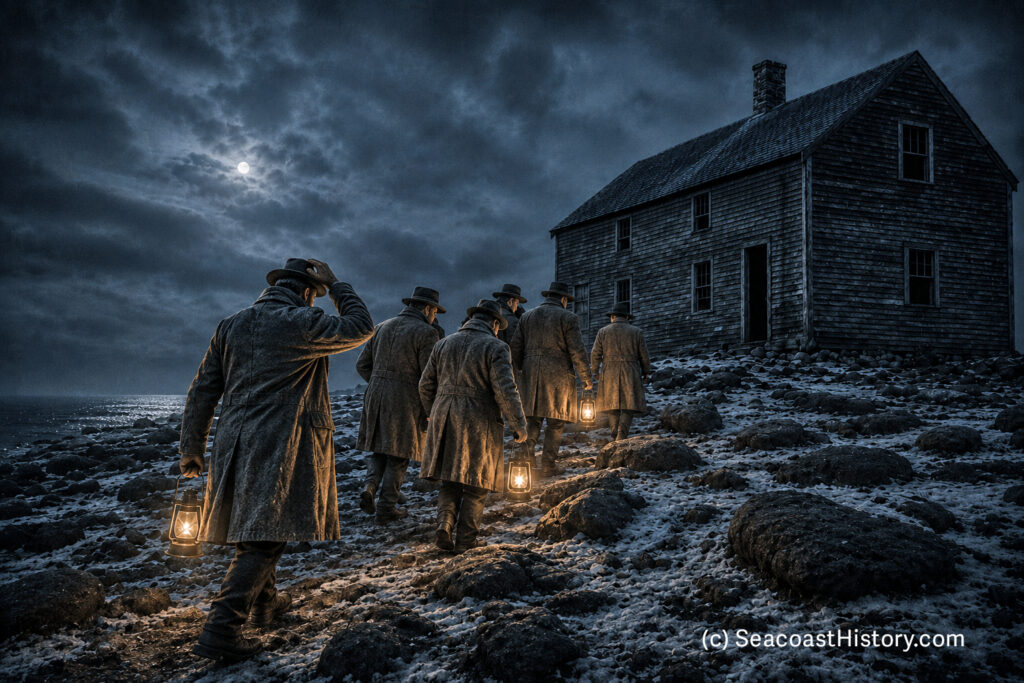
Thrusting their glaring lanterns at arm’s length, the coroner’s team followed John Hontvet up the low incline towards a stark, scarlet-colored building. Shoalers called it “the red house,” but at night the two-story duplex was as black as the other shadowy structures on the island. The snow was flattened all around by the footprints of those who had first visited the horrific scene earlier that day.
An ax, a key piece of evidence, still lay in the snow by the front of the house, its handle broken and the blade thick with frozen gore. What had been gruesome by daylight had grown fearsome by night. A large flat rock not far from the corner of the house was coated with dark blood. A long streak of blood trailed from the rock to a door marked with a stained handprint.
Mr. Hontvet ushered the first of the observers through the narrow doorway on the right side of the duplex, through a cramped entranceway hung with coats, and into the kitchen, lit now only by their sputtering lamps. Anethe Christensen’s half-frozen body still lay face upwards in the center of the kitchen floor, her head toward the door. Someone had partially covered her naked form with a stray garment.
The doctors among the team placed the bludgeoned corpse of the once-beautiful 25-year old Norwegian immigrant onto a wooden plank and lifted it onto the kitchen table for a hasty medical examination. They had to clear aside the blood-stained dishes where the killer had apparently eaten a meal of tea and cake before making his escape back to the sea. Anethe’s face was savaged beyond recognition, her skull crushed by a powerful blow.
“The head was, as you might say, all battered to pieces,” a member of the coroner’s team later testified in court. Anethe’s body, the witness said, was “covered with wounds, and in the vicinity of the right ear, two or three cuts broke through the skull so that the brains could be seen running through them.”
As the doctors worked and the reporters scribbled in their notepads, the policemen searched the ransacked rooms by lamplight. The floors creaked loudly as they walked. In the other half of the duplex, the officers found Karen Christensen. Her body was partially naked and thrust under a bed. A scarf was clenched so tightly around the woman’s neck that her tongue protruded and her eyes bulged.
It was after 2 a.m. Friday morning before the coroner’s men reassembled aboard the USS Mayflower for the return to Portsmouth Harbor. It was breaking dawn before the Boston and New York reporters could telegraph the gory details to their editors. By Friday afternoon, readers up and down the Atlantic coast knew all about the bloody ax with the broken handle, the smashed furniture, the mangled bodies, and Maren Hontvet’s miraculous escape from the grim reaper’s blade. They were amazed by the news that a clock, apparently smashed during the island attack, had stopped precisely at six minutes before 1 a.m.
By Friday morning, the narrow streets of the old seaport were thick with hundreds, eventually thousands of shocked and angry citizens. The alleged killer, according to rumor, had already been captured in Boston and was en route by train back to Portsmouth under police custody. An immense and angry crowd armed with bricks and bats gathered at the city’s Eastern railroad depot. The mob was ready to waylay Louis Wagner, a fisherman and former employee of John Hontvet, as soon as the prisoner arrived. They chanted, “Lynch him! Kill him! String him up!”
But back on Smuttynose Island it was a calm and peaceful day with spring not far away. Except for the distant tapping of carpenters who were building a grand new tourist hotel on Star Island, there was only the familiar cry of gulls and the muffled splash of waves against the rocks. Anethe and Karen Christensen still lay inside the empty house where the coroner’s team had left them. They would lie there another full day, cold and silent, until the undertakers arrived from Portsmouth with their coffins.
© J. Dennis Robinson, all rights reserved.
 The Devil and Jonathan Moulton