


NOTE: The year is 1975. I’m out of college, but my freelance career is refusing to launch. I accept a job as manager and only employee of a country store in Hopedale, Massachusetts. Write what you know, they say. Here, with a little editing, is one of my first paid freelance jobs. It appeared in Good Old Days magazine with an illustration by a real artist.
Everyone tells me about the good old days, which, through no fault of my own, I missed. I’ve heard about them as long as I can remember, stories about the times when a dollar was a dollar, when a man knew what he stood for, when the work was hard, and the women were hard to get. I could recite a hundred of my grandfather’s anecdotes.
College was no escape from this ancient era. My dormitory friends who were studying computer technology by day went looking for an old farmhouse to rent. They wanted to bake homemade bread, make their own soap, and grow vegetables. The girls took to wearing long dresses, and the boys sported handlebar mustaches. We spent the weekends searching flea markets for dated items. One housemate bought a goat and chickens, then a Model T. I began to feel guilty for being born in the latter half of the twentieth century. We were all headed back to nature and the Foxfire books were our Bibles.
After college I knocked about for a few years, traveling and trying my hand at writing. Eventually, I needed money. The nostalgia craze was in full bloom when my aunt and Uncle purchased a news agency in a small Massachusetts town called Hopedale. (Even the name is wishful.) They asked me to manage it. I agreed. Then I saw the little store. The squat, ramshackle building hadn’t seen a coat of paint in fifty years. My uncle, however, was overjoyed with his new toy:
“We’re going to do the whole thing over,” he said, waving his arm as if it contained a magic wand. “We’ll sand down the floors, replace the ceiling, rip down the inside walls. When we’re finished, it will look like the turn-of-the-century country store it once was.”
I couldn’t escape the good old days.
Months later, I admit, the place is a faithful reconstruction. We did everything “right,” which means we did things as grandpa would have done them a century ago. We found a massive nickel-plated cash register that fits the motif. No convenient electric checkout here. Pressing the heavy metal keys is like exercise. It tends to get stuck like an old typewriter, the money drawer jams, and it can give quite a wallop in the gut if you don’t watch out. But it looks vintage, and that’s what matters, right?
Even though the one-room store is tiny, Uncle wants to carry every item a customer might need. We built storage cabinets below the ceiling. These are reached by climbing a ladder that swooshes along a metal runner. It is never on the side of the room you want it to be. When I run out of something, like Dr. Grabow pipe filters (which cost 15 cents), I grab the ladder and, excusing myself to any shoppers, glide the ladder around the room. Of course, by then, the customer has changed his mind. There is, I should mention, only one elderly customer in town who buys Dr. Grabow pipe filters. But Uncle doesn’t want to disappoint a soul. And I’m the first to admit that the ladder looks nicely old-fashioned.
We found a local dairy farm and a soda bottling company that offer returnable glass bottles, a rarity these days, but a customer favorite. When anyone buys a quart of milk or a sarsaparilla to take home, I charge an extra nickel. When the bottle comes back, I store it in a wooden case and refund the nickel. Cases of empties are stacked in the tiny back area. The distributor counts the bottles and credits us a nickel for each, then charges the nickel all over again for the latest delivery. But shoppers claim our soda is the coldest in town and the milk lasts longer than any brand in the supermarkets, which is, about a block away from our vintage front door.
It was a happy day when my aunt located the old cast-iron scale. We use it to weigh out candy up front the way we weigh the grass seed and rabbit pellets on the tin scale at the back.
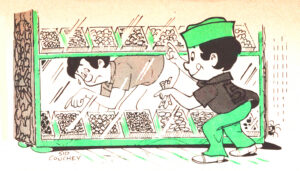
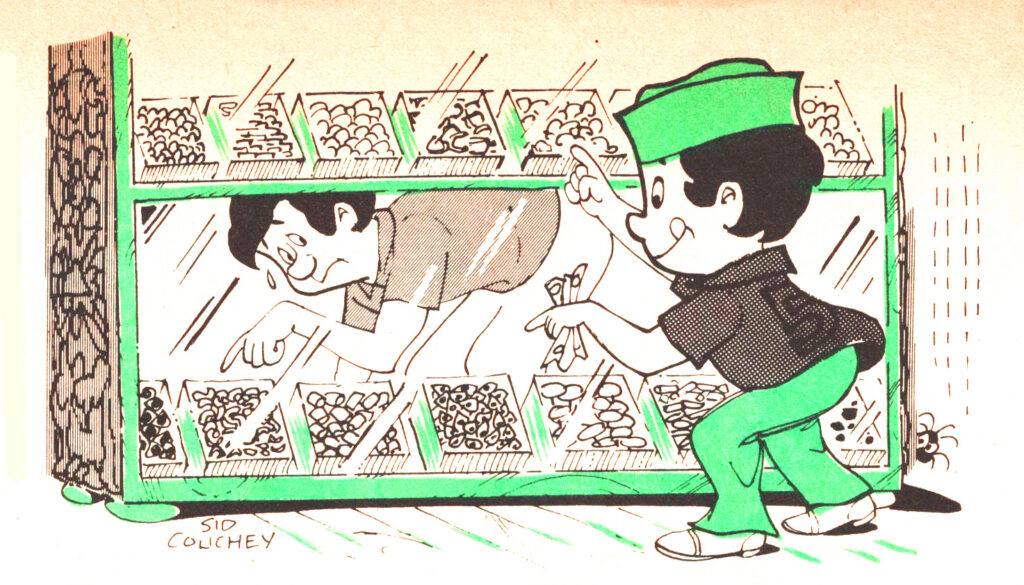
The scale is a beauty. It rests on the penny candy case, a hulking oak monster with carved sides and glass on the top and front. There are mirrors on the back doors, so to the customer, the candy goes on forever. But that case is trying to kill me.
I spend half the morning filling it with candy dots and beer barrels, squirrel nut caramels, bullseyes, shoestring licorice, and penny tootsie rolls (Yes, they still exist.) The rest of the day is spent emptying the contents of the case into the hands and mouths of dozens and dozens of tiny consumers.
The case was excellently designed to give maximum pleasure to the buyer. But, like the rest of the store, it brings the storekeeper only pain. The entire bottom shelf, some six feet long and two feet deep, is filled with one- and two-cent treats. A dollar’s worth of penny candy (not beyond the means of today’s wealthy children) may require dozens of quick deep-knee bends from me. The modern penny candy buyer, for the record, is no more capable of making up his or her mind than were the child’s parents or grandparents.
After ten hours of stretching, bending, sweeping, climbing, and toting supplies across footworn wooden floors, a true sense of the Good Old Days goes home with me. The good remedies, Ben Gay and Epsom Salts, still apply.
I complain, but there is a reward to keeping a few of these traditional stores alive. People seem to appreciate the work that goes into each jar of homemade jam and loaf of locally baked bread. As the word spreads, customers and spectators are coming from further away. Of course we have a pickle barrel, the local paper, and the racing news. The coffee is cheap and the gossip flows. Sometimes Uncle brings his banjo and the world slows down.
© J. Dennis Roinson, 1975. Updated 2026.
 The Coroner’s Team Arrives at the Smuttynose Murder Scene in 1873