


LITERARY LIONS
He was a prolific man in many ways. Portsmouth’s popular ministers sired some of the city’s most influential citizens. His first wife, Mehitable Appleton (1728–1777), bore 11 children, and his wife Margaret Marshall (1747–1806), bore six. He experimented with medicine, preached powerful sermons, made gunpowder in the Revolution and was an amateur chemist. He’s best remembered today for a South Mill Pond park that bears his name.
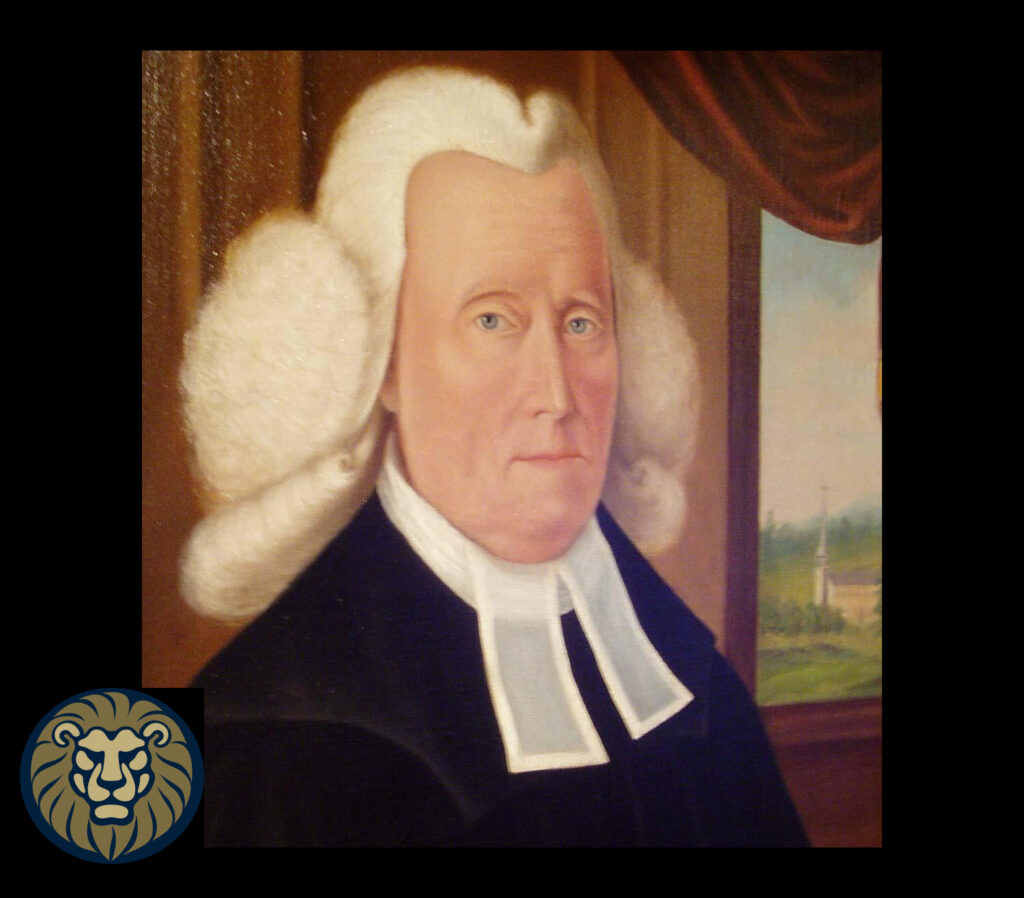
Rev. Samuel Haven
(1727–1806)
South Church minister
The father of 17 Haven children who played such an important part in the city’s post-Revolutionary flowering, Samuel Haven was called to the South Parish pulpit in 1752 where he served the rest of his life. As a teenager in Massachusetts, he heard the English divine George Whitefield preach and, after a few years teaching, the memory of that vital experience drove him to Harvard and the Congregational ministry. In 1757, a dozen of his congregation charged him with heresy for not preaching a Calvinistic predestination; his views were upheld by an ecclesiastical trial and the bulk of his congregation. Those still dissatisfied joined the tradition-minded Rev. Joseph Buckminster at North Church.
While a dozen of his most popular sermons, plus other discourses, lectures, and verse were printed locally, much of his work remains only in manuscript. A classmate’s 1747 diary records his poem titled “The Happy Student,” a moral tale against sporting, drinking and swearing composed in his sophomore year. The Portsmouth Athenaeum preserves more than a dozen of his manuscript sermons, many preached from 1752 to 1797, both “at home” in Portsmouth and from other New England pulpits.
A philanthropist and liberal Unitarian thinker, he was rewarded with an honorary degree from Edinburgh in 1770 – after Samuel Sherburne sought Benjamin Franklin’s help in an effort to repay Haven for the 1767 funeral sermon he preached for his father . He received another honorary degree from Dartmouth in 1773.
Haven ministered to the sick and even practiced with homespun medicine. His familiarity with chemistry led him to experiment with dyes (he showed them to George Washington) and led him to help produce saltpeter for gunpowder for the American troops during the Revolution. When asked what Washington should be called when he visited in 1789, Haven composed these impromptu lines:
Fame spread her wings, and with her trumpet blew,
Great Washington is near! What praise is due?
What title shall he have? She paused and said,
“Not one, his name alone strikes every title dead!”
A beloved figure, Haven was retained at South Church after 1800 even as his health failed. Timothy Alden, Jr. served as his assistant from 1796, but the younger minister’s “New Light” Puritanism ran afoul of the Unitarian beliefs of the South Church and he left to form a new academy. Alden’s later History of Religion in Portsmouth reflects his view of that disagreement.
Copyright J Dennis Robinson, all rights reserved.
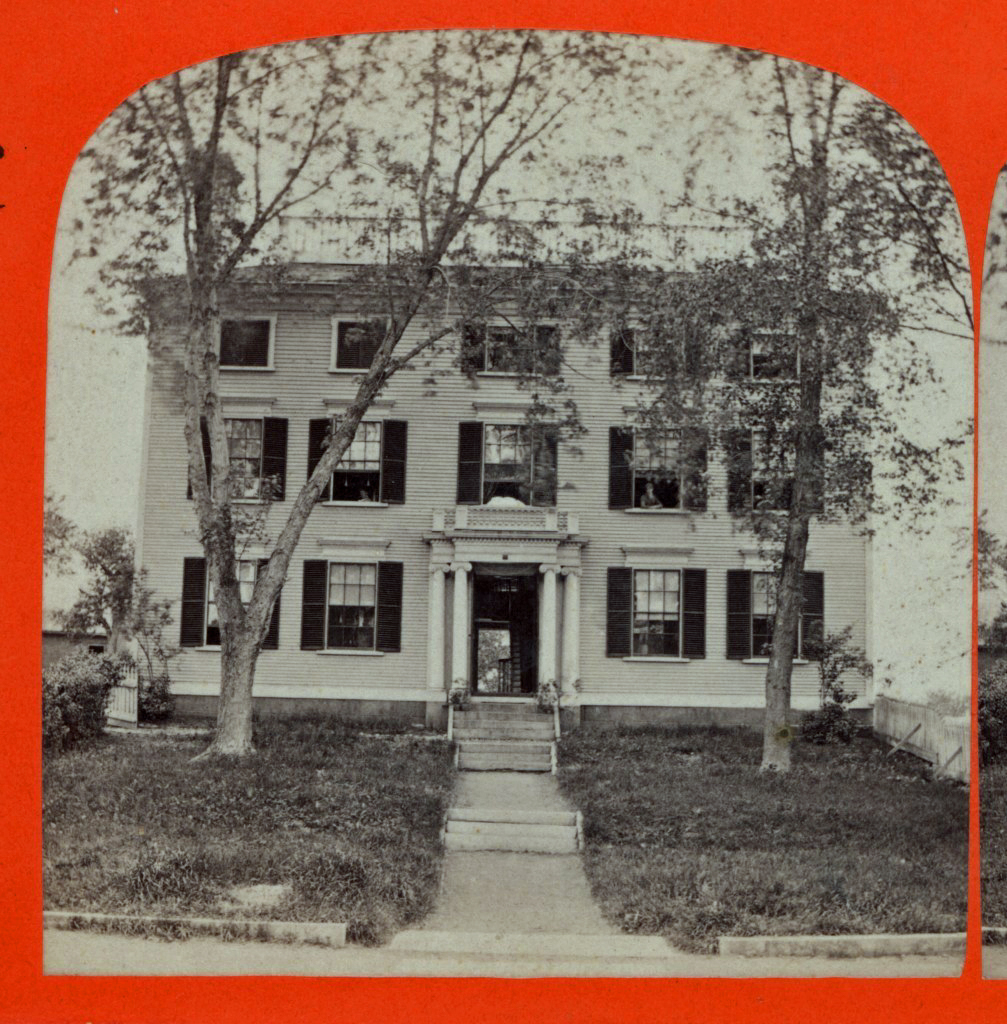
In 1898, the last Haven living in the Pleasant Street mansion died and requested in his will that the family’s stately home be torn down to create a public space. The photo shows the Rev. Samuel Haven’s Pleasant Street mansion.
He lived under three British royal governors and three American presidents. When he passed away in 1806, the city of Portsmouth was at its peak, with long, hard times ahead. Samuel’s grandson, Nathaniel Haven, Jr., ran the local newspaper in the early 1800s and is a pivotal character at the Portsmouth Athenaeum. Granddaughter Charlotte Haven is remembered for her honest report on meeting Joseph Smith, the founder of the Mormon religion. The family list goes on.
house prior to its demolition and the creation of Haven Park. It was a typical square three-story Portsmouth house of the era with shuttered windows, an iron and wooden fence, and a gigantic tree in the front that completely blocked the sidewalk. The man on the bronze horse, Fitz-John Porter, dates to the Civil War and has a fascinating story to tell.
Copyright J Dennis Robinson, all rights reserved.
 Frederick Douglass Comes to Town Twice