



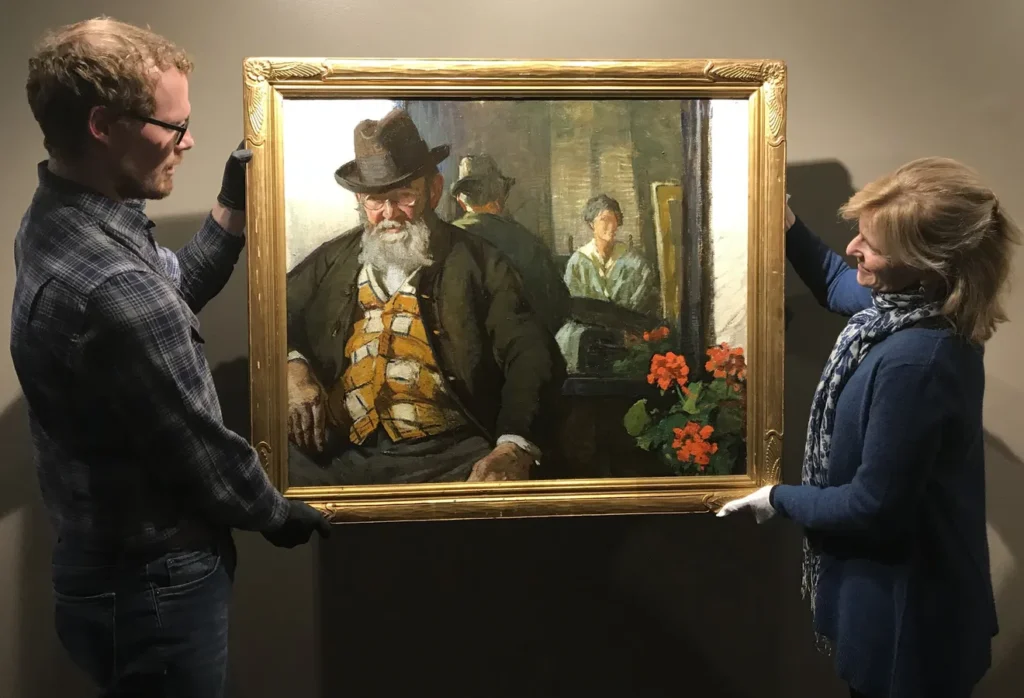
“I was floored!” says Lainey McCartney. “I couldn’t believe what I was looking at.”
That was in 2017. McCartney was staring at a hauntingly beautiful painting titled “Lady in White.” It hung above a mantel at the York Public Library.
“I would have bet my life I was looking at a Tarbell,” McCartney says, referring to the famous Edmund C. Tarbell, a key figure in the Boston School of American Impressionists at the dawn of the 20th century. Tarbell, who summered in New Castle, NH for 30 years, had been the focus of a hugely successful show at Discover Portsmouth the year before. McCartney was a curatorial assistant at the Portsmouth Historical Society that sponsored the Tarbell exhibition.
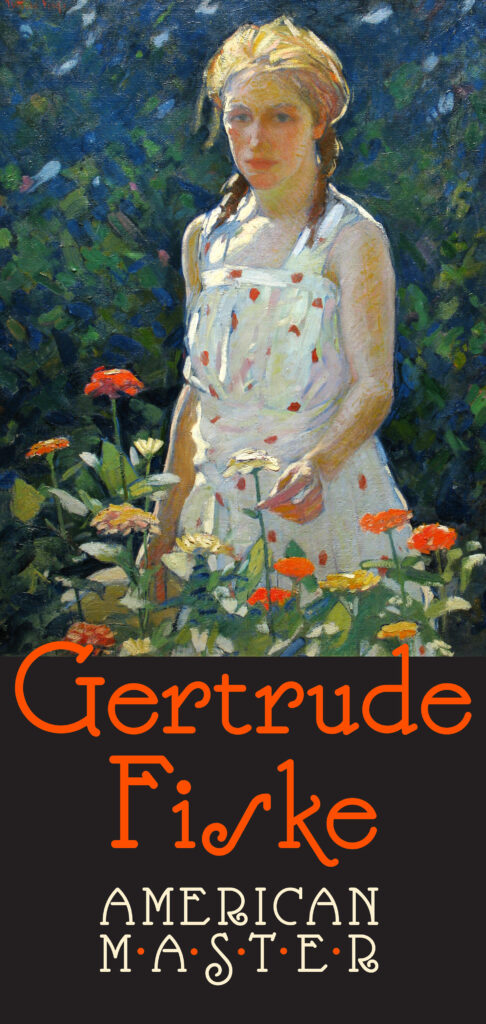
But it was not Tarbell’s work. The artist was Gertrude Fiske, one of four “Pine Hill Girls” featured in the show at York Library. All four accomplished women painters came to Ogunquit, Maine, to study with Charles Woodbury, another influential early-20th-century American painter. Again McCartney was shocked.
“Their work, especially the work of Gertrude Fiske, was so good – and I didn’t know one of their names. I had to know more,” she said.
So McCartney spoke to Richard Candee, a local historian and art collector who helped create many of the Discover Portsmouth exhibitions, including Tarbell. And Candee spoke to Janice Plourde, president of the York Public Library trustees. They agreed there were enough amazing canvases by Fiske to produce an exhibition to rival Tarbell himself.
“I think you should do it,” Candee told McCartney, who hesitated.
“I’d never curated a full show,” she said.
But Adam Brooks, PHS director of exhibitions agreed.
“You totally have this one,” Brooks told her.
By March 2017, the team was fully immersed in the life, legends and works of Gertrude Fiske, with Lainey McCartney in the lead. The curator quickly located an unseen cache of Fiske paintings at the artist’s former studio in Massachusetts. Enthusiastic collectors agreed to loan paintings that were being conserved, crated, and professionally shipped to Portsmouth. The search for financial grants, sponsors, speakers and museum volunteers began. Enormous weatherproof banners soon appeared outside of the familiar brick building. An exhibition catalog was headed to the printer. Feature articles appeared in major publications. Colorful posters and rack cards were distributed at tourist locations from Massachusetts to Maine and a short video was about to be released.
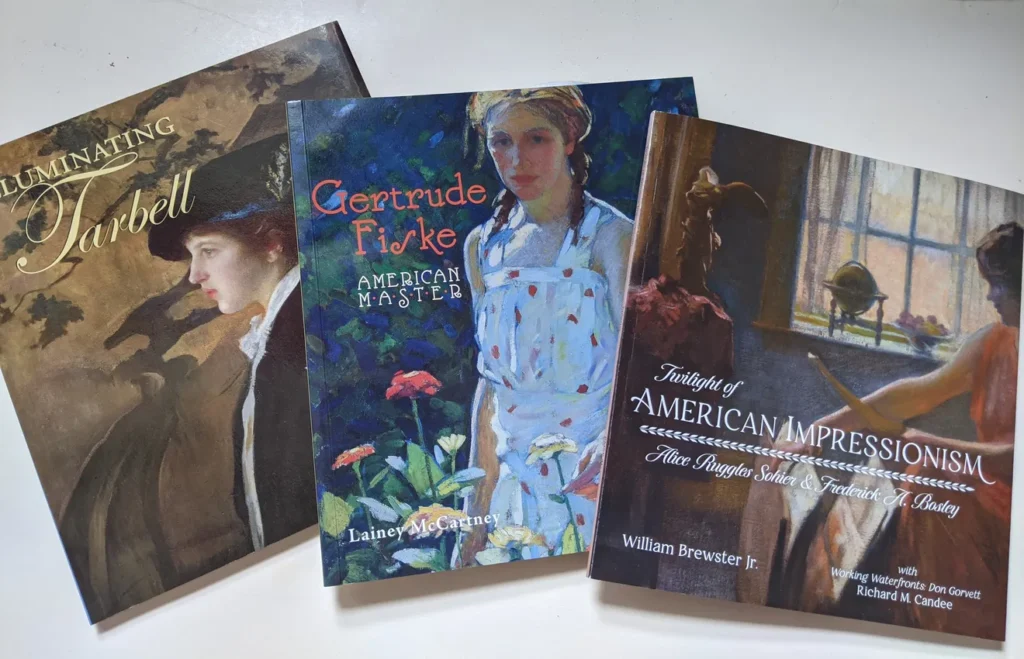
Gertrude who?
The catalog is effusive. It describes Gertrude Fiske as “an artistic virtuoso considered to be one of the most talented and bold painters of her time.” A graduate of the Boston School of fine artists, Fiske joined top American painters who summered in Ogunquit, Maine, and often painted the Portsmouth waterfront and the surrounding seacoast. Her work is considered “daring and riveting” in comparison with the often conservative formulaic output of her contemporaries.
Born into an upper middle-class Boston family in 1879, Fiske had the financial freedom to pursue her painting career. Eschewing marriage, she focused on her art, blending the light-filled, classical, portrait style she had mastered under Edmund C. Tarbell with the freer, inventive, and color-rich landscapes of the Ogunquit school. In her private life, after the tragic deaths of a sister, brother and mother around World War I, Fiske cared for her aging father. But she continued to be a prolific and much-admired painter. Although she won significant critical praise and many awards for her work, by her death in 1961, Fiske’s reputation had faded in the wake of the modern art movements of the 20th century.
Discovering great art
McCartney is on a mission to bring the work of Gertrude Fiske back into the public eye. She brings a passion to her first curated project that runs deep.

“One of my earliest, fondest memories,” she says, “is quietly studying the many volumes in my mother’s Pocket Library of Great Art. I was probably 8.”
“The seed was set,” she continues, “for appreciating different aesthetics, subject matter, color, form, etc. And I can’t remember a time when I did not recognize the fact that women and girls did not get the same air-time, shall we say, as their male counterparts.”
McCartney graduated from Colby-Sawyer College and the University of New Hampshire with degrees in French studies and cultural anthropology. She was a docent at the Currier Museum in Manchester before working with Portsmouth Historical Society curator Gerry Ward.
“My earliest memories showed me that I lived in a man’s world and it always felt incredibly unjust,” she says. “The women around me were brilliant, strong, accomplished and present. Considering this, I’ve always wondered why the men came out ahead. So it’s a fight I’ve been fighting in my own way my whole life. Women’s equality. It’s simple. It’s overdue.”
When Lainey met Gertrude
The fact McCartney mistook Fiske’s “Woman in White” at the York Public Library for the work of Tarbell was a game-changer. Poring through scrapbooks that Fiske left behind in her studio, the curator unearthed a letter from a well-known art expert who praised Fiske’s paintings as equal to any “one-man” show he had ever seen. Her work was often described as “virile,” a term usually reserved for American male artists whose aggressive and highly personalized style distinguished them from their European counterparts. Despite being called “distinct, daring, strong, authentic and visionary” in her day, the Portsmouth exhibition was Fiske’s first in decades.
“My little donation to the greater cause is this Fiske show,” McCartney says. “She was clearly empowered by the time in which she lived. She dared to step out of the bounds of what was expected for women of society. But she did it with talent and dignity and grace. She did not offend in the process.”
“In my opinion – and that of many, many critics of her day – she outpaced her teachers and her fellow artists in terms of her innovation on canvas. Yet, we hardly know her name. But we know the name of her male teachers… Really? I’m tired of it. Exhausted actually. This is my tiny statement to the world.”
Year of the woman
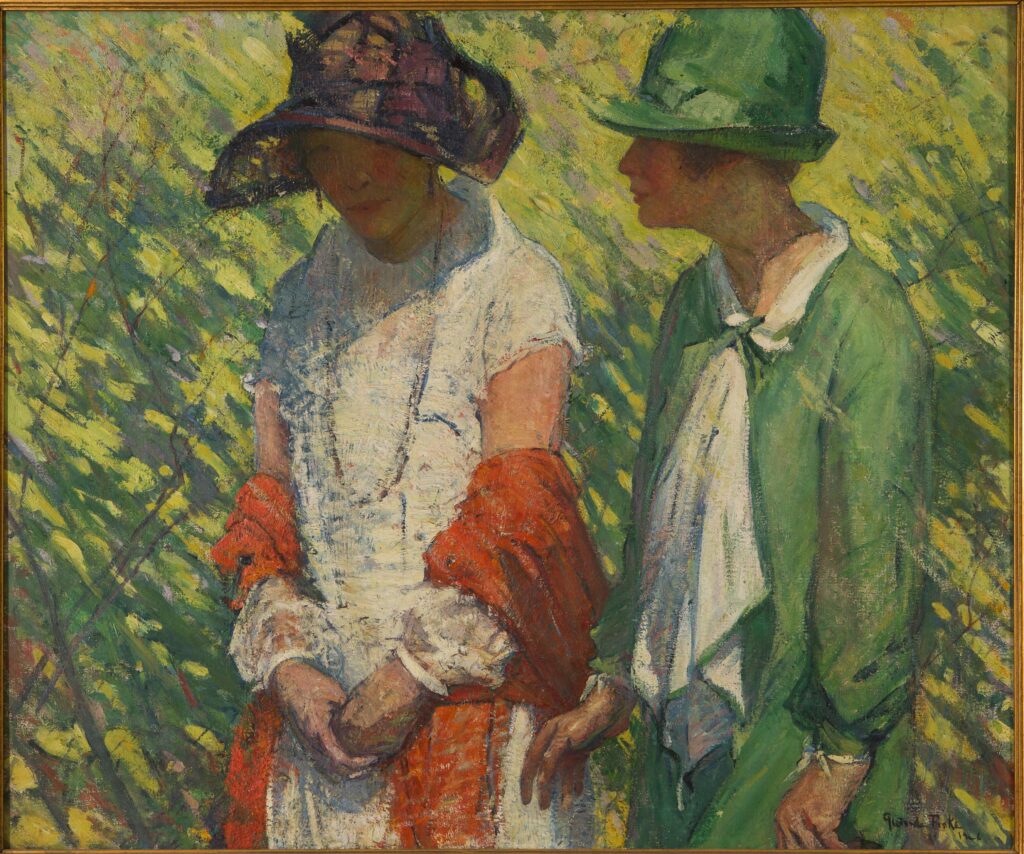
There is no single “bad guy” in the demise of Fiske’s popularity. The aesthetic that fueled the Boston School went out of fashion. Americans survived a Depression, then a second world war, a post-war boom, more deadly foreign wars and a cultural revolution. The spotlight also faded on Fiske’s teachers, including Edmund C. Tarbell and Frank Benson. And it is through the 21st century revival of those male painters, McCartney reminds us, that Fiske’s work now shines through as liberated, progressive and fearless.
“She lived her art,” McCartney says. “She breathed it, ate it and slept it. And she did so in a community of like-minded women.”
So in that spirit, the Portsmouth Historical Society chose to make 2018, the year of the woman. The Balcony Gallery above the 73 collected images by Fiske, featured works by contemporary women artists. Nearby, in the Special Events Gallery on the second floor, four of Fiske’s female contemporaries, including Portsmouth’s Susan Ricker Knox, became the subject of an exhibition titled “Sisters of the Brush and Palette.” Across the street at the John Paul Jones House Museum, a fourth show rounds out the theme. “Overlooked and Undervalued: 300 Years of Women’s Art from the Seacoast” included craftwork by women drawn from the museum’s permanent collection.
“I couldn’t have predicted this a year ago,” McCartney said with obvious pride.
Copyright 2018 by J. Dennis Robinson
 Last Call for Stoodley’s Tavern on Daniel Street