

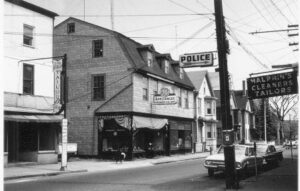

The most dramatic depiction of eighteenth-century Portsmouth was filmed on a Hollywood sound stage in 1941. The movie version of Kenneth Roberts’ novel Northwest Passage opens on the waterfront to a lush orchestral soundtrack. The year is 1757, and young Langdon Towne (played by Robert Young, best known as television’s Marcus Welby, MD) has returned home after being expelled from Harvard. Towne finds his old drinking buddy, Hunk Mariner (actor Walter Brennan of “The Real McCoys”), in the town pillory, accused of “disloyal conversation” against a local King’s official. The two fictional characters retire to Stoodley’s Tavern, where they get into so much trouble they are forced to flee the city. The real action starts when they bump into renowned “Indian fighter” Robert Rogers (played by Spencer Tracy), who abducts the Portsmouth pair into Rogers Rangers, a disciplined colonial militia on the march to Quebec.
Kenneth Roberts’ novel and film depicted Portsmouth as a refined social capital in colonial New England, the ideal jumping-off point for a tale about the harsh American wilderness. A stickler for historical accuracy, the author knew that tavern-owner James Stoodley had served with Major Robert Rogers in the French and Indian War. Rogers himself married a Portsmouth girl, the daughter of Reverend Arthur Browne of the prestigious Queen’s Chapel (now St. Johns’ Episcopal). Reverend Browne, a key figure in the town’s aristocratic Anglican Church, also presided over the nuptials of royal governors Benning and John Wentworth.
According to the official Strawbery Banke guidebook, however, Stoodley’s first Portsmouth tavern, the King’s Arms, was built about 1753, but burned to the ground in 1761. Therefore, the tavern depicted as Stoodley’s Tavern in the film would have been the King’s Arms.
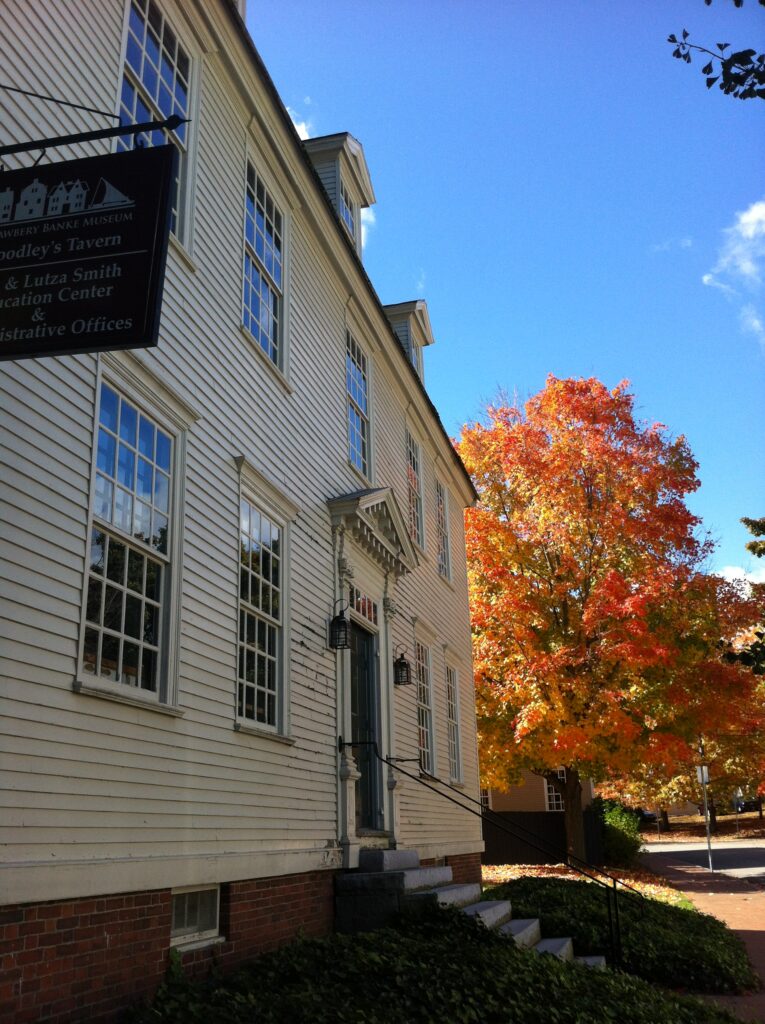
This, the second Stoodley’s Tavern, was moved to Strawbery Banke Museum in 1965 from nearby Daniel Street. It is the perfect vantage point from which to observe Portsmouth’s reluctant transition from a colonial seaport into an American town. The change did not happen overnight as history texts often imply. New Hampshire men, for the most part, were happy to remain English citizens as long as they were treated with respect. The characters in Northwest Passage were fighting for England, not for the as-yet-unimagined United States.
James Stoodley eventually sided with the Patriot cause. By 1770, citizens unhappy with British rule were holding secret meetings at his tavern. In December 1774, Paul Revere galloped into Portsmouth to warn these same revolutionaries that the British were coming by sea to lock up the gunpowder and arms at nearby Fort William and Mary at New Castle. In blatant defiance of the King, 400 locals raided the fort the next day, carrying off the guns and powder, and spiking the cannons. Unlike his friend Stoodley, Major Rogers cast his lot with King George. Rogers was later imprisoned as a traitor, turned to alcohol, and died in obscurity in England. James Stoodley’s son-in-law, Elijah Hall, eventually took over the tavern and, in a final irony, served with John Paul Jones aboard the warship Ranger, built in Portsmouth Harbor and named in honor of Rogers Rangers. Stoodley’s involvement with the sale of enslaved Africans is told elsewhere on this website and featured in the book Black Portsmouth.
Copyright J. Dennis Robinson. This blog is adapted from his hardcover book on the history of Strawbery Banke Museum (2007)
 Anne Molloy’s Memo to the Dawnland