

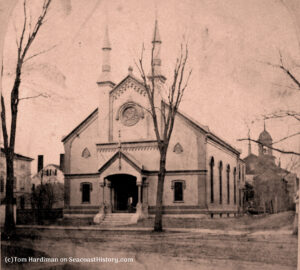
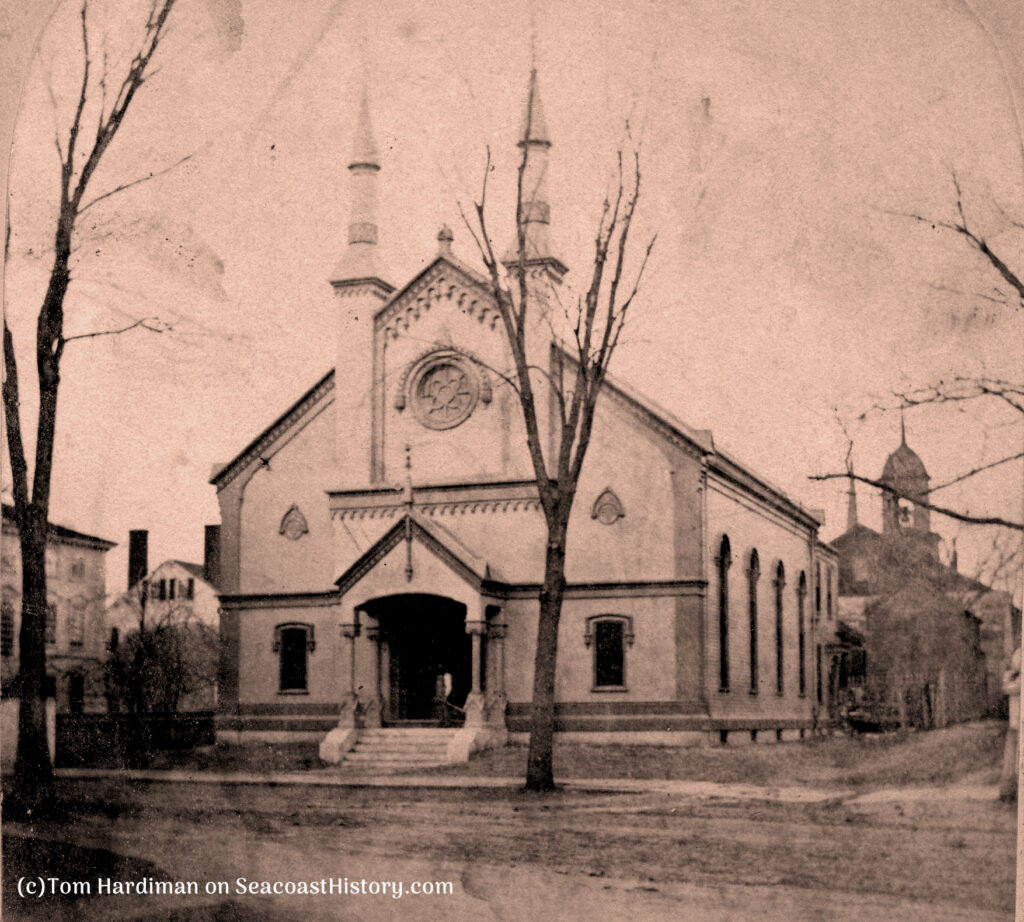
I’ll need your full attention for this one, so please turn off your television and silence your cell phone. Way in the background is the only known image of “The Temple,” a 19th-century public event and lecture hall. It stood on Chestnut Street in downtown Portsmouth, the site now occupied by The Music Hall. All we can see of the Temple is the bell toward to the far right. That’s a shame, since this was one of the most important buildings in the life of the town.
at directlyThe building in the foreground that looks like a temple, however, is not THE TEMPLE. The building we are looking at directly was the Congregational Church at 15 Middle Street. Tha building became the Salvation Army site, and is now the site of the Thaxter Hotel. Still with me?
Imagine you are standing outside the Portsmouth Historical Society today and looking up the alley known as Porter Street. The historical society, for longtime locals, used to be at the Portsmouth Public Library. The John Paul Jones House, not visible here, would be on the right.
It’s hard to believe that a building so important was never photographed. There must be images of the Temple somewhere. It was constructed in 1806 by early members of the local Baptist Church. Eventually, it evolved into a theater-like lecture hall and, with the Cameneum across the street, was the beating heart of the Lyceum lecture movement in the 19th century.
The Temple burned in 1876, making way for the city’s first purpose-built theater, the Music Hall. Before the Temple, there had been a Colonial almshouse and a prison on this site. Porter Street was originally Prison Lane.
To make things more confusing, there is no connection between The Temple and Temple Israel on State Street. This was a “temple” in the Greek sense, meaning a building regarded as a house of wisdom, rather than worship. Christian churches were occasionally called “temples” too. The current Jewish temple building had previously been a Methodist Church.
And here’s the take-home point: Churches frequently evolved into secular structures. Alters became stages. Pews became stadium seating. Portsmouth is constantly changing. Downtown buildings are continually being repurposed under new owners.
The more you know about the city’s past, the more dynamic our history becomes. The Portsmouth Lyceum period of public lectures for men and women actually began in 1826 across the street at the brick Portsmouth Academy building. It rebooted in 1833 in another former church on the site of the Worth parking lot. That entertainment hal became known as “The Cameneum.” Weird name, right? Then the Cameneum was turned into a stable and the lyceum moved across Congress Street to the Temple. I know, I know, it’s a lot to take in.
© J. Dennis Robinson, all rights reserved.
 Hopelessness Springs Eternal for Maud Muller