

When Portsmouth’s maritime economy tanked in the early 1800s, the city became a ghost of its former self. Wharves along the waterfront rotted. We were no longer a revolutionary capital or a world trade center. The wealthy colonial merchant families were played out. Young people abandoned New Hampshire’s only port for jobs in the burgeoning cities and out West. There was no major war to fuel the Navy Yard.
The Piscataqua region continued to build fine fast ships. But the grand clippers and schooners left town as soon as they were launched. Many never returned. It was during this desperate economic era before the Civil War that a group of Portsmouth entrepreneurs, including Thomas Laighton, tried to kick-start a local whale oil industry, but it was a fluke. Begun in 1832, the Portsmouth Whaling Company sank quickly and was extinct by 1848.
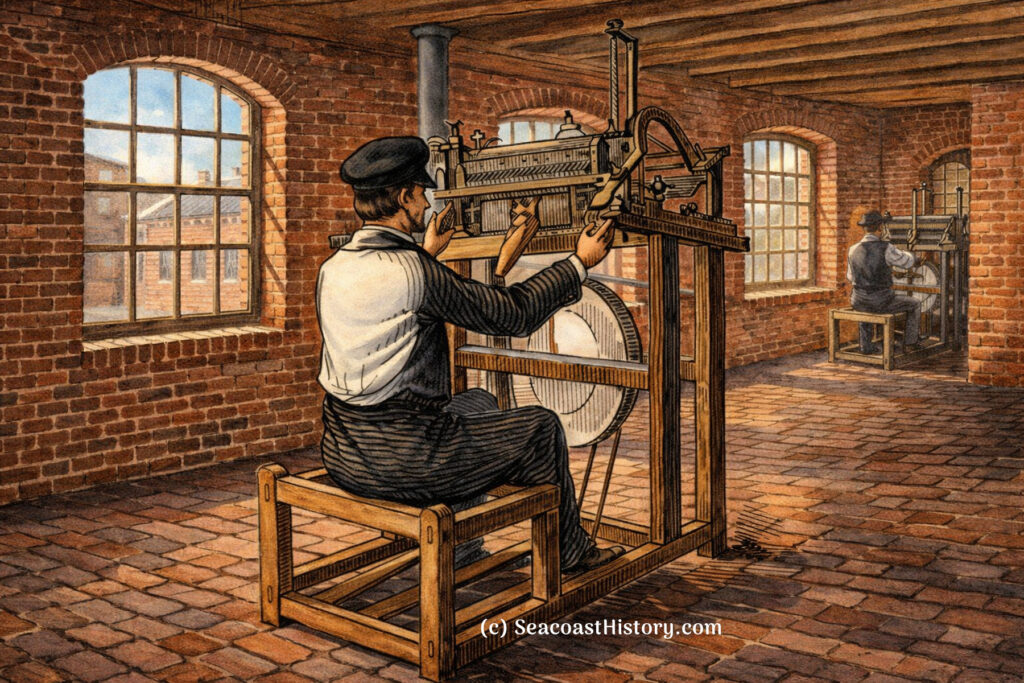
Yet two years later, by 1850, Portsmouth had stepped into a surprising new industry — now forgotten. Over 100 knitting machines, known as “hand frames,” were operating here, the largest concentration outside of Philadelphia, then the “stocking capital” of the United States. Even more surprising, many of the high-tech new machines driving the lucrative hosiery business were invented right here in Portsmouth.
Investing in the stocking market
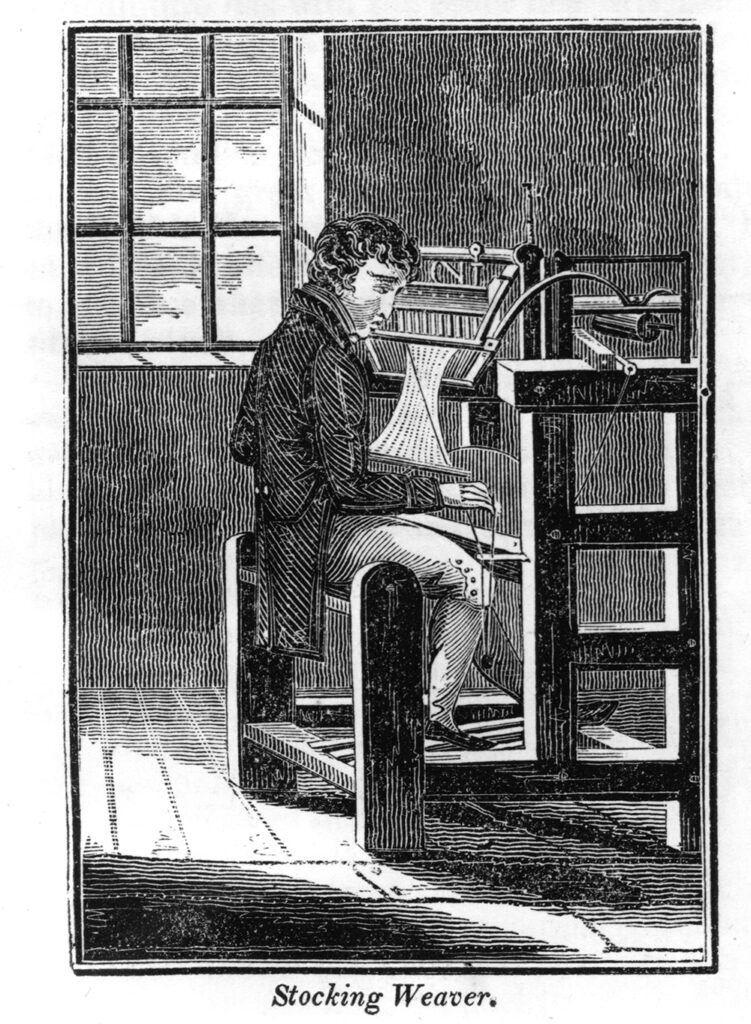
The British had been making stockings on large hand frame machines since 1589. The two halves of the manufactured stockings were then “seamed” together by hand. But by the early 1800s, the English hosiery industry was slowing down. Many trained workers immigrated to the United States, mostly to Philadelphia and New England. With them came the carefully-guarded machine designs — an example of early American corporate espionage.
When efforts to build an American hand frame industry failed in Ipswich, Massachusetts, a group of experienced weavers found their way here. The local knitting industry took root in two key locations. The Portsmouth Hosiery Factory opened on lower State and Bow streets in 1832. Boasting 15 hand frames, this factory was formerly an iron foundry. It was on this spot that Portsmouth inventors and machinists would also develop revolutionary new designs for the knitting industry.
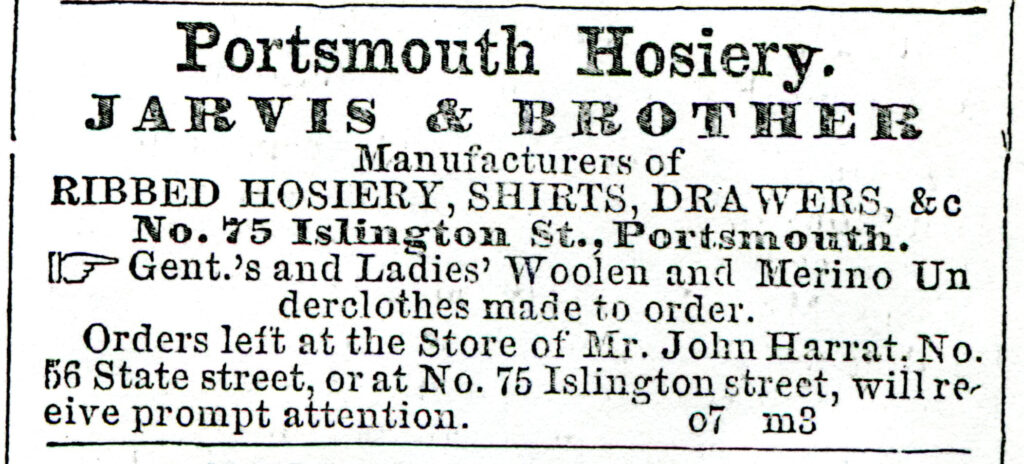
The Stocking and Yarn Factory soon followed on Islington Creek (today Bartlett & Cate streets) in 1834. When that factory burned five years later, it was replaced under new owners as part of the Rockingham Steam Factory. Some 220 men, women, girls, and boys eventually found employment at this company, working directly at the factory or from their home as “seamers and finishers.” Up to 1,200 pairs of stockings could be manufactured per week. All the goods of both plants were sent to one merchant whose Boston shop was marked by a giant six-foot tall stocking that served unmistakably as the company’s sign.
Portsmouth patents
Tariffs on British hosiery goods and a burgeoning American railroad system helped expand the local stocking trade. So did a series of improved knitting machines designed by Portsmouth-based inventors. Robert Walker, for example, patented an improved rotary-powered knitting machine as early as 1839. Walker and his partners apparently worked from the Bow Street iron foundry location, on the waterfront near the back of St. John’s Church today. Drastically reduced in size to just 20 inches, Walker’s knitting machine could be operated on steam, water, or human power. Walker and a local partner sold out their patent rights for $25,000, a huge sum at the time. Their improved machine became a popular item.
English-born John Pepper, also of Portsmouth, offered even greater improvements and created high-tech knitting machines. Working in the converted Bow Street factory, Pepper invented more efficient systems for propelling stocking looms with water or steam power. Pepper’s powered looms more than doubled the output of traditional looms. By 1847, one girl watching over three automated looms could produce 23 pairs of stockings and 22 pairs of drawers during a single shift, compared to 12 a day on the traditional hand frame. The Industrial Revolution was on, and Portsmouth was playing its part.
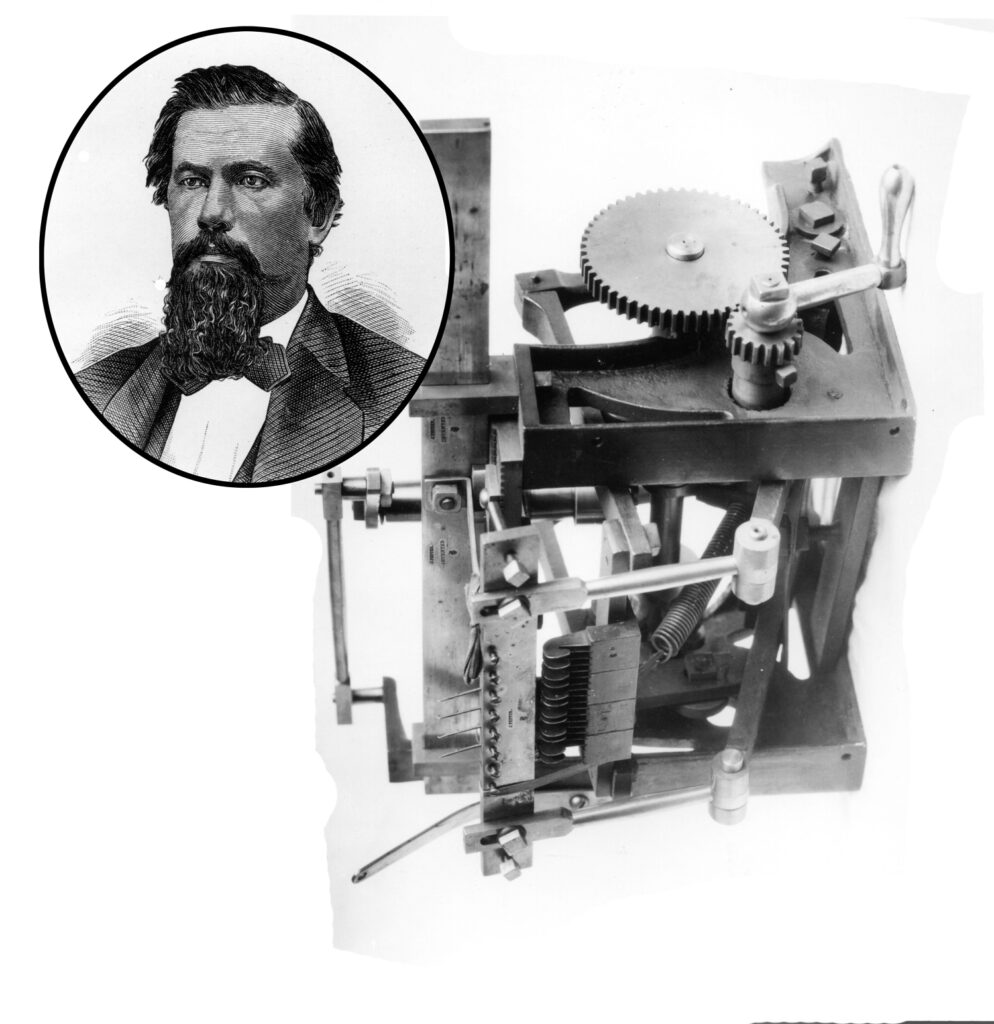
Pepper’s inventions created both controversy and cash. One of his knitting machines created less than top quality products. A patent battle arose between Portsmouth and Lowell, MA when two different parties tried to patent a system to improve Pepper’s machine. The detailed battles over small upgrades and changes to Pepper’s machinery read today like modern day copyright infringement lawsuits over nearly identical software programs. Inventors often had to sell off portions of their patent ownership simply to afford the fees, legal costs, and models required to register their inventions.
Pepper’s most successful invention, a circular loom capable of producing “ribbed” fabric was written up in Scientific American magazine. It revolutionized machine knitting in America and across Europe. Pepper also briefly owned the Portsmouth Stocking Factory in the city’s West End. The site was soon sold to another budding entrepreneur, Capt. Heman Eldredge, who built the city’s second-largest brewery on that same spot.
19th-century home offices
As with the building of great Portsmouth ships, the lion’s share of the money from Portsmouth-designed knitting machines benefited other people in other cities. But there was still a living to be made here. Much of the local work took place in Portsmouth homes by skilled weavers. The stocking industry was a rare market where women could work part time for a decent wage, but still proving time for domestic chores and raising children.
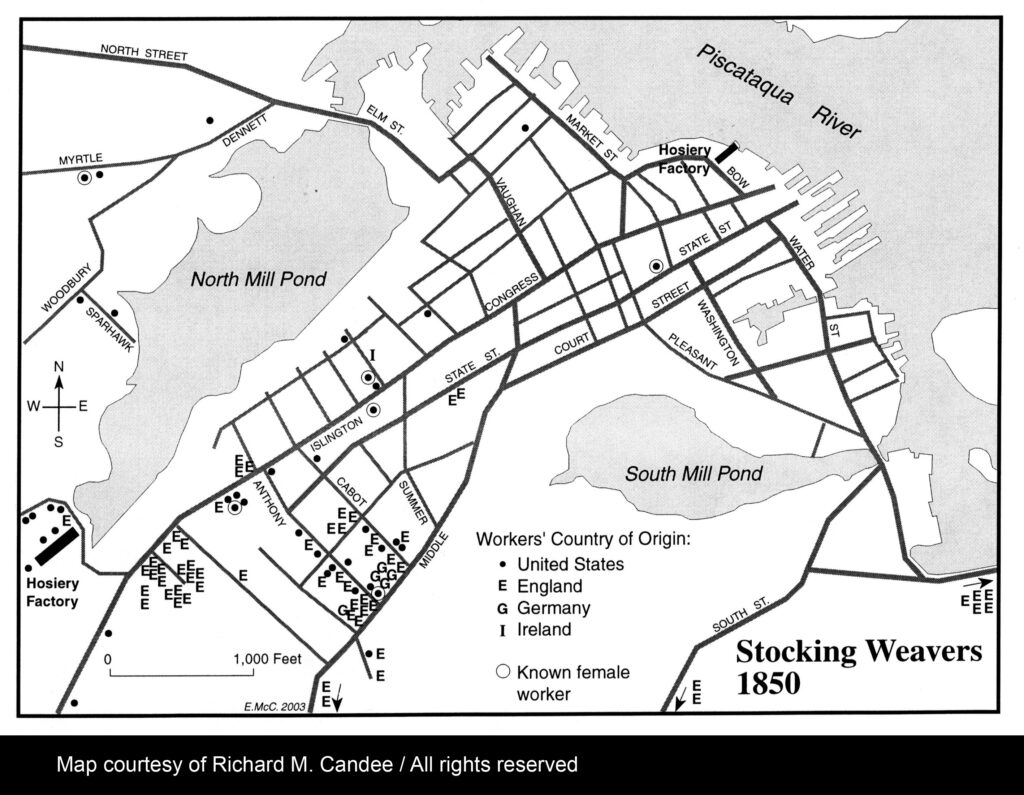
The business of making stockings had begun as a cottage industry in England. During the middle of the 19th century, much of the hosiery work in Portsmouth was also being done in homes. A map of central “Old Portsmouth,” created by historian Richard Candee, shows where English, Irish, and German immigrant weavers lived and worked around 1850. A cluster of English weavers were located “up the Creek” near the Portsmouth Stocking Factory. Dozens more were clustered at shops and homes between Islington and Middle streets.
While the two powered plants worked in fits and starts, the number and determination of local weavers kept the domestic stocking industry alive in Portsmouth even as inventors like John Pepper moved on to greener pastures. In 1852 stocking weavers participated in a workers parade. Their float included a hand-frame and a display of the products they proudly manufactured. These dedicated craftspeople went so far as to stage a “Strike of the Weavers” in 1857. According to the Portsmouth Chronicle, local stocking workers complained that nowhere except in Portsmouth were weavers paid such a low rate. “How are we to live by our labors,” they pleaded, when food, fuel, clothing, and house rents were rising?
The steam-powered Portsmouth factories did not last long. As huge mills operated by water-power expanded, the number of hand-frames in Portsmouth diminished. But a vestige of the city’s stocking trade still lingered after the Civil War. In 1875, the Portsmouth Journal noted that, “a large number of person find employment as seamers.”
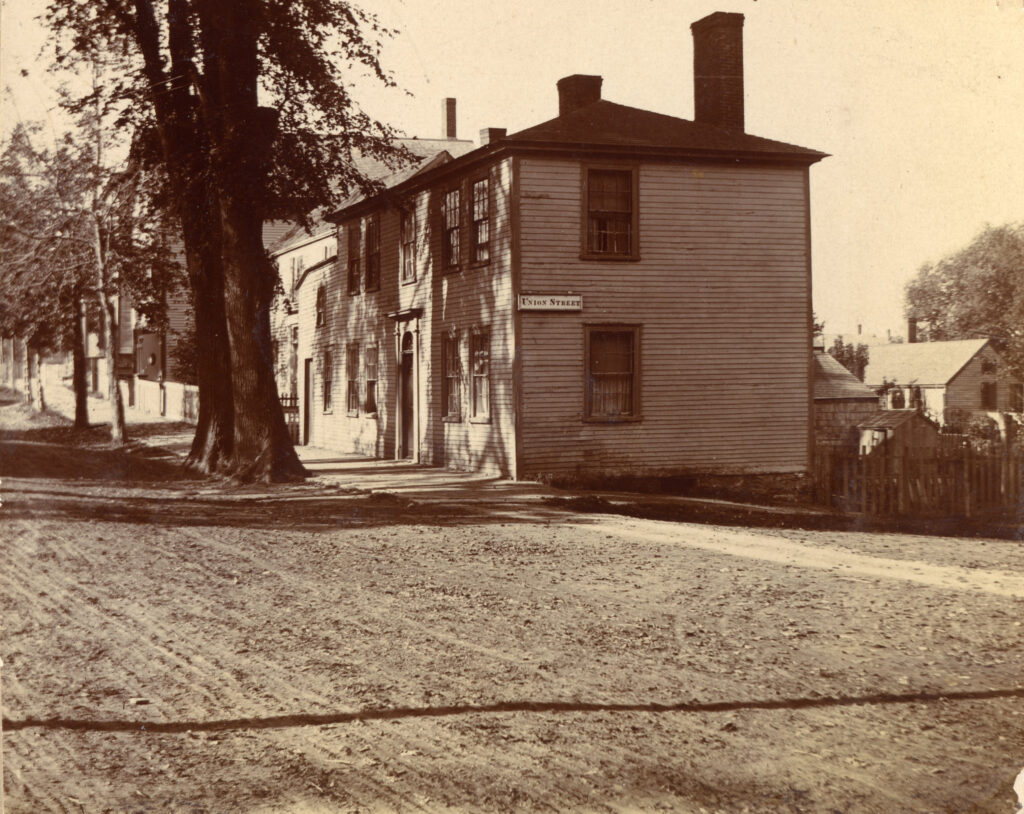
(Portsmouth Athenaeum)
Thurza Turner, the daughter of an English immigrant stocking weaver found a way to adapt to the changing times. Working from her late father’s house on Middle Street, Turner became the main local agent for a number of New England knitting factories. Receiving large quantities of unfinished goods, Turner distributed the stock to home-based piece-workers in Rye, Greenland, New Castle, Kittery, and Eliot. After the “seamers and finishers” were done, the completed stockings were returned and inspected for quality.
An efficiency expert, Thurza Turner kept precise records. During her busy season prior to fall store sales, Turner processed up to 1,200 dozen pairs of stockings each month. Turner recalled seeing children arriving at her office with their arms full of brightly colored stockings that looked like bouquets of flowers.
By the turn of the 20th century, with the rise of automatic seamless stocking machines, the outsourcing stopped. Portsmouth lost its last link to the industry that had flourished here, an industry Portsmouth inventors had helped to create, and is now an all but forgotten chapter in the city’s history.
KEY SOURCE: This article is based, with permission, on “Old Portsmouth, Home of the Stocking Business,” (Historic New Hampshire, Fall/Winter 2002, pages 85-107) by Richard M. Candee, professor emeritus of the American studies Program at Boston University, now president of the Portsmouth Historical Society. Copyright J. Dennis Robinson, all rights reserved.
 Our Two-party System was Forged in Even Angrier Times