


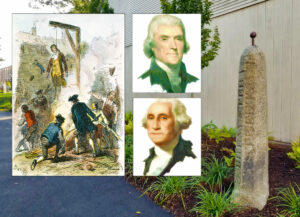
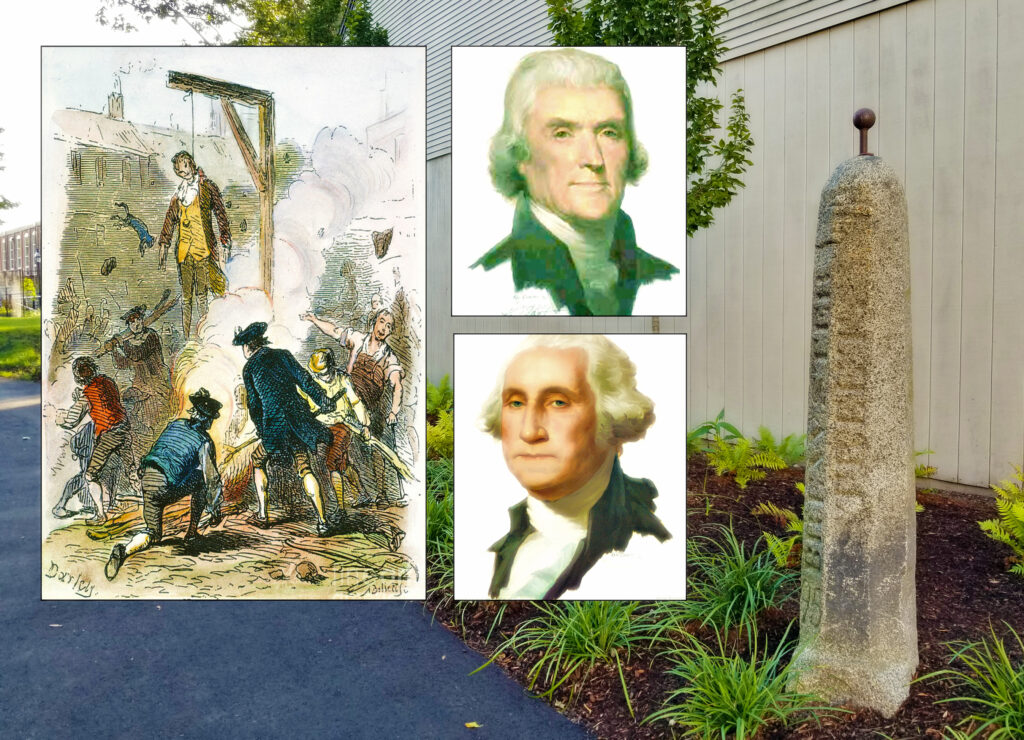
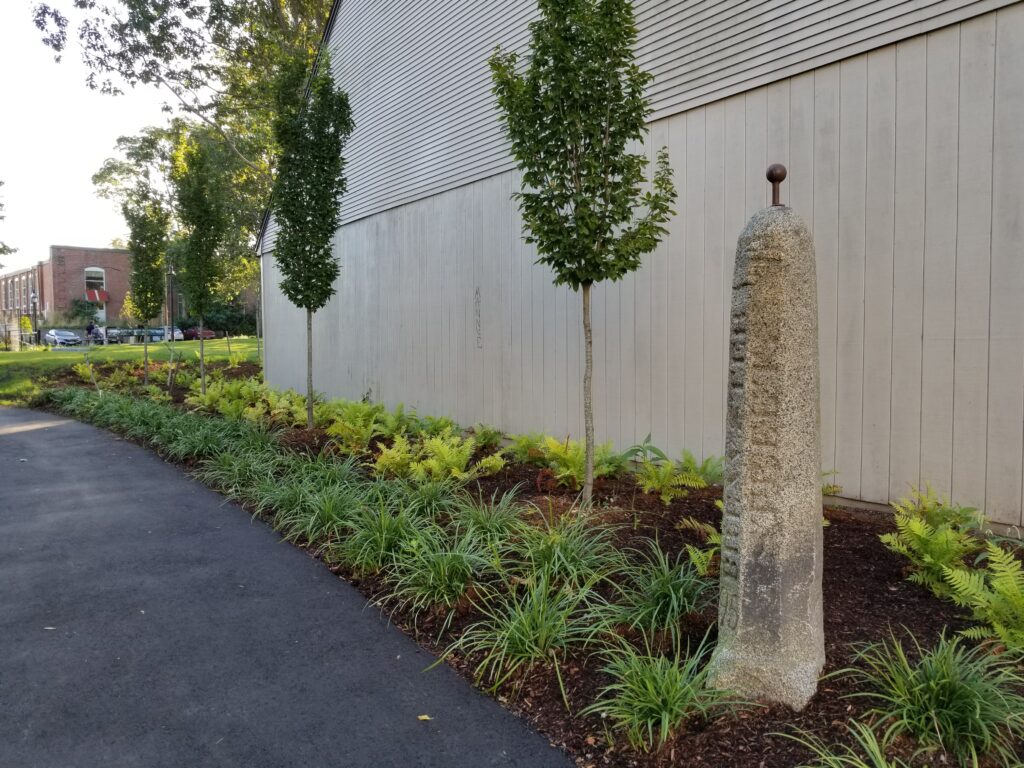
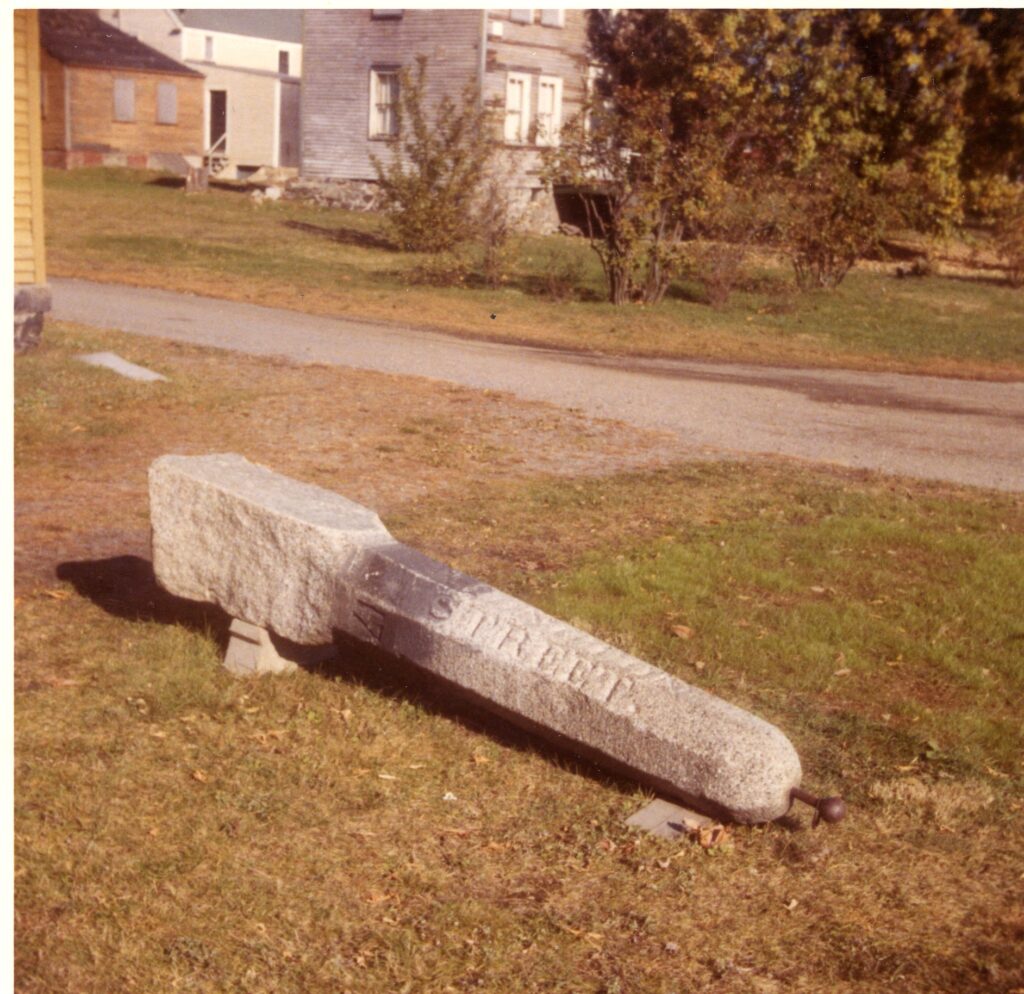
You might not notice the stone street marker at the renovated Rock Street Park in Portsmouth, NH. The carved granite obelisk, dated 1795, once stood at the intersection of Islington and Brewster streets nearby. But press your ear against the cold rock slab and listen carefully. It has an important tale to tell.
If you think today’s politics are nasty and divisive, let’s harken back to 1795 and our feuding founding fathers. Portsmouth, like today, was enjoying an economic boom. There was a new bank, a new bridge, and a massive new commercial pier. Merchants, mariners and builders were unaware that within a few years the city’s Golden Age was about to crash and burn.
George Washington, the nation’s richest president until the arrival of Donald J. Trump, owned an 8,000-acre farm worked by over 200 enslaved African. Thomas Jefferson, Washington’s original Secretary of State, owned a 3,000 acre tobacco farm operated by 130 enslaved Africans. Jefferson would soon become the third richest president in United States history. But he had quit working for Washington in 1793 and the two were becoming bitter enemies. Their rivalry played a major role in creating the two-party political system that dominates much of today’s news.
Simmering differences
In 1795, the American Revolution was but a dozen years in the past. It had been only five years since “godlike” George Washington made his triumphant four- day visit to Portsmouth. But Americans were already beginning to take sides. The “Federalists,” represented by Washington (who took office as a political Independent) and statesman Alexander Hamilton, felt the newborn nation needed a strong central government to survive. The “Jeffersonian-Republicans,” on the other hand, feared the powerful president was too close to becoming a king and advocated for a government dominated by the varying laws of individual states.
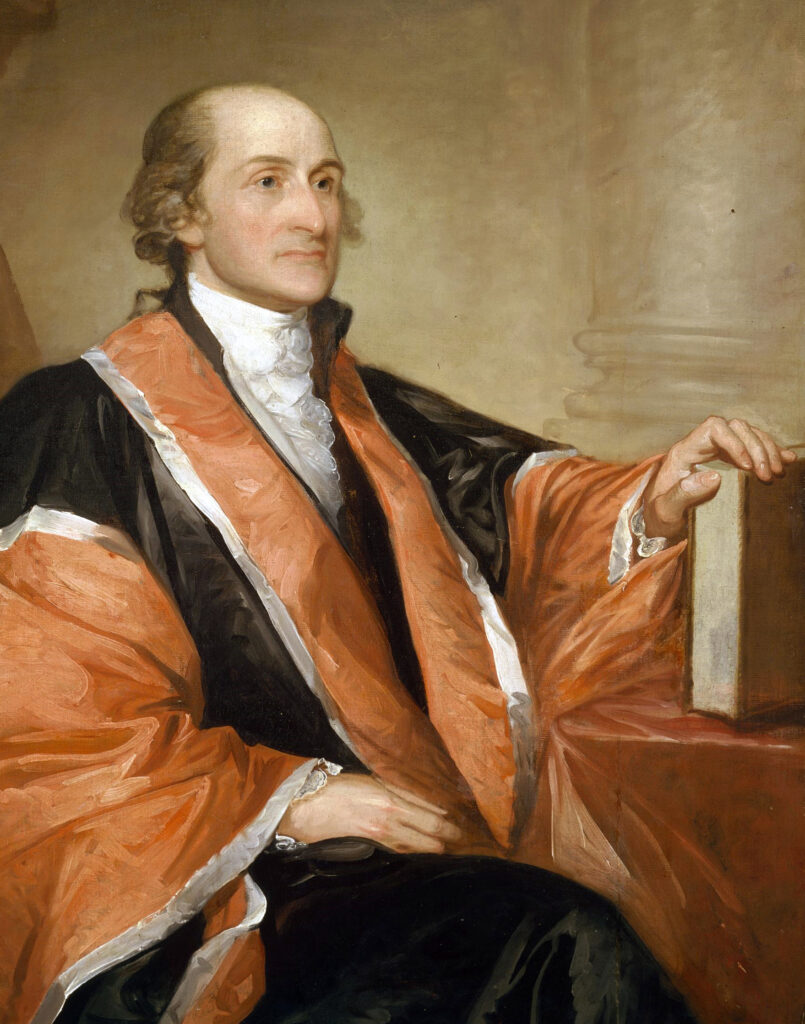
The two deeply divided political groups took sides when Britain and France went to war in 1793. Hamilton and the Federalists backed Britain, the nation’s key trading partner. Jefferson’s group favored the French. Caught in the middle, President Washington tried to remain neutral. To avoid another war with Britain, Washington sent his Chief Justice, John Jay, to England to smooth things over. The resulting “Treaty of Amity, Commerce and Navigation” brokered by Jay was designed to keep things peaceful and trade flowing between the Mother Country and the fledgling UNited States for the next 10 years.
Whistleblower and riots
The Jay Treaty, as it has become known, was in the hands of the U.S. Senate in 1795. Washington was advised to ratify the secret treaty when a member of the Senate from Virginia released a copy to the press. The unauthorized publication of the terms of the proposed treaty with Britain, according to Portsmouth historian Nathaniel Adams, “caused the president much embarrassment.”
On July 16 a group of Portsmouth citizens who opposed the Jay Treaty wrote a letter to President Washington expressing “our most hearty disapprobation.” Local Democratic-Republicans, as they are now known to historians, listed their grievances with Britain, whose Royal Navy continued to impress American sailors and seize American merchant ships. The French, Republicans reminded Washington, had been our allies during the Revolution–forgetting to mention that the French, were also seizing American merchant ships.
Portsmouth Federalists, in response, wrote their own letter in support of Washington’s treaty. But it never got sent. According to Adam’s Annals of Portsmouth, (published in 1825) between 200 and 300 enraged Republicans, armed with clubs, took to the streets beating drums in protest of the Jay Treaty. They carried effigies of the Federalists who favored the pro-British plan.
According to Adams, the mob “insulted many of the signers…broke their windows and fences, injured their trees” and offered “threats of personal injury” Adams recorded in his history of Portsmouth: “After keeping the town in confusion and terror several hours, they burnt the effigies, and disbursed.”
“Damn John Jay!” people shouted. “And damn everyone who won’t damn John Jay!” Jay later joked that he could travel from Boston to Philadelphia at night following the light of his burning effigies.
Party of two
The Jay Treaty passed into law all the same. Despite Jefferson’s fear that the president was usurping tyrannical powers, in a very un-king-like move, the following year, Washington decided not to run for a third term. In his Farewell Address of 1796 Washington urged the states to stick together and preserve the Union. He warned of regionalism, partisanship, and foreign entanglements. Washington condemned the rise of the emerging partisan political parties that he feared might someday play into the hands of a corrupt demagogue seeking to seize power. Washington’s famous speech is still read annually in the hallowed hall of the U.S. Senate.
Jefferson lost the 1796 presidential election to John Adams, who had served as vice president to George Washington. It was during this vicious campaign that Federalist attack ads accused Jefferson of raping his 14-year old enslaved servant Sally Hemmings (the half-sister of Jefferson’s late wife). DNA evidence has since proven that the “affair” took place and that Jefferson went on to father six mixed race children with Hemmings. During the acrimonious campaign Federalists also denounced Jefferson as an atheist, a military coward, and of supporting the bloody French Revolution.
The Democratic-Republicans, in turn, attacked Federalists for their newly enacted taxes, for the Jay Treaty, and for trying to turn the presidency into a monarchy. Adams was maligned as fat and corrupt, but he edged out a victory in 1796. Based on the rules of the era, Thomas Jefferson, who took second place in the election, became vice president. It was not a happy marriage. The mudslinging got even worse in the rematch election of 1800 when Adams was attacked as a blind, bald, crippled, and toothless hermaphrodite. If Jefferson were to win, one partisan newspaper warned, “Murder, robbery, rape, adultery, and incest will be openly taught and practiced.” Our forefathers, it seems,quickly forgot how to play nice.
Lessons not learned
We almost lost the 1795 granite obelisk that marked the intersection of two unpaved Portsmouth streets. Uprooted during urban renewal, it found its way to Strawbery Banke Museum around 1971 and lay with other odd bits of the dismantled city. Kittery sculptor Thomas Berger rediscovered the one-ton marker among items he obtained from the museum and gifted it back to the City of Portsmouth a decade ago. It was discovered once more in storage at the Public Works Department during construction of the Foundry Place Parking Garage. It has since been included in the rehabilitated Rock Street Park.
-Despite real-life scandals and political attack ads, Thomas Jefferson finally made it to the presidency. His vice president, Aaron Burr, killed former U.S. Treasury secretary Alexander Hamilton during a duel in 1804. (That story is cleverly told in the hit Broadway musical “Hamilton.”) Three years later in 1807, President Thomas Jefferson signed the Embargo Act that prohibited French and British trade with American seaports. The Jay Treaty and the Embargo Act briefly postponed a second war with Britain. But Jefferson’s embargo, combined with three devastating Portsmouth fires and the War of 1812, put an end to the financial rise of New Hampshire’s only seaport. It took two long centuries for the Portsmouth economy to boom again. Our divisive two-party political system, launched in 1795, continues to thrive.
Copyright 2019 by J. Dennis Robinson, all rights reserved. Thanks to Stephanie Seacord for this story idea.
 The Hexploitation of Goody Cole