


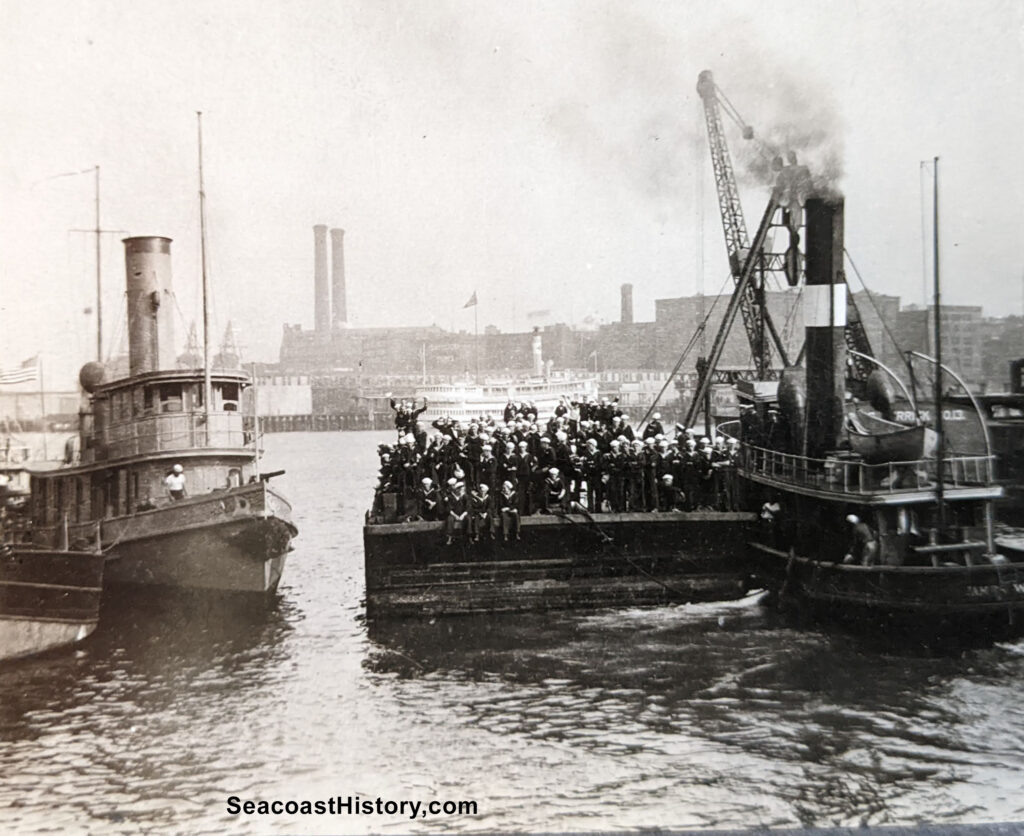
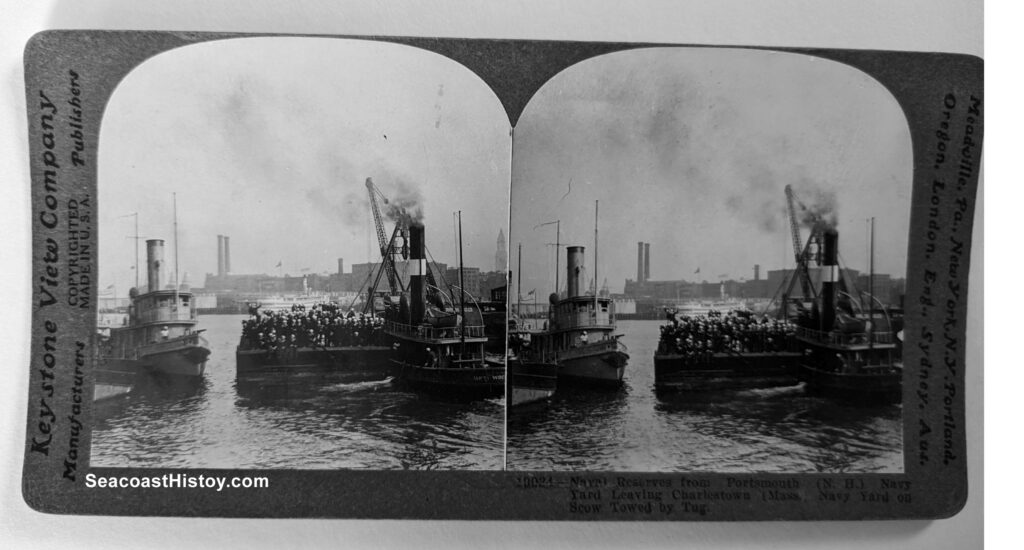
Back before the digital age, our analog ancestors collected facts on paper. Stereoview cards were a popular medium–affordable, collectible, and when viewed with a handheld device, they gave the illusion of a 3-dimensional image. Many were scenic souvenirs, but others were educational media. The back of this photo, for example, came packed with statistics about the build-up of American troops in World War I.
The photo shows men from the naval reserves being mobilized for war. According to the caption, these are reservists from Portsmouth, NH. Having been delivered to Charlestown Navy Yard, they are being shipped out aboard “a scow towed by a tug, likely the James Wooley.
Boston was then the headquarters of the First Naval District. Thousands of men were delivered to Charlestown for training, outfitting, and assignment. Many were transferred to an island off Hingham, MA. A Portsmouth Herald article from this era documents the travels of a former Portsmouth police officer, Christopher Smart, Jr., who may have been among the reservists pictured. Smart was shipped to Charlestown and then to Hingham, MA, then on to Bumpkin Island Training Camp.
Formerly the site of a disabled children’s hospital, the Navy took over Bumpkin Island in WWI for a training station and barracks for men in the Naval Reserves. Similar to army facilities at Fort Stark in New Castle, NH, as many as 1,300 sailors were housed at Bumpkin with a mess hall, educational and recreational facilities, and a hospital on base. These men were trained to serve on ships at sea during the war. The site is now a hiking and picnic area in Boston Harbor operated by the national and state park system. – JDR
THE FACTS ON THE BACK
Keystone Stereoview Card
When a state of war existed in the United States early in the spring of 1917, the Naval Reserves passed into control of the Navy Department. A mobilization order called into service 70,000 enlisted men, 8,500 members of the naval militia, a large number of naval reserves, and men in the Coast Guard service. It was estimated that for proper mobilization of the Navy, the total number required was 99,809 regulars and 45,870 reserves.
On September 26, 1917, the strength of our naval forces was as follows: enlisted in the Navy, 143,776; Naval Reserves, 42,000; naval volunteers, 14,500; Marines, 32,000; hospital corps, 6,500; Coast Guard, 5,000; officers, 12,809; total, 256,585.
When the break was made with Germany, there were only 55,445 men in active service in the Navy. Since that time, the number of ships in commission has increased from 224 to over 1,200. These statistics show that the Navy has recruited its strength wholly by voluntary enlistment. The Navy has developed tremendously, as has the army, within the past few months. They enlarged until the Navy today has new naval training stations; 15 cantonments have been built, which number will soon be increased to 24. Each cantonment will handle 100,000 men. Every large ship in the fleet has become a training ship and taken on more men.
The Navy has already accomplished much in the war. It has safely convoyed a large number of troops and supplies to France. It has thoroughly patrolled our eastern coast, and it has armed and manned over 400 American vessels for self-defense. In less than a month after the beginning of war, American warships were in the European war zone ready for duty.
 A Snapshot of Our Earliest Photographers