

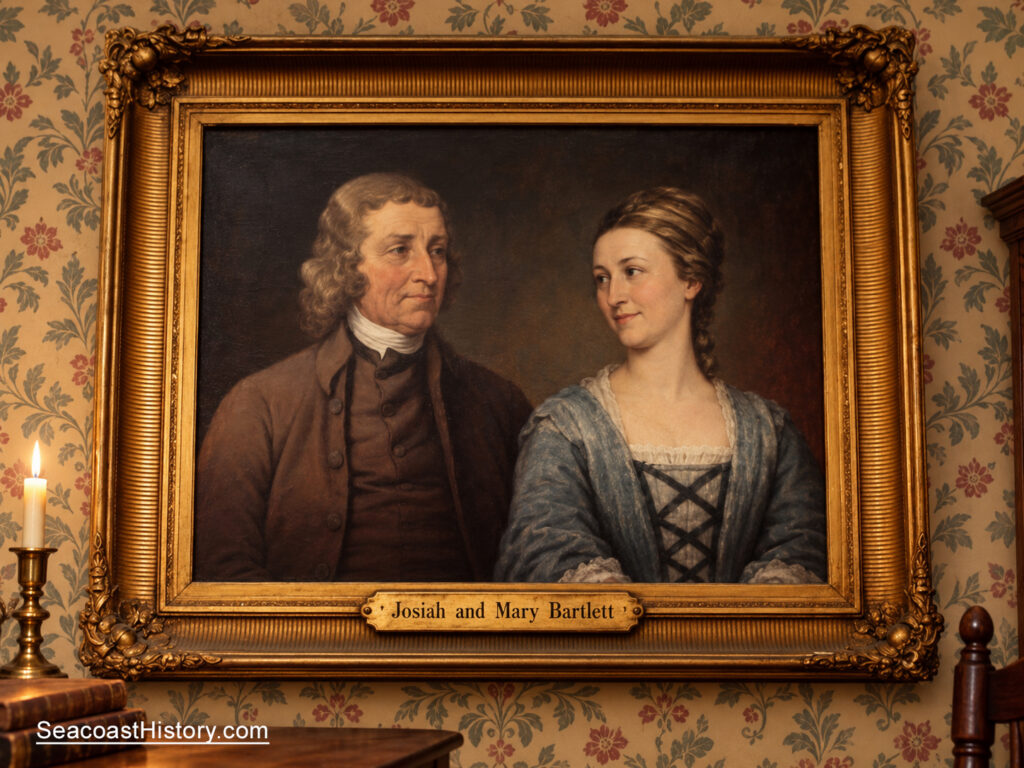
NOTE: If John and Abigail Adams were the “Power Couple” of the American Revolution, the Bartletts of New Hampshire were the “Love Couple.” Josiah and Mary Bartlett sustained each other during hard times by writing letters during long absences. Her intelligence and incredible domestic skills kept the family together through the tumultuous American battle for independence. This essay comes from Exeter writer Olive Tardiff (1916-2015), who was an avid local historian. –JDR
MARY BARTLETT (1730- 1789)
Married to Declaration signer Dr. Josiah Bartlett of NH
By Olive Tardiff
Mary Bartlett, born in Newton, New Hampshire, and married in 1754 to her first cousin, left us a priceless heritage in letters that have been carefully preserved. Well educated for the times, Mary wrote regularly to her husband, Dr. Josiah Bartlett, signer of the Declaration of Independence, while he was attending the Continental Congress in Philadelphia in 1775-1776.
Raising Twelve Children
With eleven children, and a twelfth on the way, Mary had plenty to do without pausing for letter-writing. She had to supervise the work on a farm that covered many acres, and run a household that included several servants.
The family was dependent on the produce raised on the property, and Mary was faced daily with decisions about crops, livestock, money matters, and childcare. With her husband gone, there was no medical help available for emergencies. She probably relied on Ames’ Almanack for advice on infant care, and Tusser’s Book of Husbandry for farm lore. Spinning, weaving, making clothing, preparing meals over a fireplace, and preserving foods for winter use kept Mary and her household constantly busy.
SEE: The Bartletts of Bartlett Street
Mary’s letters show she not only wanted to keep her husband informed, she also wanted to ask his advice. She expressed her worries about the children and about her own health. Because Dr. Bartlett was the family physician to many in Kingston and surrounding villages, she often reported to him on the condition of his patients and of illnesses and deaths in the community. Josiah and Mary shared their concerns in letters that often took more than four months to reach their destination.
In addition to her correspondence with Josiah, Mary kept in touch with her oldest son, Levi, who was at Drummer Academy in Newbury.
“Dear Son, (she wrote in one letter), I have sent a horse by James Gale to bring you home. I would have you look up all your Books and cloathing to bring home as many of your Cloathing as you can conveniently. . . The rest of your Books and Cloathing I would have you lock up in your chest.
This is from your Mama.
P.S. Any books you shall want to learn in at home I would have you bring.”
Hardships at Home and Away
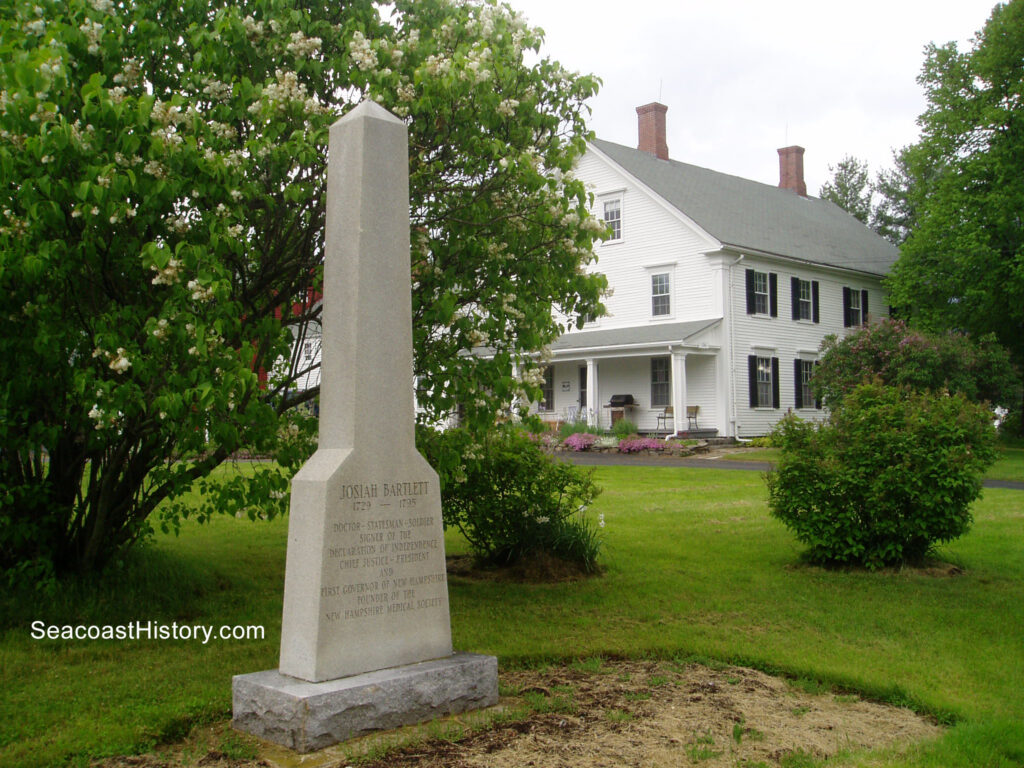
In writing to his wife, Josiah advised her to “hold the letters over the smoke a little before you handle them as the Small Pox is very frequent in the City.” He asked whether the house had been finished. (The first Bartlett home had been burned in 1774, perhaps by Tories.) He recommended preparing for winter with “cloathing” and by laying in a good supply of wood. Addressing Mary as “My dear,” he urged her to visit him in Philadelphia. He promised to send her chintz for three gowns, and silver sleeve buttons for the children.
Mary’s letters to her husband are filled with accounts of the children’s ailments,–Sally’s colic or worms, Ezra’s “canker and scarlet fever,” Rhoda’s fainting spells, Lois’s pain in the head and sore throat. “Miriam,” she wrote on September 24th, “has been poorly,” probably because she took “a cold bath in the sea.” Mary noted that dysentery was prevalent. She also reported on her own “sick headaches,” and on September 9th, 1776, begged (concerning her pregnancy) “Pray do come home before cold weather. As you know my circumstances will be difficult in the winter, –If I am alive.”
Bartlett’s Revolutionary Letters
Mary told Josiah about deaths due to a smallpox epidemic in the area, about swarms of flies and worms eating the corn, about sharp lightning and thunder, and about a frost on May 30th that damaged apple trees, beans, pumpkins, and cucumbers. She sometimes complained that the hired men were not working well under her direction, although “Billy and Peter manage pretty well, and the menfolks have done the hilling of Indian corn.” Josiah replied with suggestions about saving seed corn, telling Peter to take good care of the cattle and not to waste hay, hiring a “good hand” for nine months or a year, and buying a few barrels of apples so that there would be plenty of New Hampshire cider.
No doubt Mary’s letters alarmed Josiah as much as his upset her. When he complained of his frequent colds and coughs, she immediately dispatched by stagecoach a warm “gound” and a cordial made of rum with cinnamon, saffron, and sugar. By the time such remedies would have reached him, he must have recovered.
Mary not only kept things going at home; she showed interest in the aims of the Revolution. “I believe this year (1776) will decide the fate of America,” she wrote to Josiah. In spite of hardship, she felt part of the new government that was taking shape under the direction of Josiah Bartlett and other representatives of the thirteen colonies.
Mary Bartlett was one of thousands of wives and mothers who contributed to the success of the American Revolution. Her letters tell the story of those difficult years.
SOURCE: “They Paved The Way: A History Of NH Women”, Women for Women Weekly Press, 1980. Reprinted by permission of author Olive Tardiff. This article was first published online exclusively by SeacoastNH.com in 1997 and later updated by the author.
 My Hero, James T. Fields