


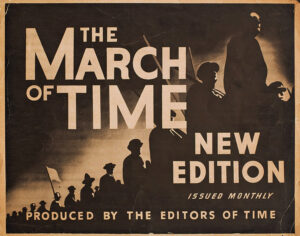

On the top shelf of my office library are 33 videotapes labeled March of Time. Each tape in this boxed VHS series is roughly 90 minutes long. Back in the days of VCRs, I watched hundreds of hours of these black and white newsreels —and I was never bored.
The March of Time ran in thousands of movie theaters from 1935 until newsreels were killed off by television in 1951. These 20-minute monthly mini-documentaries were part journalism, part education, part entertainment, and part propaganda. Before TV and the Internet, the March of Time shaped the way millions of Americans thought about world politics, sports, medicine, the arts, race relations, popular culture, science–you name it.
De Rochemont called his invention “pictorial journalism.” Others called it patriotic propaganda. De Rochemont’s influential boss, Henry R. Luce, the creator of Time, Life, and Fortune magazines, called it “fakery in allegiance to the truth.”
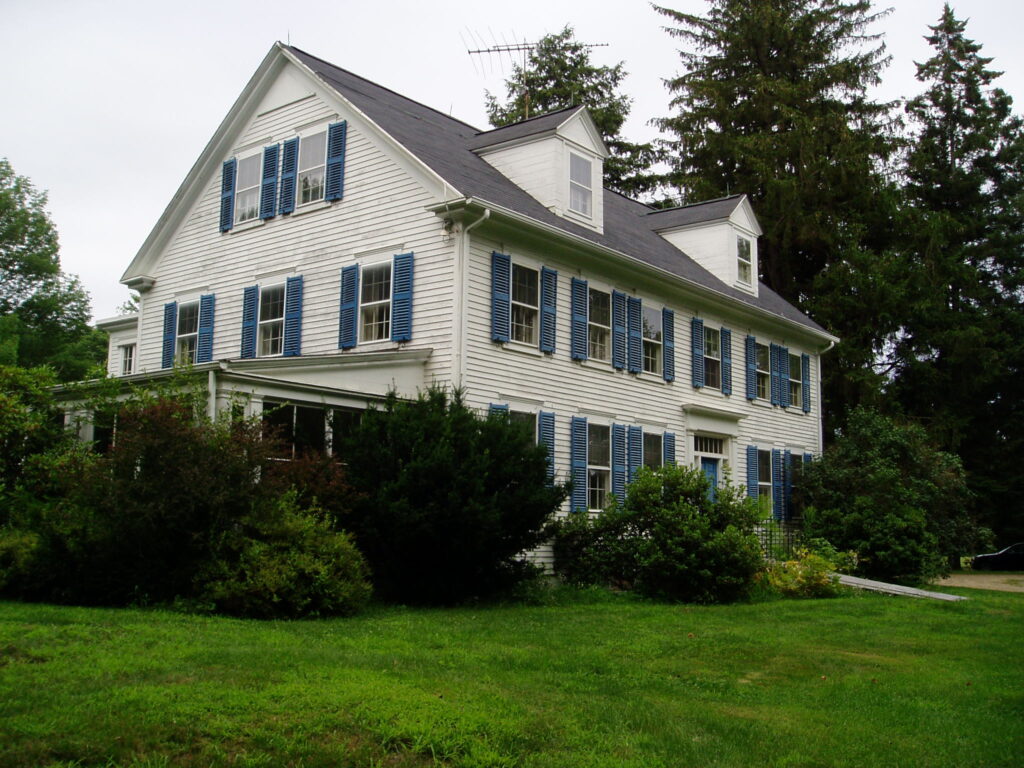
This powerful cocktail of news, stock footage, dramatic re-enactment, music, and storytelling was created by Louis de Rochemont (1899-1978) of Newington, NH. His home near the Piscataqua River, nicknamed Blueberry Hill, has since been swallowed up by malls and industry. He and his wife, screenwriter Virginia Shaler, later moved to the Rockingham Hotel in Portsmouth, NH.
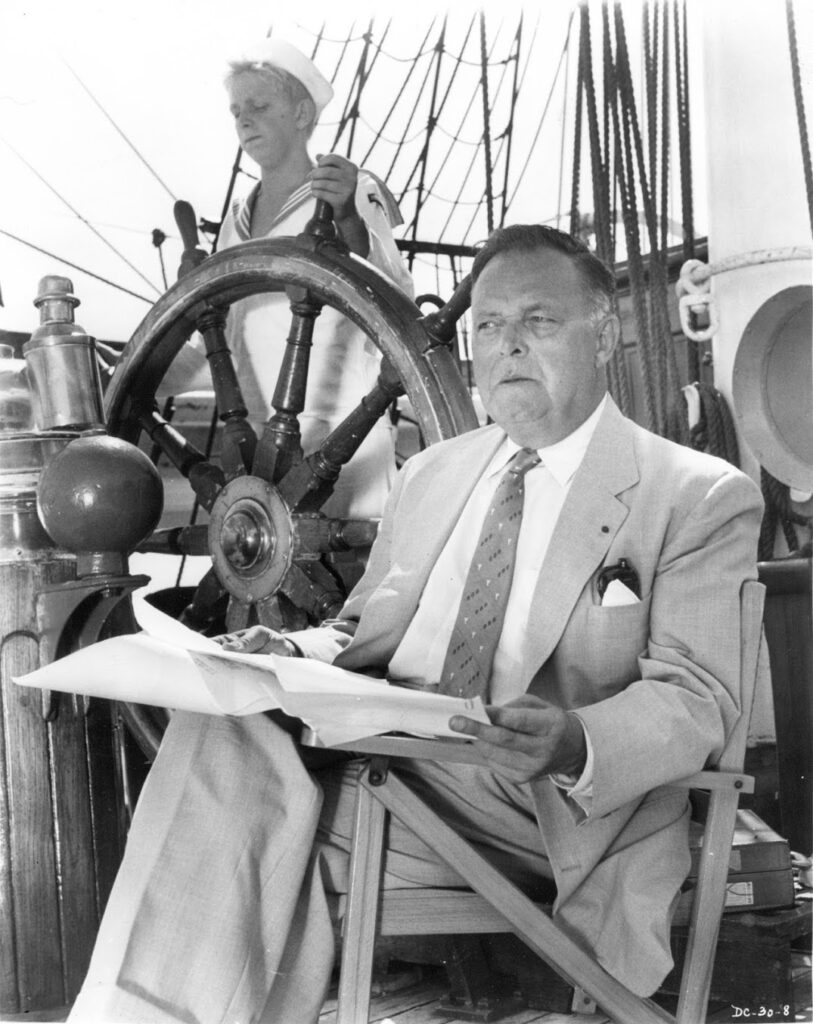
Most of my writing about de Rochemont has focused on the wild and crazy array of feature films he produced after March of Time. Addicted to controversy, he tried his hand at spy thrillers, romance, social commentary, travel films, a feature-length cartoon, widescreen Cinerama, musicals, nature tales, and religious biography. Beneath every film was a moral message based on a story “ripped from the headlines.”
Locally, de Rochemont is best known for Whistle at Eaton Falls (1951), the story of a wildcat factory strike, shot here on the seacoast. It starred Lloyd Bridges, Ernest Borgnine, and Anne Frances. His early “race film,’ Lost Boundaries (1949), focused on a family with “Negro blood” passing for white in rural New Hampshire.
Exeter, the perfect town
Louis de Rochemont defies categorization, but he remains ubiquitous. His explosive career as a maverick filmmaker has yet to find a biographer. But his work is embedded like shrapnel in every field of the American cinema.
Just the other day I got a message about a March of Time segment posted on Facebook. The 1941 clip showcases Exeter as the ideal New England town. De Rochemont loved the New Hampshire seacoast and moved here from Massachusetts around 1940. His view of Exeter might be mistaken for Camelot.
The clip opens with the familiar “Voice of Time.” Parodied as “The Voice of Doom,” narrator Cornelius Westbrook Van Voorhis was as familiar to audiences in the 30s and 40s as James Earl Jones or Morgan Freeman is today.
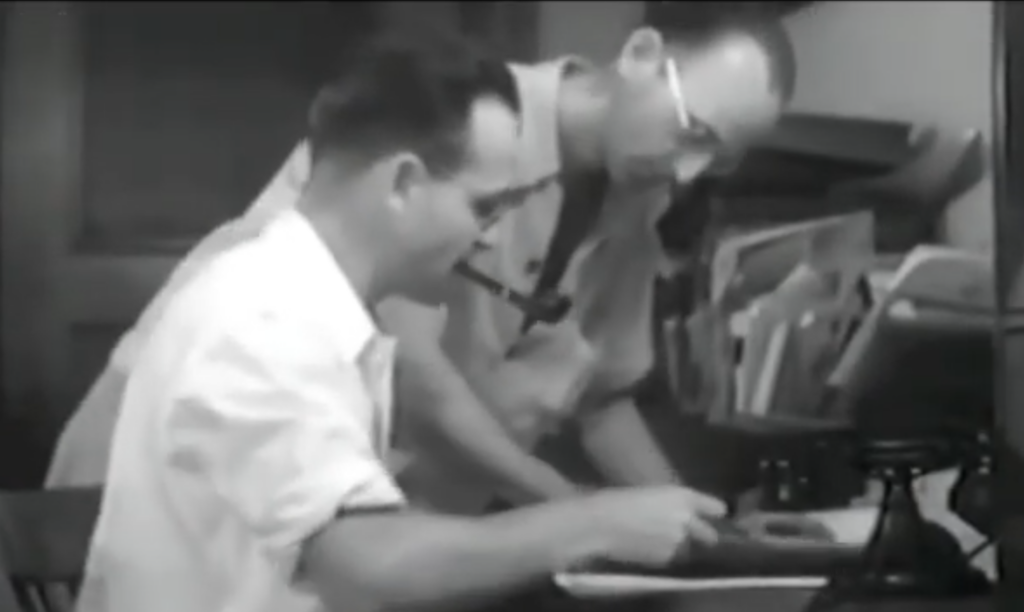

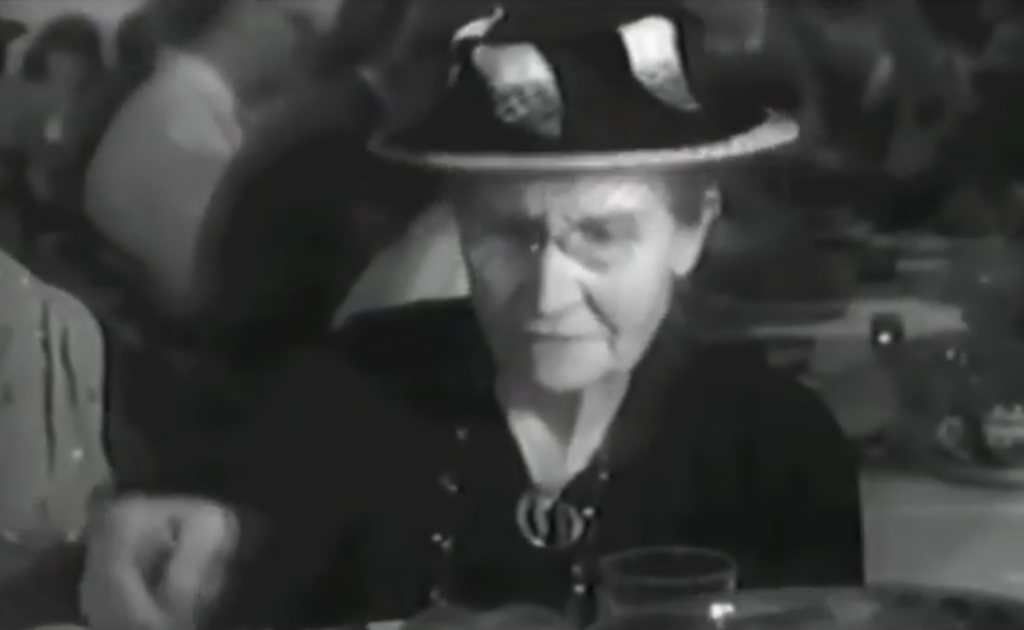
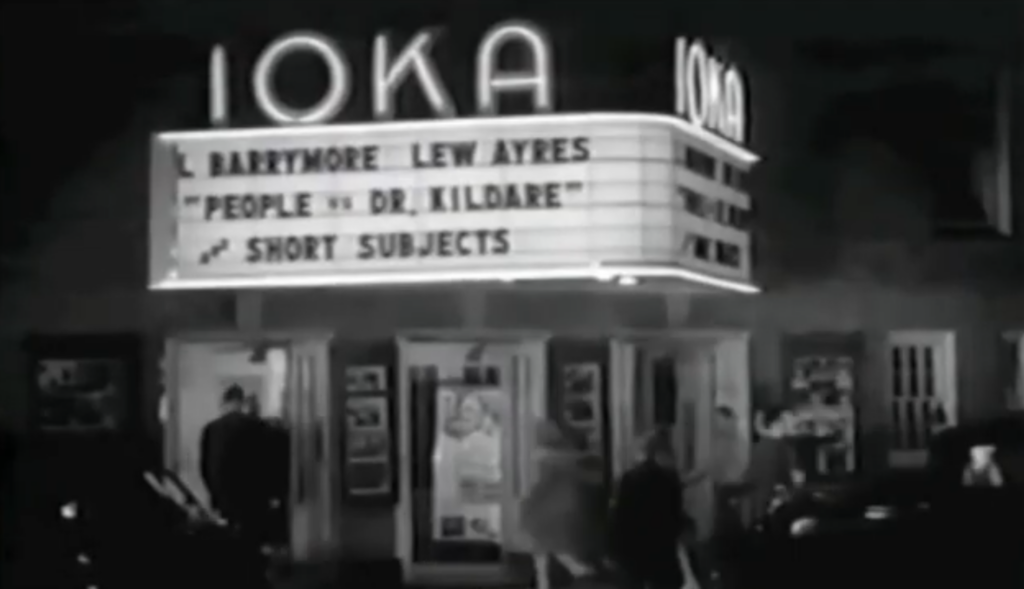
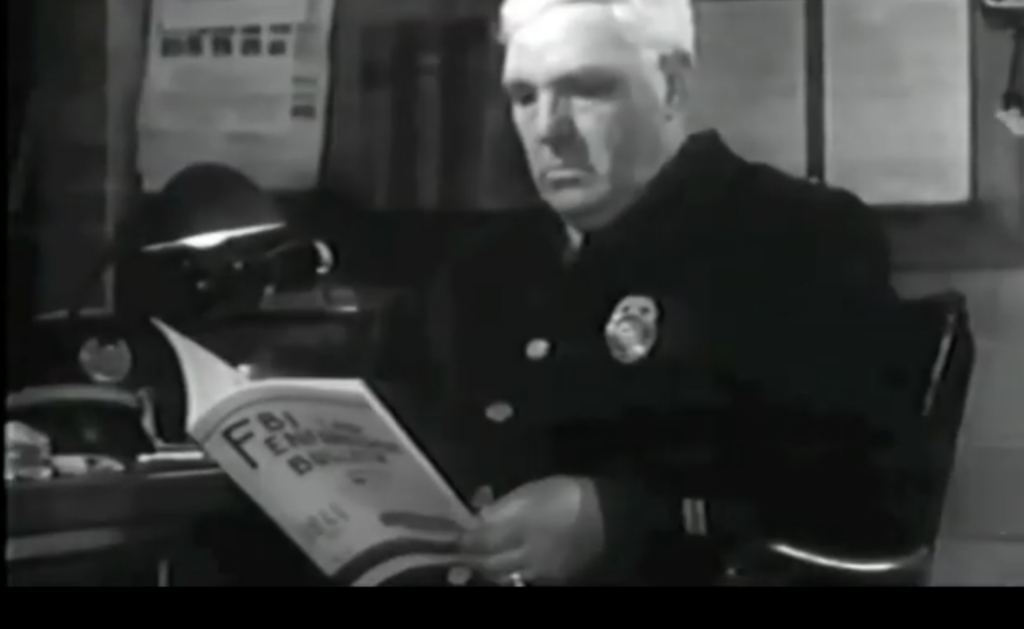
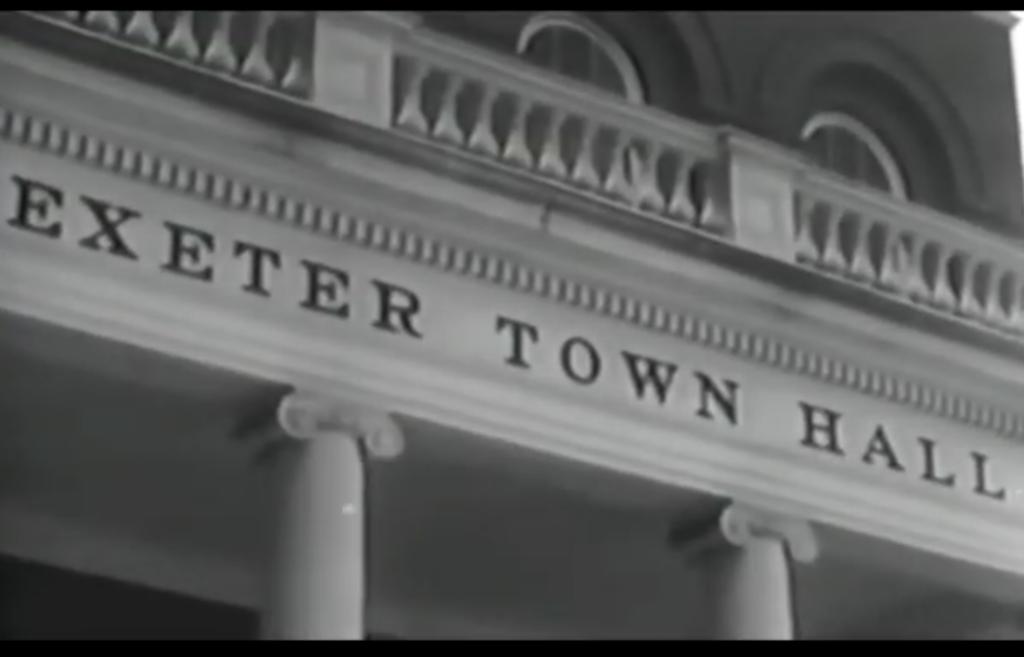
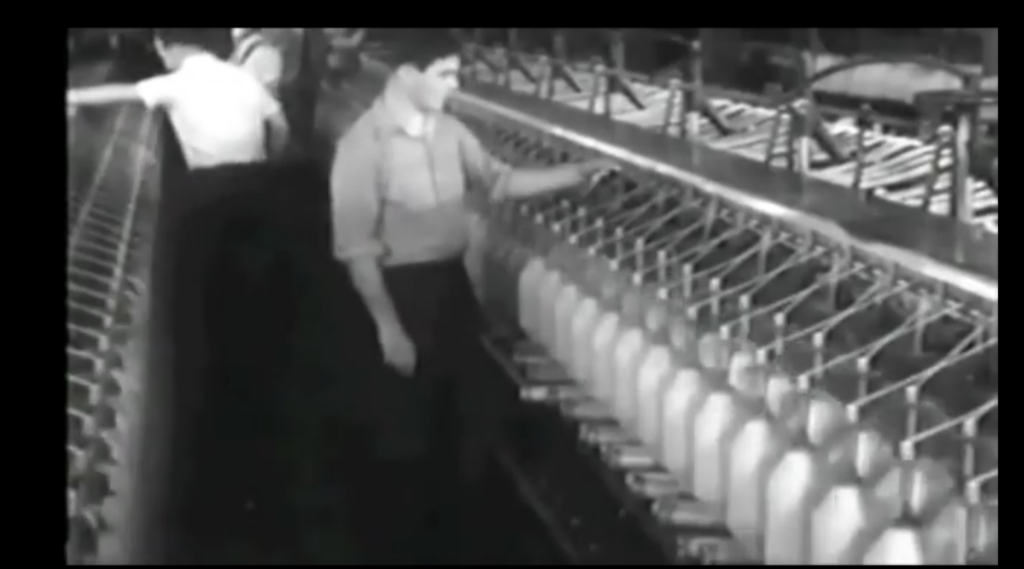
“Life in Exeter is not exciting by big city standards, but it is full and pleasant all the year round,” the narrator says as we see pastoral images of snow-covered farmland and white colonial homes. “Though winters are long, they don’t seem so severe as years ago. Not many people in town can afford to go South. But there are hundreds who wouldn’t miss a winter in Exeter, even if they could afford it.”
In pure de Rochemont style, the 11-minute segment is highly produced. Exeter then had 5,500 residents (14,306 in the most recent census) with many employed in local factories. The March of Time zoomed in on mill owner Harvey Kent who also had a controlling interest in the local bank and was a 10% owner of the Exeter Newsletter. The documentary team showed the Kent factory in operation, and followed Mr. Kent to his large home, estimated to cost $50,000.
March of Time got up close and personal with newspaper editor Harry Thayer, Mr. Haley. the butcher, and William Seward, owner of the pharmacy and soda shop on Water Street. Growing up in Massachusetts, Louis de Rochemont had been enamored of the bad boy tales of Exeter’s fictional Plupy Shute. The filmmaker hoped, someday, to turn the novels into movies, but that day never came. In 1941, however, he got to meet his hero, author Judge Henry Shute, then 84.
In a scripted scene, now politically incorrect, Judge Shute and his younger brother Ned swapped tales from the good-ol-days. Ned recalled an old Exeter codger who once said, “I can forgive a man for beatin’ his wife, but never for splittin’ the Republican ticket.”
In convincingly authentic scenes, March of Time packaged Exeter as the quintessential Yankee town. The underlying message, because de Rochemont always had one, was that the American way of life was worth preserving. With Adolph Hitler threatening the peace of the world, he implied, that democratic lifestyle was at risk. The film was a work of patriotic propaganda, urging Americans to end their isolationism and enter World War II.
Fervently anti-fascist, de Rochemont had been warning the nation of Hitler’s rise to power in film after film since the mid-1930s. Using stock footage and even actors portraying the German dictator, the New Hampshire filmmaker dared to say what most media and politicians avoided. “To the good Nazi,” the Voice of Time announced boldly, “not even God stands above Hitler.”
Time marches on
Begun as an elaborate weekly radio show, March of Time dramatized the news of the previous week. Actors including Orson Welles, re-enacted the words of famous people, sometimes inventing the dialogue. As many as 75 actors, engineers, writers, and musicians created the broadcast each week. The show was extremely expensive and always intended to advertise Time magazine. When Henry Luce tried to end the costly show, Americans protested.
De Rochemont’s genius was in convincing Luce to pump even more dollars into an exciting new kind of newsreel ,that brought world headlines to life by immersing viewers into the story on the wide screen. In de Rochemont’s first year on the job in 1935, March of Time earned a special Oscar for excellence in journalism. Eventually these enhanced newsreels appeared monthly in 9,800 theaters (another report says 11,000), reaching 25 million viewers. Louis de Rochemont, a social liberal, had unprecedented influence, even offering private screenings to presidents at the White House.
By the middle of World War II, de Rochemont was moving on. He wanted to make bigger, longer, and more costly productions. His brother Richard de Rochemont took over much of March of Time. But the creator’s influence remained stamped on every clip.
Not quite famous

Filmmaker Gary Anderson, who worked with de Rochemont in the 1970s, has been trying for decades to package the not-quite-famous producer. The first segment of Anderson’s film, De Rochemont: The Language of News, premiered at the NH Film Festival in 2013. It opens with a 16-year old Louis convincing a police officer to pose with a suspected terrorist. The teenaged cameraman scooped every other newsreel and a career was born. De Rochemont continued to re-engineer the facts in hundreds of productions to come.
“The editing technique that he developed for the March of Time,” Anderson says, “you see the DNA of it in every evening newscast and every documentary now.” Anderson’s biopic is still a work in progress.
De Rochemont is a tough hero to honor. Hard-drinking, moody, fiercely independent, he was always controversial. His one-man war against commercial Hollywood films won him few friends.
The March of Time catalog contains over 200 films from around the world. Topics range from the history of the phonograph, alcoholism, atomic energy, and progressive education, to Mahatma Gandhi, preachers in Harlem, and Albanian King Zog.
Long before Ken Burns, filmmaker Louis de Rochemont tracked down the roots of American jazz and filmed the battles of World War II. His influence, known or unknown, for good or for ill, is now playing on your television, portable computer, cell phone, and at your local cinema.
FOR MORE INFO: The book March of Time 1935-1951 by Raymond Fielding (1978) remains the only definitive study. Both the Exeter March of Time segment and Gary Anderson’s film clip can be seen on YouTube.com.
Copyright © 2016 by J. Dennis Robinson, all rights reserved.

 The Lost Interview with Historian Dorothy Vaughan, Part 2