



READ Lost Interview part one
“What are you screaming about?” Portsmouth Herald editor Ray Brighton reportedly said to Portsmouth historian Dorothy Vaughan. “Any time they touch anything, you start hollering.”
Theirs was the classic preservation battle over historic houses in the mid-twentieth century. Its lessons may apply today. For Brighton, an editor and owner of the daily newspaper, the city needed to evolve and stay economically viable in tough times. For Vaughan, the city librarian, every old building lost was a heart-rending tragedy.
“But we can’t lose them!” Vaughan said of the city’s old buildings.
“Poof!” Brighton replied. “We’ve got so many that one more going won’t make any difference. What are you crying about, just one more? We can afford to let one more go.”
“We can’t,” Vaughan insisted. “We can’t afford to let one more go!”
Quality or quantity?
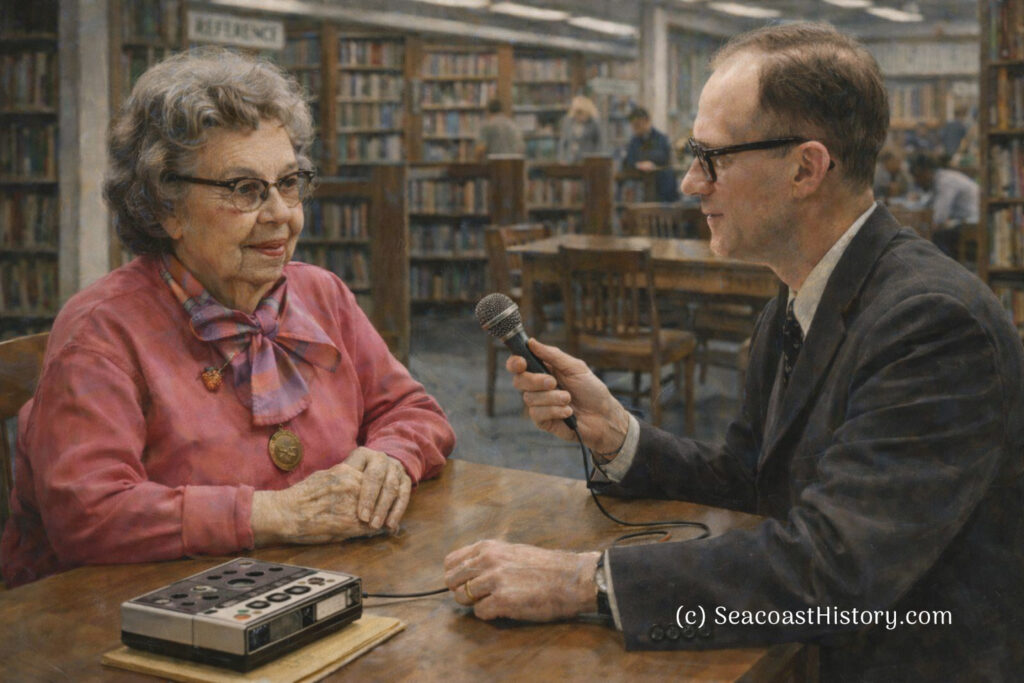
This dialogue comes directly from an unreleased 1969 interview with Vaughan by architectural historian Prof. Charles B. Hosmer. His two-volume book Preservation Comes of Age is a classic study of how Americans decide what parts of the past are worth saving, and what parts we can live without.
Vaughan was the go-to person for history in Portsmouth in the year of the first moon walk. She spoke candidly about the preservation of the city’s many historic house museums. She was then the volunteer president of the new 10-acre Strawbery Banke Museum. But after reading her own words in a transcript of Hosmer’s tape, she refused to allow its use. The unpublished transcript was recently discovered among documents that her heirs gave to the New Hampshire Historical Society in Concord.
Ray Brighton was also a dedicated historian who eventually wrote half a dozen books about Portsmouth. But to Vaughan, he would always be “one of the boys at the Herald” who saw progress as more important than preservation. And yet as Hosmer discovered in his interview, Vaughan’s rose-colored vision of the city’s past often sounded more like Camelot than the authentic hard-scrabble seaport.
Her patriotic Colonial Revival views, typical of her era, focused on famous Revolutionary War heroes and on the fashionable social life in the colonial mansions of wealthy merchants and sea captains. But her vision often glossed over the poverty, party politics, racism, religious schisms, crime, slavery, and other unsavory topics that were equally part of the city’s heritage. Only stories that glorified Portsmouth interested her.
In the 1930s and 40s Vaughan had worked with two independent groups that attempted to preserve and beautify old houses in the city, but both projects had gone down the drain. With eight independent historic house museums already operating in Portsmouth by 1969, many residents, like Brighton, seemed to feel that enough was enough. While Vaughan imagined the city as a Mecca for heritage tourism, the Herald scarcely reported on the destruction of hundreds of “blighted” buildings in the city’s ethnic North End in the years that followed under urban renewal.
“Everywhere you look there’s old houses,” Brighton told Vaughan. “You’ve got plenty of them.” And this, she admitted to Hosmer, was the way the whole city felt.
Hosmer asked Vaughan if the attitude toward historic preservation had improved in Portsmouth since the 1930s.
“No,” she said with evident disappointment. “I don’t think the shopkeepers and the merchants saw anything to it. You’d have to hit them over the head to make them contribute.”
A disciple among giants
While the city had an extraordinary number of house museums for its size, there was no unity. Each board of directors was a kingdom unto itself, Dorothy Vaughan told Hosmer. They were “all as jealous as they can be of each other,” she said. “If the John Paul Jones House had ten more visitors this year than the Warner House, the people at the Warner House would be awful mad.” There was an ongoing battle to attract the trickle of summer tourists, and one house would never recommend another to a visitor.
Vaughan knew well. She had made it her job to join or befriend the members of every historic house in town. As a city librarian, Vaughan inevitably ended up as archivist, press agent, historian, treasurer, or secretary for these struggling nonprofit groups. She was, before the Internet, the heart, the hub. and the connective tissue of historical information in town. And despite her lack of a college degree, the more she learned, the more people came to her with questions about Portsmouth’s past.
Because of her reputation, Vaughan was asked to do research for a book by the prominent architect John Mead Howells. She worked with Maine novelist Kenneth Roberts whose book Northwest Passage, with scenes set in Portsmouth, became a star-studded Hollywood movie in 1940. She kept company with the wealthy and eccentric William Sumner Appleton, founder of the Society for the Preservation of New England Antiquities, now renamed Historic New England.
She got to “brush elbows with giants,” Vaughan told her interviewer in 1969. “They were very enthusiastic about old Portsmouth. I was a natural disciple for them.”
It was William Sumner Appleton who purchased the 1664 Jackson House in Portsmouth in 1924, now considered the oldest surviving home in northern New England. Later the group acquired the John Langdon House that had been “padlocked” during Vaughan’s early days in town.
Born in 1874 and a Harvard-educated Boston Brahmin, his nonprofit organization saved 50 houses across New England. Vaughan set up the first tour guides, called “hostesses,” at the Jackson House and acted as treasurer. In return, Appleton took her to lunch at the Union Club in Boston where the social elite gathered.
“He was tall and he was burly, and he was big, and he had shaggy eyebrows, and his clothes always needed to be pressed,” Vaughan recalled.
It was Appleton who taught his disciple that architectural beauty was not skin deep. The two walked through Portsmouth together on the Fourth of July until her feet were sore. Vaughan was embarrassed to show Appleton the wooden houses in the city’s South End because they were covered in cheap tarpaper with a fake brick pattern. Appleton explained that hidden beneath these wooden buildings were historic gems.
Queen of the Warner House
Vaughan’s recovered 1969 interview also gives us an inside peek at the saving of the 1715 Warner House, one of the finest surviving early brick mansions in the nation. When the owners decided to tear it down in the 1930s to make way for a gas station, the local Daughters of the American Revolution chapter stepped in. Dorothy was a member. But they were a “poor chapter” Vaughan said. The DAR response, however, slowed down the sale and attracted Boston socialite Edith Wendell, whose husband was a Harvard professor with Portsmouth family connections. Mrs. Wendell helped raise the $10,000 needed to buy the house, now a museum on Daniel Street.
“Yes, I knew Mrs. Wendell very well,” Vaughan said. “She was a very dynamic person. She looked like Queen Victoria. She was a very large, formidable woman, and when she showed up at a meeting, you certainly sat up and took notice.”
Mrs. Wendell did not impress “the local people,” Vaughan noted, but she had great influence over the wealthy summer people who annually visited nearby Rye, New Castle, Kittery Point, and York. “If she gave a tea party, you never sent your regrets.”
Vaughan had a conflicted relationship with the highly educated and wealthy social set who, she openly admitted, were almost entirely responsible for saving the historic houses of Portsmouth. They were the modern version of the colonial Portsmouth “aristocracy” that she so richly admired and whose world she longed to re-create. But as a working-class librarian earning only a few thousand dollars per year, unmarried and without family connections, pedigree, or a college diploma, she was always on the outside of their world looking in. When she attempted to visit the Boston Athenaeum, even with a letter of recommendation from Appleton, she was treated “just like a piece of baggage,” she told Hosmer.
So while she longed to be among the rich and famous, Vaughan simultaneously resented their privileged lives and their “card-playing and tea partying” friends. These ladies were “loaded,” she told Prof. Hosmer, and Portsmouth’s historic houses were merely their “playthings.” While Mrs. Wendell’s friends easily wrote checks for hundreds of dollars, “all I could contribute was two bucks for my dues,” she recalled.
Dueling with Dale
Vaughan joined another local group in the 1930s that fell short of the $10,000 needed to preserve the Wentworth-Gardner mansion and the Tobias Lear House in the South End., Charles Dale, lawyer for the wealthy Prescott Sisters, put up the last $1,000. But after World War II, Vaughan was shocked to learn, that Dale somehow had become the legal owner of these historic houses.
Years later, after Dale had served as New Hampshire governor and Portsmouth mayor, Vaughan tangled with him again. When Dale threatened to tear down the Treadwell Mansion on Congress Street in the 1950s, Vaughan launched an effort to buy the historic property.
“You haven’t got enough money to talk with me,” Dale told Vaughan. “You couldn’t possibly afford it. I wouldn’t sell it to you…I’ll do what I want to do with it. Got to go. It’s full of termites.”
She later discovered, Vaughan told Hosmer, that Dale was angry with the city over tax issues, and razed the beautiful mansion out of spite. The following year, when Vaughan was marshaling locals to preserve what became Strawbery Banke Museum, Dale called the preservation project “a pig in a poke.” Without social connections, her efforts to raise millions of dollars to preserve almost three dozen Puddledock buildings fell flat.
“We can’t get any money from DuPont. We can’t get any money from Ford. We can’t get any money from Rockefeller,” she said. “We’ve tried all the big shots, and all the doors are closed.”
Sweat equity
Yet she soldiered on. What she lacked in social skills and education, Vaughan made up for with dogged determination and long hours. After World War II, as tourism began to revive, she fought to get the feuding house museums to advertise themselves in a collaborative brochure. Two decades later she was still fighting to get Strawbery Banke Museum off the ground. Her efforts, meanwhile, had earned her an honorary degree from the University of New Hampshire. By the Sixties, “Miss Vaughan” had become Dr. Vaughan.
“We’ve fought bloody battles,” she told Hosmer, “and we’ve almost gone under time and time and time again. And sometimes, I think that it was nothing but sheer dedication and positive thinking that has brought Strawbery Banke through, because we could have lost it so many many times. But we wanted it so much — I wanted it so much — that I made other people think that they wanted it too.”

The middle way
In her interview with Charles Hosmer that she refused to publish, Vaughan neglected to mention the wealthy local benefactors who contributed considerable time, money, and expertise to the early survival of Strawbery Banke. They would provide millions of dollars in years to come. She neglected to mention Richard Howland of the National Trust in Washington, DC whose speech in Portsmouth galvanized local business owners into launching Strawbery Banke in 1958. As trained historians and administrators and board members joined the Strawbery Banke effort,
Vaughan became disenfranchised. Her dream of restoring Portsmouth to the way it had looked at its hey-day after the American Revolution would not come true. The new historians brought with them a new vision of “old Portsmouth” as a more complex, diverse, imperfect, and dynamic city.
Dorothy Vaughan was often right. As she predicted, Portsmouth has become one of the nation’s favorite heritage destinations. And the income from short-stay visitors, as she promised business leaders half a century ago, is now the engine that drives the local economy. But as she so often told interviewers, Vaughan wanted to save everything old. To her, every scrap of Portsmouth’s past was equally precious. Her idea of preservation, to Ray Brighton and to others of his era, was to stop the clock entirely, and to live in a nostalgic past that never existed. But bulldozing the historic city under urban renewal, as Brighton favored, was equally not the answer. The solution, if we can truly learn from history, falls somewhere in between. A little Vaughan plus a little Brighton may show us the middle way.
Copyright © 2013 by J. Dennis Robinson, all rights reserved.
 The Trivial Pursuits of a Hyper-Local Historian