


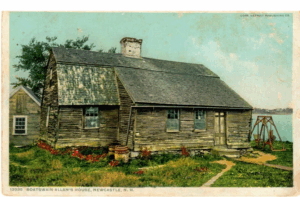
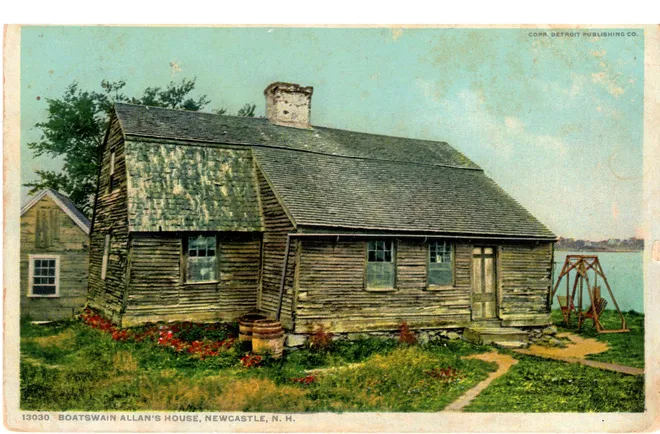
In history, as in modern news, there is a sad truism. It goes like this: If you say something often enough, long enough, and loud enough, people assume it’s true. One sure way to promote information in the early 20th century was to put it on a penny postcard. Countless millions of cards, often “colorized” from black and white photographs, depicted historic American landmarks. Now and then, the postcard makers got it wrong.
Souvenir postcards of New Castle typically showed the hotel, the lighthouse, the fort, the toll bridge and the ruins of the old Walbach Tower. Another popular card showed a battered, weather-beaten, Colonial cape labeled the “Bos’n” or “Boatswain” Allan House. Some card captions note the house was built in 1734. Others claim that Allan (or Allen) sailed with John Paul Jones aboard the frigate Ranger in the American Revolution. The connection makes sense. The Ranger was built just across the river at what is now Badger’s Island. Jones certainly boarded in Portsmouth and sailed the Ranger to England in 1777.
The postcards are everywhere. You can see them in online auctions, in local archives and collections, on Wikipedia, and at the Library of Congress website. But who was Bos’n Allan? Jim Cerny of the New Castle Historical Society says the story appears to be a myth. Two local historians, the late Ken Maxam and Ivan Meloon, did a lot of research to debunk the origin of the Bos’n Allan story. There was a boatswain named William Allen who said with Jones, but he did not live on Cranfield Street where the house once stood, Cerny says. He was likely confused with a young sailor who died at sea, whose family owned the old house.
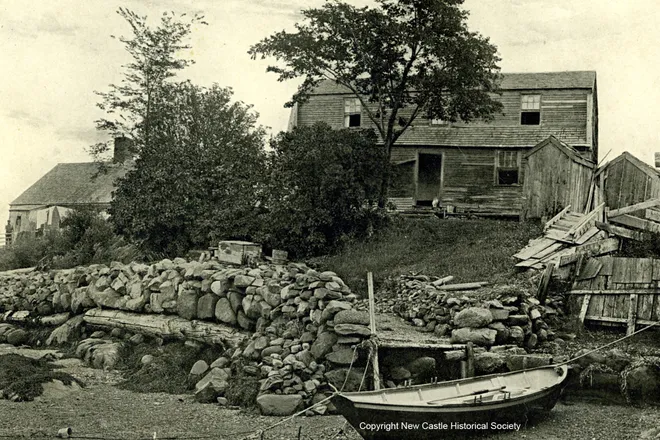
How the two characters got confused is not yet known. And that sounds like a fascinating assignment for yours truly. I just happen to own about 100 biographies of John Paul Jones, and someday, I would love to dig into this myth. Cerny notes that an early photograph in the historical society collection shows the ramshackle cottage in the Upper Cove before it was torn down in 1929. It indicates, he says, just how poor the town of New Castle was in the 19th and into the early 20th centuries. The quaint cottage in the postcard I just bought on eBay lives on. It may not tell the truth, but it satisfies the romantic image of New England as a charming and historic vacation site, still popular with tourists today.
J. Dennis Robinson, all rights reserved.
 A Hasty History of Prescott Park