



According to my notes, a British East India Company ship delivered 27 chests of tea into Portsmouth Harbor on July 27, 1774. City fathers wanted to avoid a repeat of the damage done at the “Boston Tea Party” seven months earlier, a protest that led to the blockade of Boston Harbor by the British Navy. So locals hid the controversial tea delivery inside the Portsmouth Custom House until it could be secretly shipped back to England. Crisis averted.
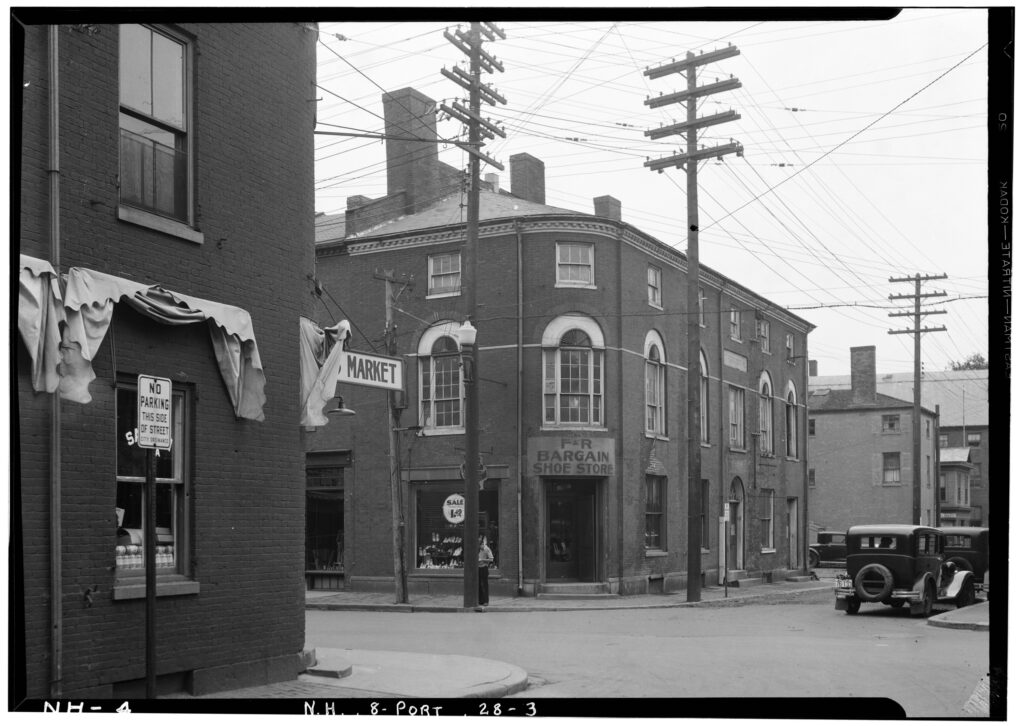
I assumed the valuable crates of tea were hidden in the Old Custom House downtown. You know the brick building with the curved entrance at the corner of Penhallow and Daniel streets as seen in this week’s history photo. But that building went up after the great downtown fires at the dawn of the 19th century.
This building served as the city’s Custom House and post office from only 1817 to 1858. It was replaced in 1860 by Portsmouth’s “newer” Old Custom House and Post Office, a towering granite edifice at the corner of State and Pleasant streets. In the not too distant past, it housed marketing and real estate agencies, many offices, a dress shop, a doll shop, and an auto parts store. Historian Charles Brewster, who owned the printing shop across the street in 1860, called it “a noble structure, perhaps adapted to what Portsmouth is to be, rather than what it now is.”
In this week’s 1935 photo, the Old Custom House at 73 Daniel St. was temporarily home to the F&R Bargain Shoe Store. Their sign hangs over the door. A smaller sign in the window reads “Sale $1.49.” There was a pawn shop at this address a decade earlier, and by the 1940s it was Halprin & Son Cleaners and Tailors. Commercial real estate shifts rapidly downtown as old buildings recycle tenants. Today, the building is occupied by a shop, restaurant and apartments.
There was a third customer house. Before the 1817 building, Portsmouth’s custom house was a small attachment to the home of Joseph Whipple (1738-1816), brother of Gen. William Whipple, who signed the Declaration of Independence. Following the American Revolution, Joseph served as collector of customs in Portsmouth from 1786 to 1789, the year George Washington visited this city. On July 31, 1789, the U.S. Customs Service (now Customs and Border Protection) was founded. The following month, Washington reassigned Joseph Whipple to the same post, making him the first customs officer in the new nation. Joseph Whipple’s home originally stood at 363 State St., now the corner of State and Chestnut streets. The house was moved in 1969 to make way for a bank parking lot and is now an apartment building at 599 Middle St.
If we count the addition to the Whipple apartment on Middle Street, that’s three surviving post-Revolutionary custom houses. But where did they hide the tea in 1774 when we were still a British seaport? According to Charles Brewster, the colonial custom house was operated in an “antiquated building” by “an antiquated man.” Eleazar Russell ran the custom house out of his home on the waterfront by the old ferry landing. The building dated to the late 1600s. Portsmouth Athenaeum “Keeper” Tom Hardiman saya that puts the building roughly where the parking lot for the Isles of Shoals Steamship Company ferry is today. Makes sense, since it was right on the waterfront.
Before and soon after the Revolution, any ship coming in or out of the harbor had to file papers with Eleazar Russell. So, chances are, the tea shipment of 1774 went through him. Brewster describes Russell as a lifelong bachelor of strict habits, spare and sharp, wearing a wig, three-cornered hat, and formally dressed with buckles on his knees and shoes. Deathly afraid of smallpox, Russell reportedly received papers delivered to his Custom House with a pair of tongs. He then smoked the documents over a fire before touching and reading them. He died at age 78 in 1798 and is buried in North Cemetery.
Copyright J. Dennis Robinson, all rights reserved.
 Legend of the Bos’n Allan House