


Editor’s Note: My 2023 hardcover history of New Castle, NH was in progress when this feature appeared in the local newspaper in 2017.
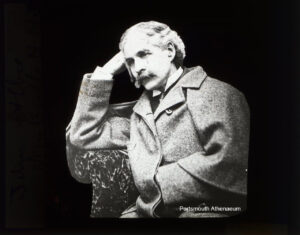
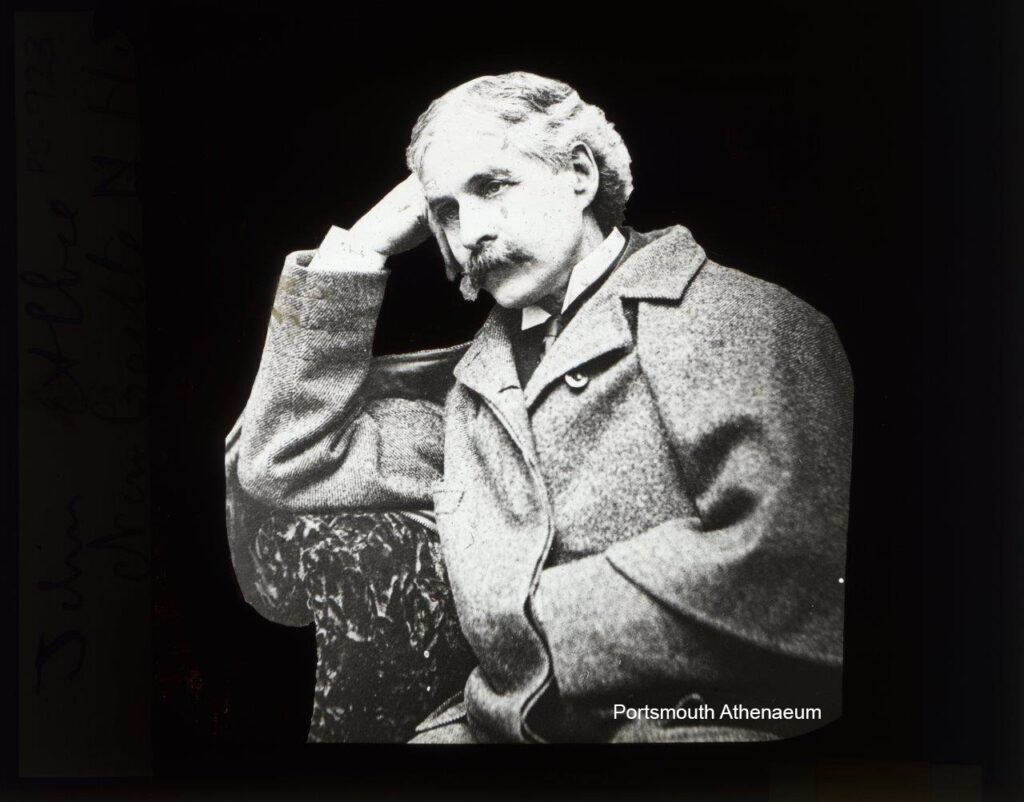
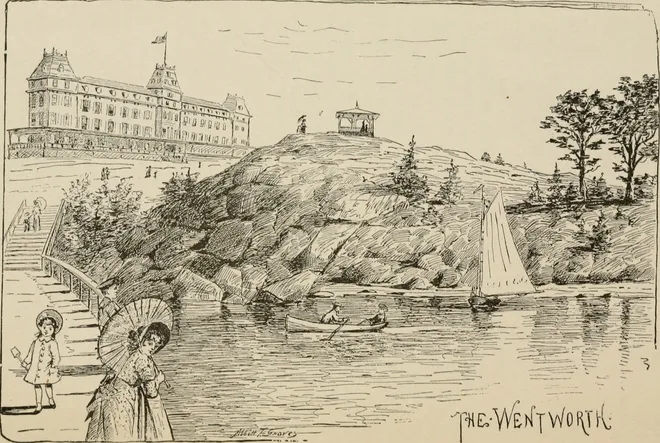
The best known history of the town, so far, is by a guy named John Albee (1833-1915). I’m reading his book now. “New Castle: Historic and Picturesque” came out in 1884, soon after ale tycoon Frank Jones took over the Wentworth Hotel. Jones likely hired Albee, a minor poet, farmer and former minister, to write the book as a marketing tool to attract tourists.
John Albee set a high bar. His prose is pretty snappy for a Victorian minister educated at Harvard. Although he was writing and farming in New Castle by the close of the Civil War, Albee was not a local boy. He grew up in Bellingham, Massachusetts, a few miles from Milford. Coincidentally, I hail from that region too. Born in Worcester, I grew up in nearby Grafton, where Albee once taught school. I lived briefly in Milford after college when I was the manager and sole employee of a tiny news and candy shop in nearby Hopedale, best known today as the hometown of Aerosmith’s lead guitarist Joe Perry.
But this story is not about me or Joe Perry. What follows comes from an incredible, but unheralded, memoir that John Albee wrote in his waning years. “Confessions of Boyhood” (1910) knocked me flat. The opening chapters are, admittedly, fairly dull by modern standards. But the heart of the book is a moving, insightful, and revealing look at the struggling growth of a poor New England boy in the mid-1800s.
On being a boy
John Albee was born in a red house under a large elm. It is unclear from his memoir how his father, a farmer from Bellingham, died following “an attempt to save his shocks of rye from ruin” during a violent thunderstorm. At his father’s funeral, holding his mother’s hand, Albee was too young to understand what was happening. Later, he realized, “in that grave all our hopes were buried.”
Albee was the only boy among three sisters, one of whom soon followed their father into the grave. His mother, bereft and impoverished, was deeply religious and rarely spoke. Until he was 16, the boy wore clothes cut down from his dead father’s wardrobe. Often alone, Albee roamed the nearby woods and pastures. He picked berries, gathered walnuts and fished in a nearby stream using a bent pin for a hook. His best friends he writes, were shadows, echoes, animals and the moon. His world was entirely Bellingham and beyond it, he imagined, was China, where everyone flew kites.
But Bellingham had no mountains or hills, no monuments, no ruins or historic sites, no famous people, and no poets. Although he was only as tall as a man’s leg, the sensitive, curly-haired boy in the wide-brimmed straw hat craved adventure. Albee recounts with rich detail his first solo visit to neighboring houses. His father had owned only a single book of sermons. Now he saw libraries full of books and kitchens full of food. Albee describes the ecstasy of spending his first well-earned penny on candy at a store, and the sadness that flooded over him when his penny was gone.
At age six, the boy fell hopelessly in love with a 23-year old woman and suffered a broken heart. That same year he joined his mother and neighbors as they witnessed the amputation of the leg of the local cobbler. Albee found it thrilling. When a political uprising in nearby Rhode Island panicked his family, the brave little soldier promised to fend off the rebels with his fishing pole. When Rev. William Miller’s prediction that the second coming of Jesus Christ failed to take place in 1844, sweeping away the sinners of the world, the boy was deeply disappointed. In response, Albee built a model city in a nearby field and set it on fire. He spent a night in a closet on bread and water as punishment.
Finding a career
No amount of baking or sewing for neighbors or taking in boarders would supply Albee’s mother with enough money to send him to college. So he was apprenticed at age eight to a bootmaker. It did not go well. He sobbed for weeks until he was returned home. At 10, he was apprenticed to a sawmill owner and attended school in the summer. But after two years, he grew sickly and depressed, “and I wished myself dead,” he confessed. He resolved to become a sailor.
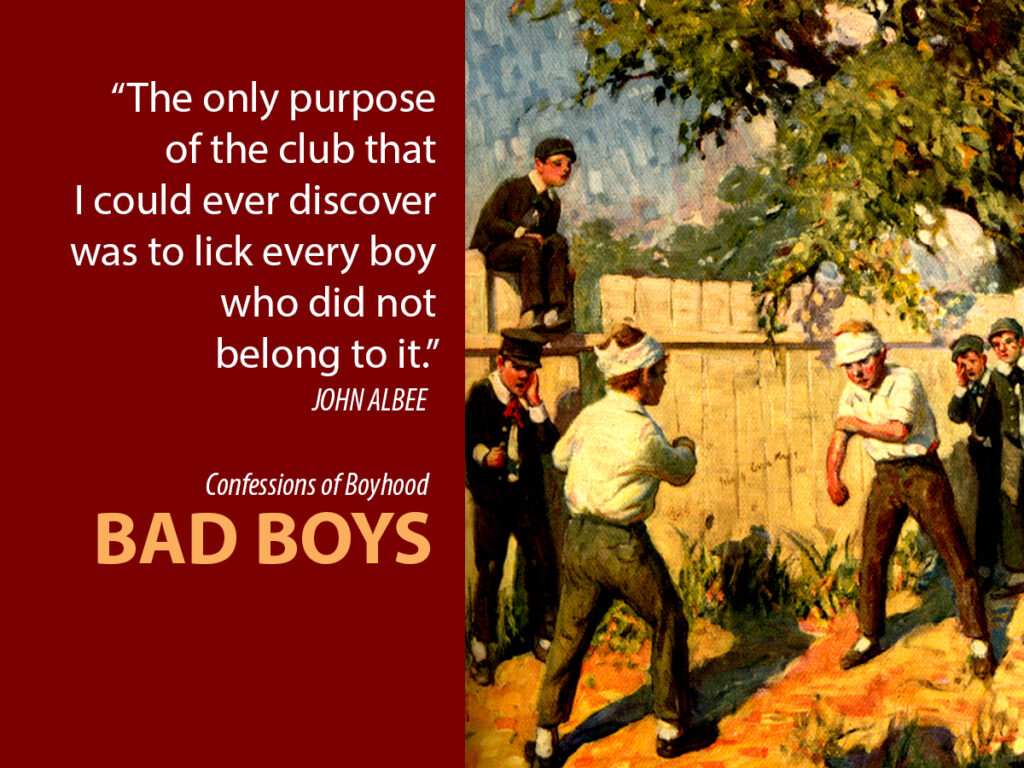
Instead, Albee’s older sister, a well-respected teacher, brought her brother to Norwich, Connecticut, where he attended classes and befriended her wealthy students. But he was soon required to learn a trade. This time he worked in a dry goods shop where he swept up, kindled the fire and ran errands. Falling in with a gang of rough boys, he learned to smoke and swear. “The only purpose of the club that I could ever discover,” Albee wrote, “was to lick every boy who did not belong to it.” Attending a town fair, this time with a whole quarter burning in his pocket, he squandered all his money to gawk at albino children, watch dwarves battle giants and see a trained pig play cards.
One day he came upon the frozen bodies of passengers from a wrecked ship laid out in the street. The scene gave him nightmares. When a tribe of Penobscot Indians pitched their tents nearby, he longed to travel away with them. He romanced local girls and learned the art of swindling customers in the store where he worked. His life, he realized, was without direction or meaning.
The awakening
When his sister moved to a teaching position in Worcester, Albee followed. He found work in a gun factory. The company made a patented six-barrel self-cocking revolver used more for decoration than shooting. Almost 15, he found himself dressed in blue jeans and coated in grease for 10 hours a day.
Ever inventive, Albee found he could get out of work at the pistol factory by feigning illness. He was taken to a doctor who dosed him with lobella, a flowering plant used as a purgative. The doctor, it turns out, was also a professor of medicine. Albee borrowed books from the doctor’s classical library and helped him obtain cadavers – they came in barrels of oats shipped to the railroad station–that the doctor and his students dissected in the basement.
Hanging out with the doctor’s medical students, John Albee realized he would never be anything but a lowly farmer. On a whim, he walked the 25 miles from Worcester back to the red house where he had grown up in Bellingham. His mother had moved on and his uncle now ran the farm. A week or two of farming and Albee was back at the pistol factory.
With his sister’s help, the discontented boy enrolled at Worcester Academy, a mediocre institution with only a hundred books in its library. Tuition was a dollar a week and the students did pretty much whatever they pleased. Books became his teachers and his personality seemed to shift with every book he read, from Greek classics to the poetry of Lord Byron. He dabbled in writing essays. He became bookish and, by his own admission, a bit of a snob.
Worcester was then a hotbed of reform and revolutionary thinking. Albee attended lyceum talks by the likes of Sojourner Truth and William Lloyd Garrison. He was drawn to the anti-slavery movement, to the cause of women’s rights and to temperance. Albee joined the Free-Soil Party and began reading the works of Henry David Thoreau, Louisa May Alcott and Ralph Waldo Emerson. His eyes were opened.

New Castle bound
Like many teenagers of his era, once John Albee had gained a rudimentary education, he became a teacher. He boarded with an elderly Baptist family and ran a schoolhouse in Grafton, Massachusetts, the very town where this writer grew up. But unlike his sister, Albee was not a great teacher. His newly acquired progressive beliefs got him in trouble with some of the local parents, whom he called “rummies.” He fell for a local girl and began writing poetry. Eventually he found his way to Phillips Andover Academy, and that’s where “Confessions of Boyhood” ends.
How John Albee got from Andover to Harvard Divinity School and ended up in New Castle I do not yet know. The island fishing families were very poor at the time, and the tourism business had not kicked in when Albee purchased 28 acres with “buildings thereon” for $1,775 on March 18, 1865. That was the old “Jaffrey Cottage” that burned in the 1960s. He bought another 10 acres in 1873 for $1,050. He seems to have farmed his land in the summer and worked on his books, poetry and magazine articles in the winter months. According to one report, he sometimes edited a Portsmouth newspaper.
I’m sure Mr. Albee and I will become close friends in the coming years. Some say we even look alike. We certainly share a fascination with the past and a compulsion to write about it.
“Local history is the only important history,” Albee once wrote. “In it we come nearer to human life, to man, than in that of empires.”
In New Castle, it also appears, the boy found a spiritual home. Like his father, he tilled the soil and tended his animals. Like Bellingham, New Castle was small, rural, folksy, poor and full of memorable characters.
“When the town grows to a city all is lost,” he noted in his “Confessions of Boyhood.” And why? “The larger the city, the easier it is for rascals to rule,” he wrote. No problem in New Castle, where the population hovers on the edge of only 1,000 residents.
But unlike his hometown, New Castle was awash in history. It had been, in its first decades, the beating heart of the New Hampshire province. It offered, for Albee and those who follow him, a rollicking cast of characters–brave fishermen, bold patriots, shrewd merchants, boat builders, accused witches, beloved teachers, wealthy rusticators, religious firebrands, hoteliers and tavern owners, lighthouse keepers, fort soldiers, bridge builders, philanthropists, painters, and poets.
For more information: John Albee’s books, “New Castle: Historic and Picturesque” (1884) and “Confessions of Boyhood” (1910) are both available to read or download free of charge on Google Books. Copyright 2017 by J. Dennis Robinson, updated 2025, all rights reserved.
 Portsmouth’s Many Old Custom Houses