


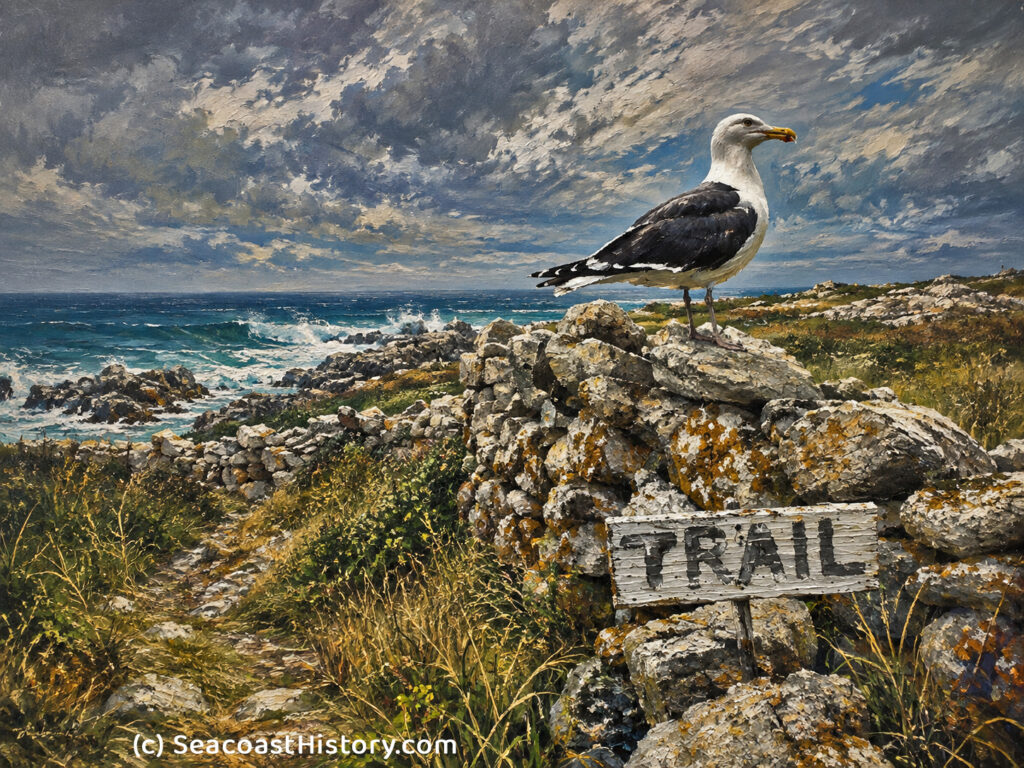
For years I was attacked by ferocious seagulls on the uninhabited tip of Smuttynose Island in Maine. My job was to clear the hiking trail that winds through acres of poison ivy, swamp grass, bog, and bracken from Haley’s Cove to the stone cairn three-quarters of a mile away.
The island is little more than a rocky shelf streaked in gull poop and muskrat scat, but the 360-degree view of the sea, the mainland and the other Isles of Shoals is beyond words. I carried a super-sized gas-powered weed whacker that ripped through the thick greenery like a Vegematic on a stick. It took about two hours a day for a week to whack back the trail in the first hot days of June. I returned to the cottage coated in a cocktail of unknown plant juices. I was scarred by flying sticks and stones and speckled with mosquito bites. The island offered no running water, no electricity. There are no roads, no other occupants, no stores, no flush toilets. I loved it.
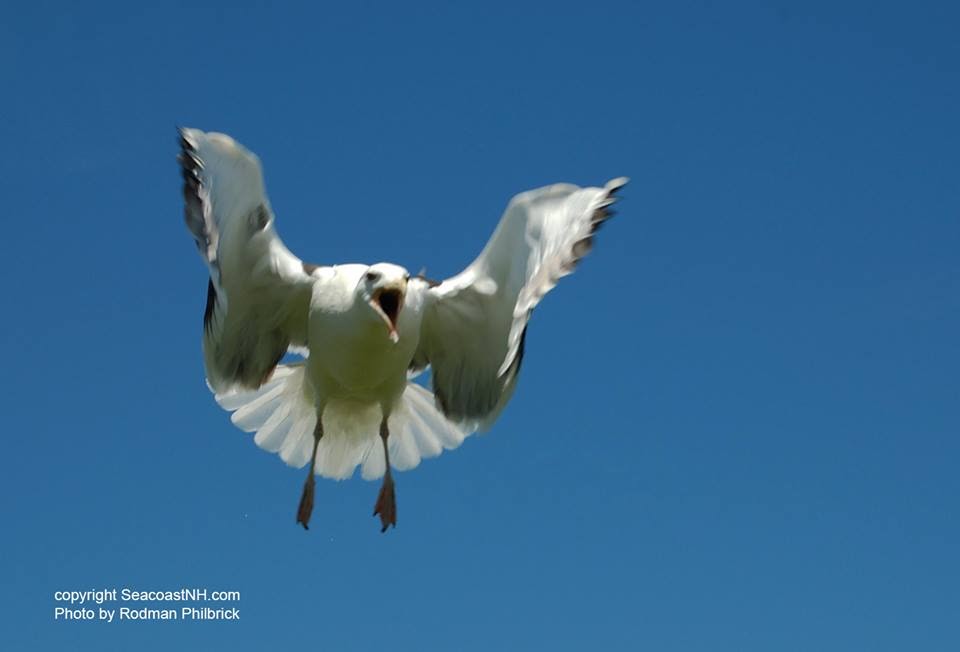
The Smuttynose Trail runs smack through the breeding grounds of hundreds of nesting seagulls and blackbacks who lay their gray eggs in late spring and protect their gray chicks with Hitchcockian passion. Visitors are advised to carry sticks above their heads. Gulls like to attack from behind and will use their sharp beaks, which can inflict a nasty head gash at 40 mph. A gull wingspan can reach five feet. They have a fishhook-shaped barb in the middle of each webbed foot that they use like a small dagger. They may be beautiful in the air, but on land they are nasty, carnivorous, and stupid. Like lightning, they attack the tallest object, which is where the stick comes in. It is not a weapon, but a decoy, a false head. Some people like to put a hat on the stick and hoist it tentatively like a cowboy hiding behind a rock in an old western shootout.
But gulls shoot first and ask questions later. Strike that. Gulls shoot first and never ask why. One island visitor was coated from hat to sandal while reading a novel in a lounge chair in front of the island cottage. It was an unprovoked act of raw terrorism. Gulls fire their guano from the air, or upchuck a foul semi-digested bile of raw fish, muscles, and dead crab guts. They shoot wildly, like a baby with a gun, and they never account for the wind. But sometimes they hit the mark.
I understand that I am the aggressor here. To the gulls, I am walking through their maternity ward with a chainsaw. Now and then, there is collateral damage. Eggs look like rocks, and sometimes a nest gets built deep in the folds of the long swirling grass in the center of the trail. But the gulls are aggressors too. An island visitor confirmed that, when she was here in 1947, there was scarcely a gull in sight, and the island was almost bare of vegetation. The gangs of gulls and their excrement and the lush greenery have all arrived in the last half-century.
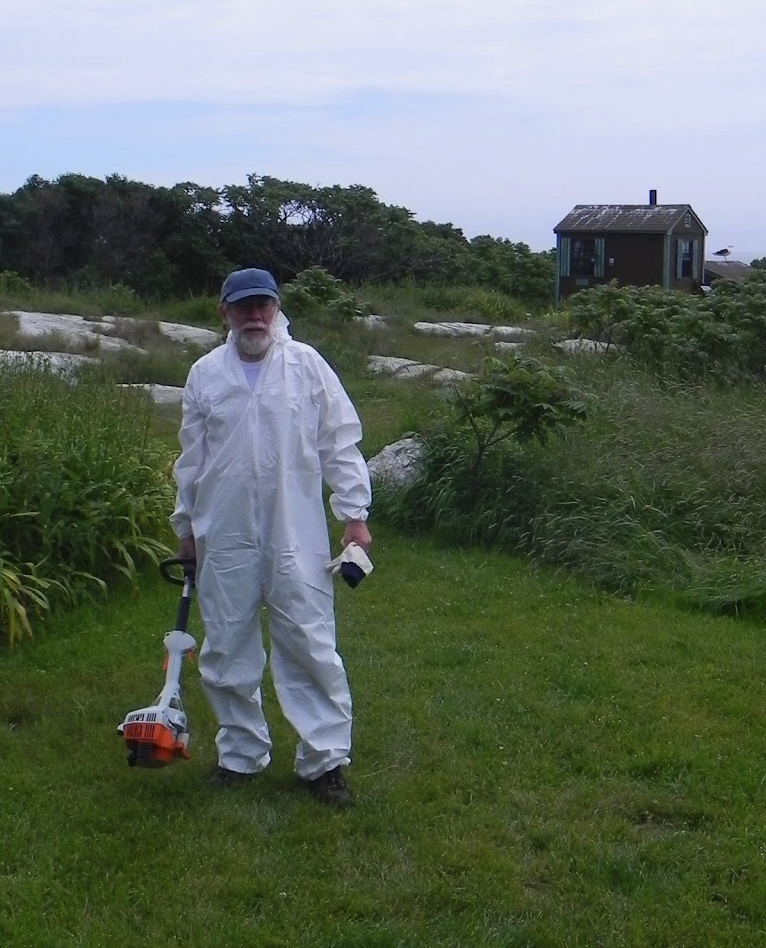
All we humans want back is a small swath of land for a few months each year. My job for 20 years was to take that territory and hold it for the season. I was good at my job.
Although there are rarely more than two people on island, Smuttynose is crowded ornithologically. Each gull has only a few yards of turf and only attacks when you threaten his/her space, so if you keep moving, you are quickly ignored. The action begins when the trailblazer has to clean a spot managed by a particularly testy bird. One summer my nephew named the nastiest one “Gullzilla.” I used to strap a long stick to my back to give him something to attack while I quickly trimmed my way along the trail. Then I decided I could run no more.
Beyond the ancient stone wall that cuts the island in half is a killing ground. Gulls eat their neighbors’ kids and prey on the weak and elderly. The guano-streaked rocks are littered with bleached bones, rotting corpses, and discarded feathers.
Researchers at the Shoals Marine Lab on Appledore have proven that gulls recognize human faces. Gullzilla was not pleased to see me back in his kingdom that year. He hovered over his stony throne, squirting and screaming into the powerful winds that almost always blow across the island near sunset. This time I did not move. I screamed back. I stepped onto a flat white boulder the size of a kitchen table.
“My rock!” I shouted. “My rock, my rock, my rock!”
Gullzilla went into an attack spiral overhead, but the wind was on my side, forcing him to attack only from the direction that provided the most glide and speed. I refused to turn my back, rotating slowly and looking directly at him. I kept my stick to my side. His first swoop was tentative and distant, his first projectile way off the mark. “My rock!” I told him again.
For Gullzilla, there was no backing down. Too many of his subjects were watching. He turned in a great arc, then drove in, dropping almost to my level and charging head-on. “My rock!” he screamed, then fell three feet in a split second, hammering forward. In that same split second, I raised my stick at arm’s length, suddenly doubling my height, and shouted. Gullzilla swerved, climbed, shouted back, and fired all in one fluid motion, tapping the top of my stick with his webbed foot and almost knocking it from my hand. I twisted it seems now in slow motion as the undulating white missile pulsed past my shoulder.
It took a dozen identical strikes before Gullzilla gave up the fight. He ran low on ammo as his attacks grew more distant and less enthusiastic. Seeing this, several competing gulls began harassing their former leader as he looped back around, as if they were drawing his fire from me. I was, by rights, their new King of the Rock. Gullzilla, chastened, found himself a distant perch near the breaking surf.
I restarted my whacking machine, cleared the holy rock of excess vegetation, and moved on. The next day, Gullzilla was back on his stone. We eyed each other, and with scarcely a sound, he flew off. When I passed down the trail, he resumed his sentry duty. Only I was allowed to pass.
When I told this story to my friend, standing in a Revolutionary War era-cottage, coated in sweat, suntan lotion, and green debris, she gave me a “that’s nice, dear” smile. She advised a bath in the cove before dinner. The fact that I had out-gulled the biggest, baddest bird in town did not seem to resonate with her.
But I am a man, or for one shining moment, a man-bird. I took that rock alone and, in doing so, claimed the ancient island of Smuttynose. Like old Sam Haley, who raised 11 children here and who is buried just behind the ancient Haley cottage, I was king of a 27-acre kingdom surrounded by the sea.
“My rock!” I screamed once more into the exploding sunset, and none dared protest. There was no sound besides the faint lapping of waves, the rumoring wind, and the prayerful chatter of a thousand adoring gulls.
Copyright © 2006, edited 2026 by J. Dennis Robinson. All rights reserved.
 A Lovely Artifact from Philbrick’s Pharmacy