


Research for an upcoming history feature has taken your humble historian into the unfamiliar world of physical fitness. I’m not saying I don’t own my share of exercise equipment. I do. But getting these infernal machines out of the box is exhausting. It can take years.
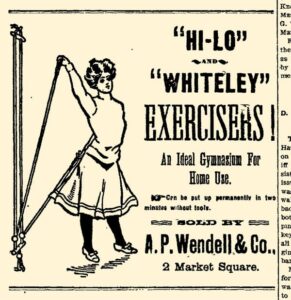
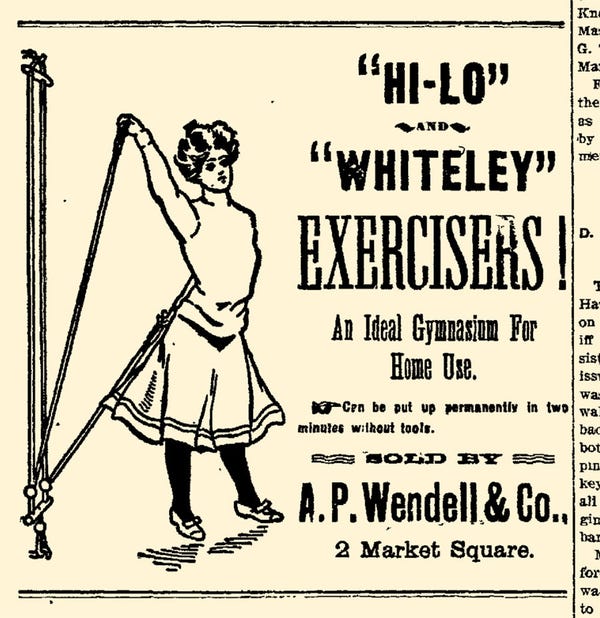
One hundred and twenty years ago, this ad for “Hi-Lo” equipment from the Whiteley Company (also spelled Whitely) claimed to be “an ideal gymnasium for home use.” Since Portsmouth men were exercising in downtown athletic clubs, the ad, like many from the Whiteley Company, pictured a woman working out on a pulley system attached to the wall by a hook.
The exerciser “can be put up permanently in minutes without tools,” the ad notes. It was available from A.P. Wendell & Sons at Two Market Square. Andrew P. Wendell (born 1844) took over the longstanding hardware store from his father and uncle. Besides the trendy exercise equipment, Wendell specialized in paints, varnishes, oils, firearms, ammunition, cutlery, bicycles, fishing equipment, and boat fittings.
This ad appeared in a 1903 copy of the Portsmouth Herald, owned by F.W. Hartford. That same year Hartford purchased the Music Hall through a privately owned stock company known as the Portsmouth Theatre Company.
Another Whitely ad from this era shows mom, dad, and a little daughter, all exercising together at home with the pulley system. The mustachioed father is still wearing his tie, starched collar, and vest while the girl is in her Sunday-best frilly frock. Exercise is “the most sensible Christmas present,” the headline claims.
“Its use brings every muscle into play,” the advertising copy reads. “[it] makes sluggish blood active, developing muscle, and quickening the intellect. Makes weak women strong, giving them good form, good complexion, good health.”
The accompanying lesson book, developed by a noted Swedish expert in Physical Culture, offered an unbeatable guarantee. “By no other method ever discovered,” according to the lesson book, “is it possible to obtain in so short a time and for so small an expenditure such astonishing results.” That may be true. Made from “a pure gum cable of many strands covered to protect it from weather,” the exerciser prices ranged from one to five dollars.
Copyright J. Dennis Robinson, all rights reserved.
 The Last Seacoast Days of Rev. Whitefield