



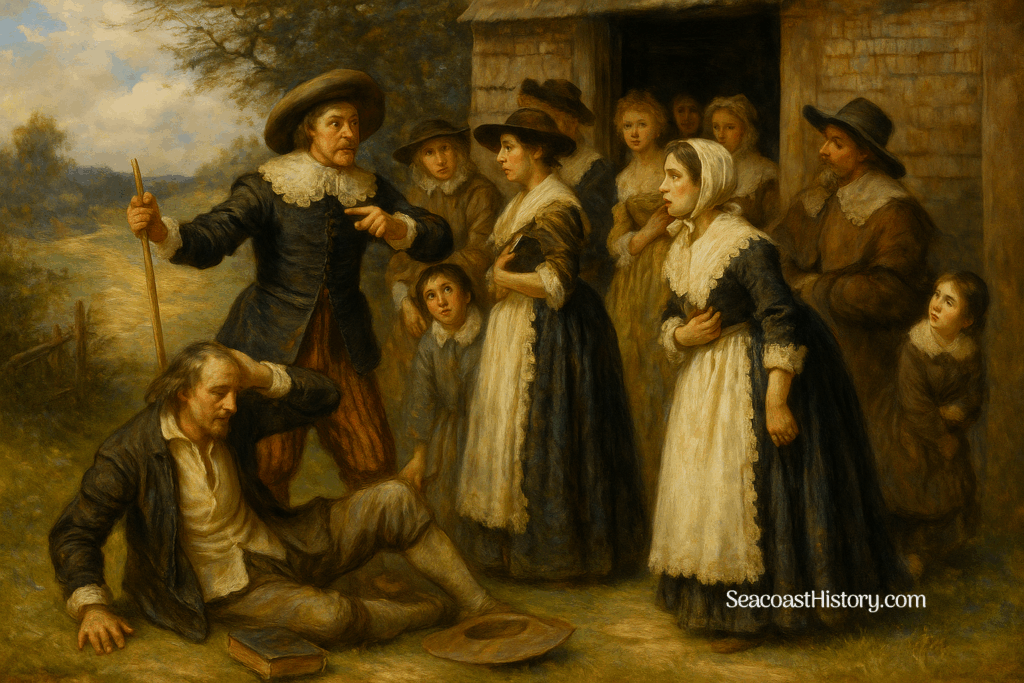
The year 1681 didn’t go well. A blazing comet lit up the night sky. It was a clear sign, many seacoast residents decided, that God was unhappy. Then New Hampshire’s first royal governor, John Cutt of Portsmouth, got very sick. To appease the Lord, all citizens of the province were required to fast, set aside their daily work, attend church, and pray for Mr. Cutt. Those who didn’t obey were fined. But the governor died anyway.
So in 1682, New Hampshire got a new governor, and things got worse. Technically Edward Cranfield was lieutenant governor and commander in chief, but he acted more like a dictator. Cranfield’s temper was “easily excited by opposition,” according to Nathaniel Adams, Portsmouth’s first historian. Appointed by King Charles II of England, Cranfield was vindictive and regularly sought revenge on anyone who dared disagree with him. “The arbitrary manner in which he exercised his authority had a tendency to render him unpopular,” Adams wrote.
A little background
Let’s remember Portsmouth was founded by British investors. Capt. John Mason, who held the New Hampshire patent, hoped to create a sort of feudal kingdom here. He would own all the land and everyone would pay him rent. But John Mason died suddenly in 1635, having never seen his colony at Strawberry Bank. His investors quit, so the abandoned first settlers each grabbed a chunk of land and settled down to fish or farm, to run sawmills or trade with the Natives.
Over the next two decades, 20,000 English Puritans moved into nearby Massachusetts and largely took control of New Hampshire’s four seacoast towns: Portsmouth, Exeter, Hampton, and Dover. During that period things went wild in England. King Charles I was beheaded in 1649 when Puritan leader Oliver Cromwell took control of the government. But the Puritan takeover didn’t take. Cromwell died and was buried in 1658. The following year his corpse was exhumed, put on trial for treason, hanged in chains and thrown into a pit. Cromwell’s head was cut off and placed on a pole outside Westminster Abbey in London. Our politics, by comparison, appear almost kindly.
A royal province
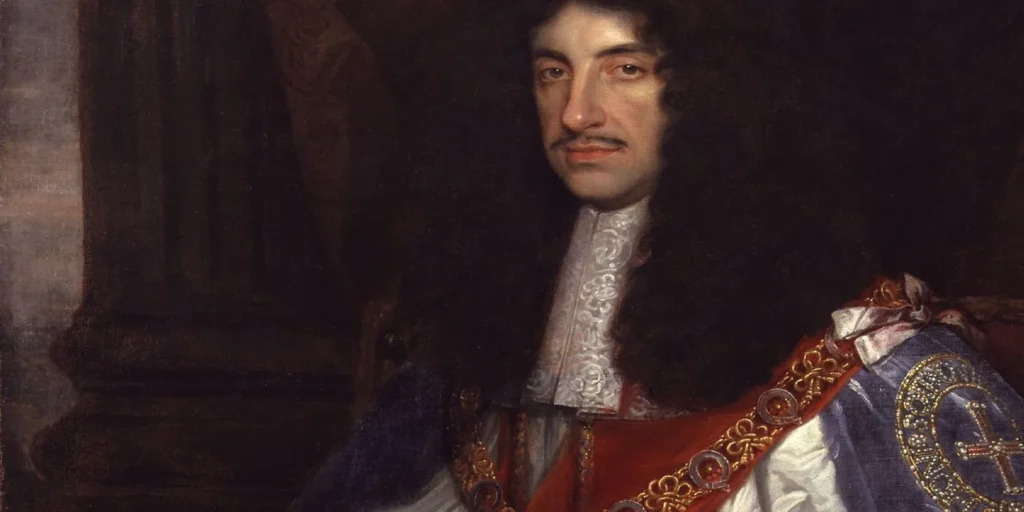
By 1660, the monarchy was back. Charles II, son of the beheaded Charles I, was on the throne and – no surprise – he wasn’t happy with the Puritans running New England. In 1679, he declared New Hampshire to be a royal province, subject to the laws of the Church of England. This was fine with the larger population of Portsmouth residents who lived, at that time, at Great Island, now the town of New Castle. The largely pro-Puritan locals tended to live close to what is now the South End of downtown Portsmouth.
Enter Robert Mason, grandson of Capt. John Mason, who believed his family still owned all of New Hampshire. Mason had previously tried and failed to convince locals to pay him rent for their land. They laughed and sent him back to England. But that was when the Puritans were in charge. By the 1680s New Hampshire was a royal colony again and Edward Cranfield was in power. So Mason cut a deal. If Cranfield could get the locals to pay their rent, the governor could keep the lion’s share of the money for a few years. King Charles would also get a slice.
Cranfield made it very clear he was accepting the post as governor for the money, and he was going to get rich. When members of the local general assembly (who usually met at Great Island) didn’t like his tactics, he fired them. When residents refused to pay their rents to the Mason family, he strong-armed them. According to Adams, he employed pimps and and spies to dig up dirt on his enemies.
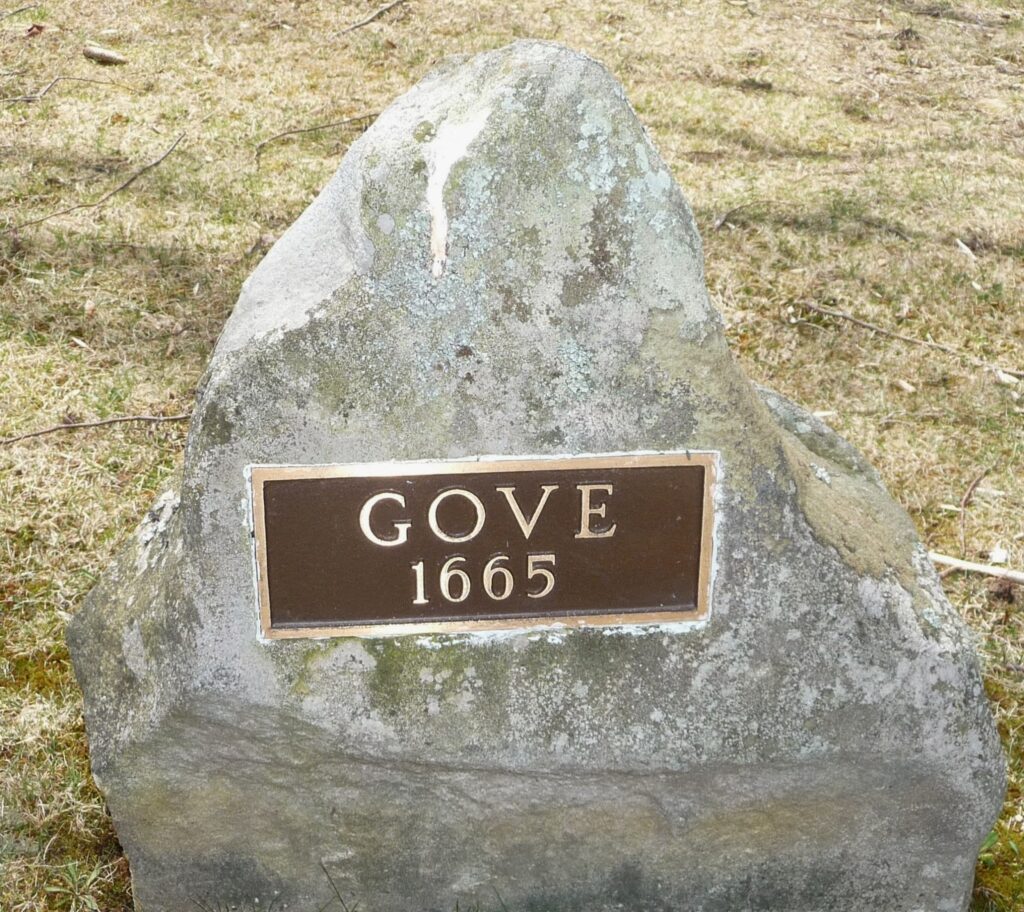
Cranfield’s efforts to enforce English navigation laws were especially heinous to New Hampshire merchants who were developing profitable tradeways with foreign buyers. In 1683, incensed by quitrents, tariffs, and shipping penalties, Edward Gove of Hampton plotted to oust the new governor. Gove’s Rebellion was quickly suppressed. Gove was charged with high treason and imprisoned on Great Island. Sentenced to be hanged, drawn, and quartered, Gove was shipped off to England where he spent three years in the Tower of London. He was eventually released and sent home.
A growing enemies list
When Portsmouth’s first minister, Joshua Moody, accused one of Cranfield’s men of lying, the governor struck back. Cranfield insisted that Moody, a Puritan, serve communion following the rules set down by the Church of England. When Rev. Moody would not comply, he too was jailed on Great Island. Moody was banned from preaching to his followers in Portsmouth’s South End. He was eventually released and fled to Boston, returning to Portsmouth many years later towards the end of his life.

Unable to convince most locals to pay rent to the Mason family, Cranfield tried to line his pockets by adjusting the value of the local currency. He increased fines on illegally imported and exported goods. He seized properties. Following rumors of Indian raids, he charged locals for funds to upgrade the fort at New Castle, hoping to keep his share. Finally forced to issue a stiff local tax, Cranfield instructed local officers to collect funds door to door.
At Exeter in 1684, according to historian Jeremy Belknap, Cranfield’s terrified sheriff was driven off with clubs. The women “prepared hot spits and scalding water to assist in the opposition.” At Hampton the tax collector was beaten and his sword taken away. Then he was put on a horse with a rope tied around his neck and his feet tied under the horses belly and driven off.
Take it to the king
Had Cranfield been more political and less greedy, history might have judged him the victim here. He was, after all, following the king’s desire to turn a rowdy province, rich in natural resources, into a profitable colonial outpost. And the more Puritan preachers he could suppress in the process, the better. But according to Belknap, Cranfield’s disappointment at not quickly gaining wealth inflamed his temper, which then “urged him to actions not only illegal, but cruel, and unmanly.”
Like Robert Mason and the English king, Edward Cranfield wanted to own the province rather than govern it. And Cranfield’s control over New Hampshire was strong. He could appoint judges and juries, hire and fire local council members, veto their decisions or even suspend the government – all of which he did. His power was second only to that of King Charles II.
So the locals brought their complaint to England in a written petition. It was a dangerous move since the governor was perpetually surrounded by his spies and his newest team of sycophants. Nathaniel Weare of Hampton made the perilous journey to England to deliver the colonists’ complaints. It took many months to get the king’s ear, but Charles II eventually learned of the “certain irregular proceedings” in New Hampshire.
The king turned the matter over to his Board of Trade. They required Cranfield to respond to Weare’s petition “with all speed…so that we may the better distinguish the truth of what is alleged and complained of and such defense as you shall be able to make.” But Cranfield was able to slow the investigation process by refusing to call witnesses to testify and by blocking access to public records.
Gov. Edward Cranfield was fired for his “arbitrary acts” and “an unwarrantable abuse of power.” But having seen the writing on the wall, he had already left Portsmouth for a “leave of absence” in England. He never returned to New Hampshire. Cranfield was then assigned a lucrative post as commissioner of customs in Barbados, where he levied a hefty new tax on sugar exports. He died in 1700.
Charming at first, Cranfield made friends and found supporters easily. But over time, almost everyone displeased him. He then branded them “disloyal rogues,” after which he took great pains to humiliate them in public. The governor’s greatest flaw, beyond his endless quest for wealth, was an inability to return the loyalty he demanded from others.
Copyright 2020 by J. Dennis Robinson, all rights reserved.
 Saving the Music Hall Again