


NOTE: She was the last survivor of the Laighton children to live at the Appledore Hotel. Although Aunt Celia Thaxter died when Barbara Laighton Durant (1891-1982) was only two years old, her memory of the island in the final hotel years was crisp and colorful. Barbara was the daughter of Cecil Laighton, Celia’s brother, who, with brother Oscar, struggled to keep the magic alive on two hotels at the Isles of Shoals. Cecil died in 1899, and the Appledore disappeared in a tremendous blaze in 1914. This essay comes from the Laighton Family Papers in the Shoals Collection at the Portsmouth Athenaeum. – JDR
Random Childhood Memories of Appledore Island
By Barbara Laighton Durant
My grandfather, Thomas B. Laighton, and his devoted wife, Eliza Rymes, built up the hotel at Appledore. They had a daughter, Celia, who married Levi Thaxter and two sons, Oscar and Cedric. I am the youngest of the three daughters of Cedric and his wife Julia Stowell. I am the only one left of my generation, and the only one left of the Laighton family who has lived on Appledore for the whole summers and one winter.
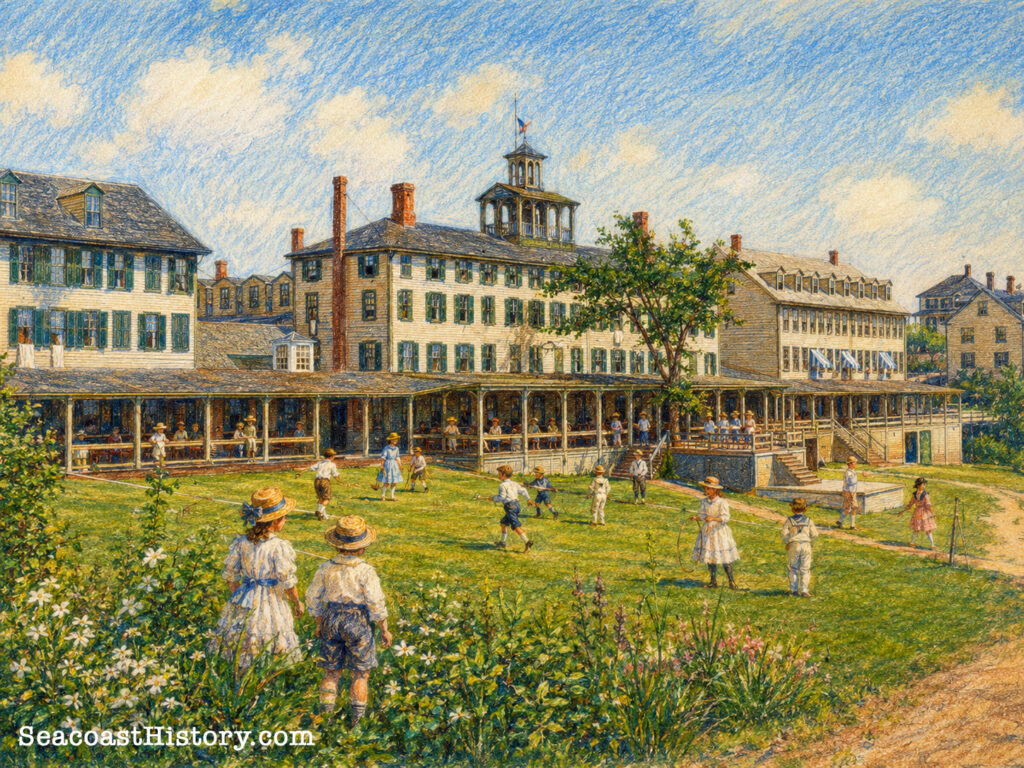
Appledore Island presented a different picture in my day. The large hotel, with its many cottages and its boardwalks connecting them, is not there. We used to have such fun, a little boy and I pushing an express cart down those sloping boardwalks, whizzing along at a great rate. This same little boy insisted he was going to marry me and pay off the mortgage. Neither of us had any idea what “mortgage” meant, but he must have overheard his parents discussing the situation. This memory came back to me when I knew only too well what it was all about.
I remember the fragrance of the air filled with the sweet smell of wild roses, bayberry, and Aunt Celia’s garden, mixed with the refreshing salt sea breezes. This was all enhanced by the sight and sound of a gull overhead and the beautiful song of the song sparrow.
The island could be explored easily, as the many paths and the two mile road around the island were kept clear. They were used morning and afternoon by guests who liked to walk and view the scenery. The rocks were treasured not for the rare birds but for the joy of watching the surf. The people loved to find a cozy place there to read or just to watch. The artists went to try to capture rock, sea, and sky on their canvases. To the children the rocks meant games played on high bluffs, and caves in which to hide. To me they meant a special kind of experience. I skipped sure-footed from rock to rock, free, and surrounded by the heavens above and the wide, wide ocean below. The rocks were part of me. It was like flying, and yet this lightness of motion was combined with a firm contact with the rock. I and the rocks were one. It felt like dancing. It’s hard to describe but unforgettable.
My general impression about the hotel life on Appledore is one of fun, laughter jokes tossed about from person to person, and a certain gaiety that pervaded every-thing. It also seemed to be filled with music and song. It has always been my idea of Heaven, and in later years I found out that my sisters felt the same way.
However, I did not realize that these years marked the end of Appledore as I knew it.
Our family lived in the Laighton Cottage which was built shortly after my parents were married. That ceremony took place in 1881, and I imagine that all of us children first saw the light of Appledore Island fairly soon after we were born. When Aunt Celia died, we moved to the Thaxter Cottage close by. This was done so that my father and mother could be there to take charge of her house and garden. Unfortunately, I do not remember Aunt Celia, for I was only 2½ at the time of her death. My sister, Ruth, was 9 years older than I, and Margaret 7½ years older so that they remembered her well.
I remember a rock between the two cottages, the Laighton and the Thaxter. This was a flat rock surrounded by bushes on one side. Here I spent many happy hours shut off from the world. One of my games was to make scrambled eggs from buttercups and daisies. Why this is a vivid memory I cannot say, but the peace of playing by myself and the warmth of the sun made a deep impression. It must have been in the early spring, before the hotel opened, and while in this retreat I could escape being told not to do this or to do that.
There were other days when I liked the excitement and bustle of getting things ready for The Opening. Carpets in the bedrooms had to be made over or new ones put in, and all tacked down. Carpentry was needed, and even now, when I hear the sounds of hammering I can smell the fresh, clean air and feel the contentment that I always experienced when on Appledore. The atmosphere of the island was quiet before the guests came and after they left, and also, we then had the place to ourselves. It was not that we did not enjoy our many good friends who came after the hotel had opened, but we were glad when they came and we were glad when they left.
Every morning at eleven o’clock Mr. William Mason played in the Thaxter parlor. The music of Chopin and Schumann drifted down to the pool, and as I swam about, it seemed to enfold me. Though this was a momentary sensation, yet, as I think it over, it is strange that a young child should be so moved. This was the effect of Mr. Mason’s playing. At times I went by the open door of the parlor on my way to the pool and I was struck by the complete absorption of the people who came to listen to him. You could have heard a pin drop. There they remained, not moving a muscle, with their heads bowed down or stretched upwards. They assumed the most grotesque positions.
There was great excitement when the boat came in, especially at it’s noon arrival. This large boat, the “Viking,” was filled with people, but before they had a chance to get off, the mail bag was thrown to the “messenger”. We watched him run up the boardwalk to the hotel, following him into the office to see the mail get sorted, which was finished and the names called by my father before the first person from the boatload of people arrived. There were always quite a few sightseers who, on their way off the wharf, passed the Fish House where the fish were laid out in the sun to dry. Some sightseers turned off at the little pump to go to my Aunt Celia Thaxter’s garden and parlor. Occasionally I showed them around the parlor, giving them all the wrong information just for the fun of it. Oh dear! I guess I was very naughty, and left the poor things with the idea that the picture of Beethoven was Celia’s husband. Others went directly to the rocks to picnic. After they left on the three o’clock boat, a horse and wagon went around the island picking up the trash that had been dropped on the road and summer house.
In order to call people for meals, a bell which had been installed on top of the hotel was set in motion by a long rope reaching down into the office. This could be heard for quite a distance. How we loved to be allowed to pull the rope! My father and uncle and their faithful secretary, Miss Sweetser, were very good to us, allowing us to sit on the counter and watch what was going on. They joked with us and played with us. How important it made us feel!
Dinner from one o’clock to two-thirty P.M. was a feast. I remember the delicious prime ribs of beef and Yorkshire pudding. Lobsters were always on the table. A fish course and all the rest that goes with a good dinner. The food was always of the best. The dining room seemed very long as I remember. There were two rows of tables jutting out into a wide center. One of my chief joys was to look across the room to watch a lady well past her prime who, before she ate, had to remove some fillers which helped puff out her sunken cheeks. One of the artists of the island used to sit beside her, and I often wondered what he thought of this manoeuvre. There was a nurses table where the very young sat with the nurse that their parents had brought to the island. I have vague memories of once eating there and later being promoted to the family table.
At the north end of the piazza was the Bowditch Cottage where the Wood family lived. They came every year, as did so many families, bringing their many children and grandchildren, the Martins, the Struthers, and the Hoskiers. These young people were responsible for no end of good times on the island. I remember having tea with Mrs. Wood, who was quite an old lady, when I was very young. I loved to go there, for she treated me as if I were a grown-up, and to this day if I eat a vanilla wafer that scene comes back to me, for she always had them with her tea.
During the morning, the greatest activity for the children was the pool, although some older people also used it for a swim or a wade. I recollect, especially, two ancient ladies of eighty years or so, splashing about in the water early in the morning. This was a ritual they went through every day, rain or shine. Breakfast was served until 10 o’clock. Therefore, they had plenty of time to get through their bath before they ate. These were the Loring sisters. People used to watch for this event as they gathered on the piazza for an earlier breakfast. A small sandy beach had been made on the side nearest the road, so that the little children could wade while their nurses watched over them. On the same side of the pond there were bath-houses where the women and children could change. On the other side were the men’s bath-houses, and it was here that there was a diving board. Girls courageous enough to dive were allowed to use the board, but they were not welcome for any other reason. In the middle of the pond a raft was situated so that we could sit and sun ourselves or jump off into the deep water. Children loved to play in the rowboats and small boats, as there was plenty of room for a short race. A young college boy was in charge whose duties were to teach swimming, keep the pool clean, see that rules were obeyed and oversee any fights that took place amongst the young fry. I remember particularly a nice young man from Tufts College. My sister Margaret was a frequent visitor to the diving board.
Margaret was intrepid! She was always doing some daring feat, such as diving off the highest point of the wharf or steamer. Ruth, my older sister, was absorbed in writing poetry, perhaps in an effort to be like her Aunt Celia, whom she worshipped. She also kept busy studying the violin and practicing. She studied under one of the musicians in Aunt Celia’s coterie, and truly came to play quite beautifully. Although I admired and loved my older sisters, yet I did not see too much of them during the busy hotel season, for they were occupied with their teenage friends, boys and girls having glorious times together–even Ruth joined in on this somewhat. I remember particularly the times when they sang, making lovely harmony. Certain songs come to mind: “I’ve Been Working on the Railroad,” “Sweet and Low,” and “My Bonnie Lies Over the Ocean.” Both sisters did their best to bring me up properly with good advice, especially after our father’s death when my mother was extra busy.
After my father died, I was brought down to the island in a weakened condition, convalescing from a bout of typhoid fever. This necessitated my having a room on the second floor of the Thaxter cottage and also having my meals sent up from the hotel, for none of the cottages had kitchen facilities. There was a button we pressed for service from the hotel. We rang once for a bell boy, twice for drinking water, and three times for a small pitcher of water.
T
CONTINUE to childhood memories part two
 Being a Boy in New Castle in 1887