

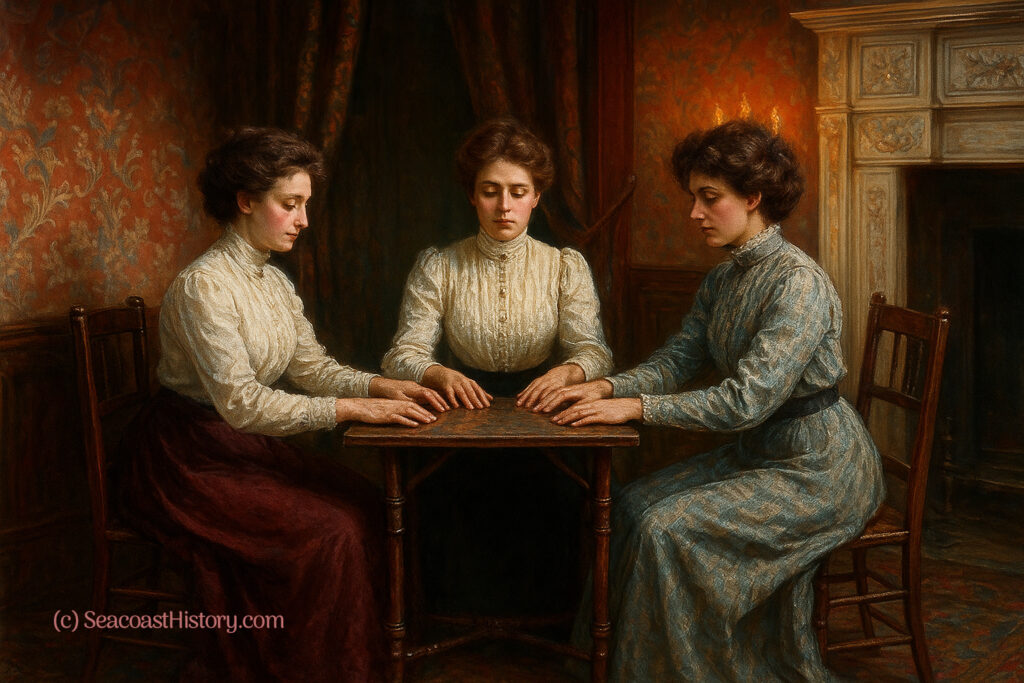
Three of New England’s most famous female writers were sobbing and hugging. The séance had turned from a light-hearted experiment in the “dark art” of Spiritualism to a deeply emotional experience. Rose Darrah, a popular Boston medium in the Victorian era, promised to open a door to the world of the dead, and all three of her celebrity clients were aching to speak with a loved one on the other side.
“Do you wish me to tell you what I see?” Darrah asked as the women clustered by the fire on the second floor of the home of Annie and James T. Fields in Cambridge, Massachusetts. Annie’s husband, James, a Portsmouth, NH, native and prominent book publisher, had died a few years earlier. Annie was skeptical of hoaxers who preyed on vulnerable widows, but she was unwilling to pass up even the remotest chance of making contact with her dead husband. Her best friend, Sarah Orne Jewett, a renowned poet from Maine, was already an enthusiastic believer in the supernatural.
“Oh, yes!” the women cried in unison. “Tell us what you see.”
Celia Thaxter, the famous poet of the Isles of Shoals, had been staying with Annie Fields on the very day her husband died in the spring of 1881. That night, James had run to the window at the sound of a fire engine to see what was happening in the streets below their grand mansion. His neighbor, Thomas Bailey Aldrich, once a Portsmouth resident, lived across the street from the Fields in Cambridge. Thomas had gone outside to see what all the noise was about. Looking up, he saw his friend James in his upstairs window and waved. Moments later James collapsed of a heart attack.
“I shall come out of this,” James Fields told Celia and Annie, but he soon slumped over dead.
Now the women were trying to talk to him from beyond the grave..
“I see a misty something,” the medium whispered, “moving slowly about over the rug.” Celia, Annie, and Sarah leaned in closer to catch the medium’s every word.
“It takes shape,” Darrah said as if in a trance. “It is a young man, a blonde young man. He walks about now. He stoops and touches the dog.”
At this point, Roger, the family dog, sat up and growled. Could the apparition be Sarah Orne Jewett’s father, Joseph? The first spirit figure was followed by yet another man with a long beard. Could it be James T. Fields returning home to speak with Annie?
Celia had come to the séance to make contact with her beloved mother, Eliza, the hostess of the Appledore Hotel at the Isles of Shoals, who had died in 1877. As Celia bent to comfort an emotional Annie Fields, she felt a ghostly presence nearby.
“Something blew softly in my ear and touched my cheek,” Celia later told her friend John Greenleaf Whittier in a letter about the séance. “I clasped my head in my hands and cried out.” The medium looked up in surprise.
“Your mother is standing just behind your chair,” Rose Darrah told Celia. “She is trying to attract your attention!”
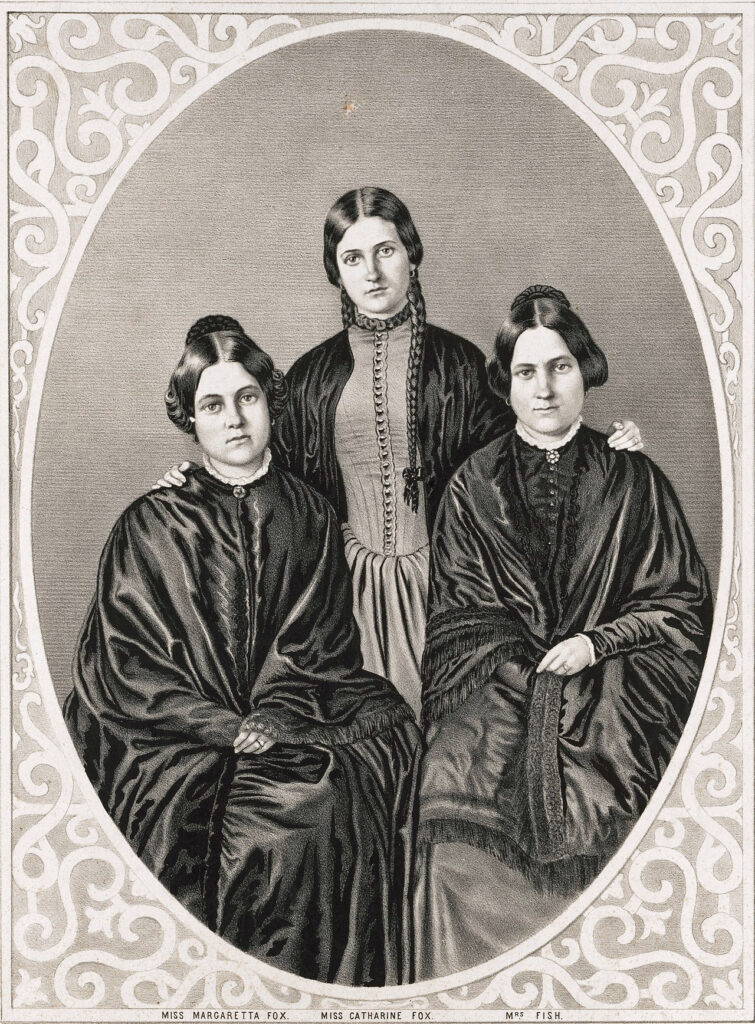
The Fabulous Fox Sisters
The cult of Spiritualism that attracted over a million Americans in the mid-1800s, historians suggest, originated with two bored teenage girls in rural New York in 1848. Kate and Maggie Fox surprised their parents and friends with mysterious tapping sounds emanating from their bedroom walls and floor. The repetitive knocking seemed to respond to their questions. In an age when Morse Code could be miraculously transmitted over electrified wires, some witnesses took the Fox girls seriously. Others claimed they were agents of the devil or mere fakes. What began as a childish prank, Maggie admitted 40 years later, quickly became a religious movement. Maggie and Kate, under the direction of their older sister Leah, turned a series of public displays into a lucrative family business.
Although most Americans scoffed at the phenomenon, others were curious. Scores of attempts to scientifically debunk the tapping sounds, including forcing the girls to disrobe in front of female examiners or be sat upon by medical doctors, could not stop or explain the tapping sounds that followed the girls everywhere. They developed systems to translate the knockings and, reluctantly at first, began charging fees for private sessions and theater shows. Within a few years there were scores of imitators and over a million new converts to Spiritualism, including the likes of writers William Dean Howells, Sir Arthur Conan Doyle, and Horace Greely, abolitionist William Lloyd Garrison, and reformer Susan B. Anthony.
Spiritualism was a perfect expression of the mid-1800s when all things seemed suddenly possible. Transcendentalists imagined a gentler kinder world where people could live in utopian communities. Suffragettes battled to break down a male-dominated society while new religious sects from Mormons to Unitarians offered alternatives less punitive paths to heaven. Old ways were breaking down as a rising middle-class could travel further and faster on new ferry and train lines. Gyroscopes, motorized sewing machines, Bunsen burners — miracle after miracle appeared.
Spiritualism was largely a woman’s movement in an era when women’s roles were strictly defined by a patriarchal predominantly-white largely-Christian society. Speaking in the voice of invisible spirits, deep in hypnotic trances like those popularized by Dr. Franz Mesmer, female mediums could say whatever they pleased without reprisal. If little girls like the Fox sisters could contact the dead, then who needed priests or popes or puritanical preachers telling people how to live their lives? Spiritualism became aligned with individualistic movements toward healthy living, homeopathic medicine, and even free love, or “Free-Spirit-Love” as it was called in the mid-1800s.
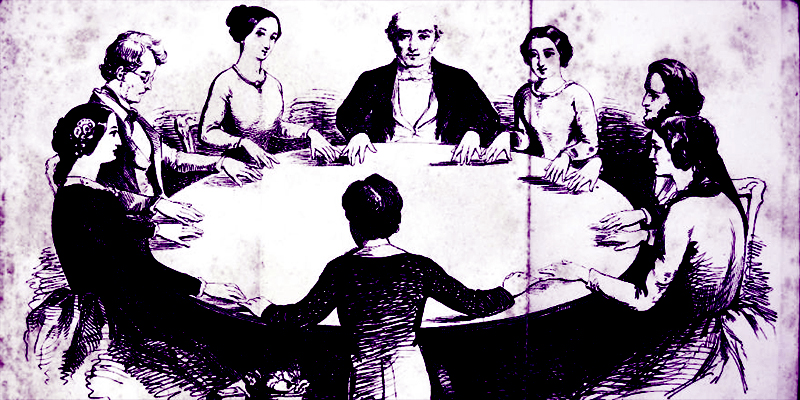
What began as a Fox family affair soon became a circus. In the lead-up to the Civil War, as Spiritualism hit its peak, every city had its own popular mediums. Boston, an important literary, religious, and publishing center, cranked out Spiritualism books and periodicals. Mediums added new tricks to their shows, including floating tables, flying musical instruments, dancing lights, speaking tubes, and automatic writing on tablets.
“It throws new light on man’s ability of self-deception,” one contemporary critic stated. Writer Henry David Thoreau put it even more simply when he said that anyone who accepted Spiritualism was “an idiot.”
Attacked by debunkers, worn down by touring, even stalked by assassins, the Fox sisters gave their youthful lives to Spiritualism. After a disastrous romance and brief controversial marriage to an Arctic explorer, Maggie renounced her supernatural talents and converted to Catholicism. Both she and Kate turned to alcohol.
Doubting Thomas
It is clear where Celia Thaxter got her interest in the supernatural. Her father Thomas Laighton was an iconoclast and freethinker of the highest degree. No image of Thomas Laighton has been found, but we know from many observers that he was short, heavyset, and walked with a limp. A banker, whaler, newspaper editor, politician, grocer, sheep farmer, lighthouse keeper, Laighton finally found his calling as the owner of the isolated Appledore Hotel, 10 miles from Portsmouth Harbor. Thomas and his wife Eliza raised and home-schooled three children.
In 1847, the year before the Fox sisters heard their first ghostly tapping in New York, Celia Laighton was listening to the tapping of hammers on her father’s huge new hotel on Appledore Island. Roughly the age of Kate and Maggie Fox, Celia too grew up without a formal education and heard, at her father’s knee, exciting legends of ghosts that wandered the barren island. A dedicated Naturalist and a creative painter and writer, Celia was at best a reluctant Christian.
An avid and highly intelligent reader, Thomas Laighton certainly heard of the Fox girls and their evolving new religion. According to an 1857 article in the Portsmouth Journal, “Mr. Laighton is a believer in Spiritualism.” In April ofthat year, according to the newspaper, Thomas Laighton took a party of clergymen out for a fishing excursion at the Isles of Shoals. Seeing the somber religious men comically dressed in flannel shirts and tall fishing boots, Mr Thaxter reportedly shouted “the devil will be raised now!”
In another early reference, Dr. Henry I. Bowditch of Boston recorded an impromptu séance at the Appledore Hotel in 1858. Writing to his wife, Bowditch noted, “This evening an attempt was made to have some spiritual rapping, but unsuccessfully.”
The death of over 600,000 in the Civil War left the nation shattered and survivors seeking comfort. According to one estimate, as many as 8 million Americans then believed it was possible to communicate with departed spirits. When Thomas Laighton died in 1866 and her mother Eliza in 1877, Celia was bereft. Her own marriage in ruins, Celia found comfort with her many literary and artistic friends including Annie Fields and Sarah Orne Jewett.
In October 1888, Maggie Fox appeared on stage in New York and admitted to the world that her spiritual career had been a hoax from the start. To gain attention she and her sister Kate had learned to create sounds by snapping their double-jointed toes and fingers, a trick that had fooled most examiners.
“My sister Katie and myself were very young children when this horrible deception began,” Maggie told the assembled crowd and the newspapers. She later exposed other medium tricks and published her confessions in a book. Then to make matters more confusing, she later recanted her story.
Although Celia Theater’s faith in Christianity occasionally revived, like many of her artistic contemporaries, she looked for rational, not religious, ways to sooth her soul. Faith was not the bulwark against the many sorrows and disappointments of her life. As Celia told Annie Fields in a letter, “the consolation of religion” did not bring her the comfort it seemed to give others. Even when her personal medium Rose Darrah was exposed as a fake, Celia Thaxter still hoped she might find a scientific way to pierce the veil of death and make contact with her parents. She never did.
SOURCES: For more on Celia, Annie, and Sarah read Beyond the Garden Gate by Norma Mandel. For more on the Fox sisters read The Reluctant Spiritualist by Nancy Rubin Stuart
Copyright © 2013 by J. Dennis Robinson, all rights reserved.
 The Two Loves of Annie Fields