

(Author’s Collection)
We do not tell the stories of local Indigenous Peoples well. Most books about early Portsmouth scarcely mention its original settlers except to chronicle the rare Indian acts of retaliation following decades of their repression by white colonial settlers in the 17th century.
A big part of the problem, of course, is lack of information. We probably know more about colonial life along the Piscataqua River in 1623, for example, than we do about 12,000 years of life among the indigenous people who named the river “Piscataqua.”
That paucity of information is made worse by centuries of slanted, condescending, misunderstood and often hostile coverage by American writers. New England, according to many white male Christian historians, had once been peopled by “savages,” “infidels” or “heathens.” The fact Native Americans were rarely reported in the early “Strawberry Bank” area, and did not attack or destroy the first European outposts here, is sometimes seen as evidence that Indians were never here at all. Prehistoric Portsmouth is often depicted as an empty landscape frozen in time. Well into the 20th century, local historians imagined an unpopulated and lush region, along a breathtaking and swift river, waiting to be discovered by white explorers.
Another reason we do not tell the Native American story well is that we don’t try hard enough. That laziness is especially evident in November when we retell the fanciful story of the first “thanksgiving,” a Puritan ritual most often celebrated by fasting, not feasting. We remember the comradery of the Separatists and the Indians who, actually, were not invited to the harvest celebration, but showed up anyway. We whitewash the 1623 horror of Miles Standish and celebrate the moments of interracial compatibility. Making friends during hard times is not a bad thing. It’s just not the whole thing.
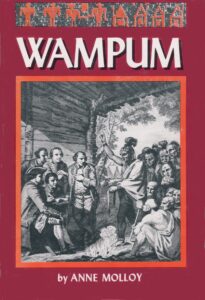
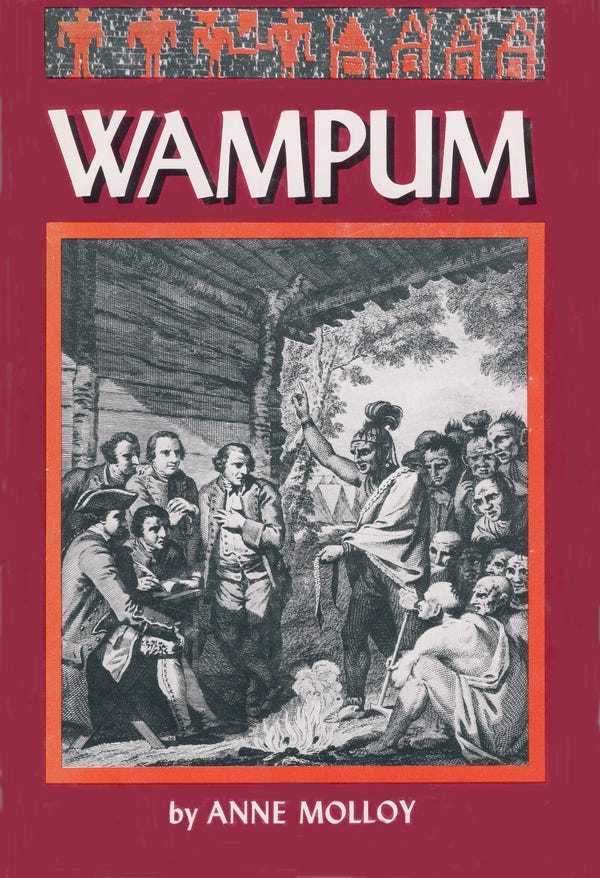
One local writer who did try hard enough was Anne Molloy (1907-1999). Best known around here for her juvenile novel about Portsmouth-born poet Celia Laighton Thaxter (“Celia’s Lighthouse”), Molloy wrote a total of 22 books for young people. One of them, titled “Wampum,” is a well-researched effort to understand the tribal significance of the colorful shell bead belts woven primarily by the Eastern Woodlands tribes of Native Americans.
Molloy moved from Winchester, Massachusetts, to Exeter with her two children during World War II when her husband Paul joined the English faculty at Phillips Exeter Academy. They moved to Portsmouth in 1976 where the author became involved in the Portsmouth Athenaeum.
Another Molloy book, “Weymouth’s Indians,” is a less politically correct, but no less sincere study of five Abenaki natives kidnapped from what is now Maine to England by Capt. George Weymouth in 1605. The captives, for the record, spent time with Sir Ferdinando Gorges in Plymouth, England. It was Gorges, determined to colonize New England, who was instrumental in the 1607 failed Popham Colony in Maine, the 1620 New Plymouth Colony in Massachusetts, the 1623 failed Thompson fishery in Rye, the 1630 John Mason settlement at Strawberry Bank, and other settlements in Maine. It was a small world back then and we only know half the story.
An updated version of the Weymouth story in the Smithsonian Museum Magazine American Indian explodes the widely published theory that the kidnapped natives included Tisquantum or “Squanto,” who appears prominently in the Thanksgiving legend. That Smithsonian article, for curious readers, is titled “Alien Abductions: How The Abenaki Discovered England.”
In a brief description of Portsmouth’s most prolific children’s author, former Athenaeum president Ellie Sanderson says, “Anne Molloy wrote her books in longhand, her feet propped up on a sofa, her paper supported by a checkerboard. She transcribed each manuscript on her husband’s Underwood typewriter.”
According to Sanderson, Molloy’s “passionate interest in indigenous people, especially the Wabanaki people of Northern Maine, never waned.” The year before her death in 1998, Molloy donated over 400 baskets crafted by Native Americans of the Eastern Woodlands to the Abbé Museum in Bar Harbor.
Although I never met Anne Molloy, we share a kinship. My late brother, Brian S. Robinson, was an archaeologist and scholar of Indigenous studies at the University of Maine. And I live in a house purchased from the late Jane Porter, Molloy’s daughter, and a former Keeper of the Portsmouth Athenaeum.
Copyright J. Dennis Robinson, all rights reserved.
 Two Worlds of Portsmouth Architecture