

There are times, I will admit, that the local historian fears he has seen it all. The gray photographs of indistinct figures against a vast ocean, the familiar colonial mansions, the same three lighthouses, colorized postcards, or the parades down Congress Street. Been there, done that.
But the archives are not static. Fresh images are added to the collection. The past, history writers know, grows clearer every day, even as the future shrinks ahead of us. Then suddenly, like the bones of a ship exposed on the beach by a passing storm– there is KING DYNAMO.
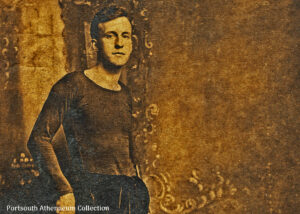
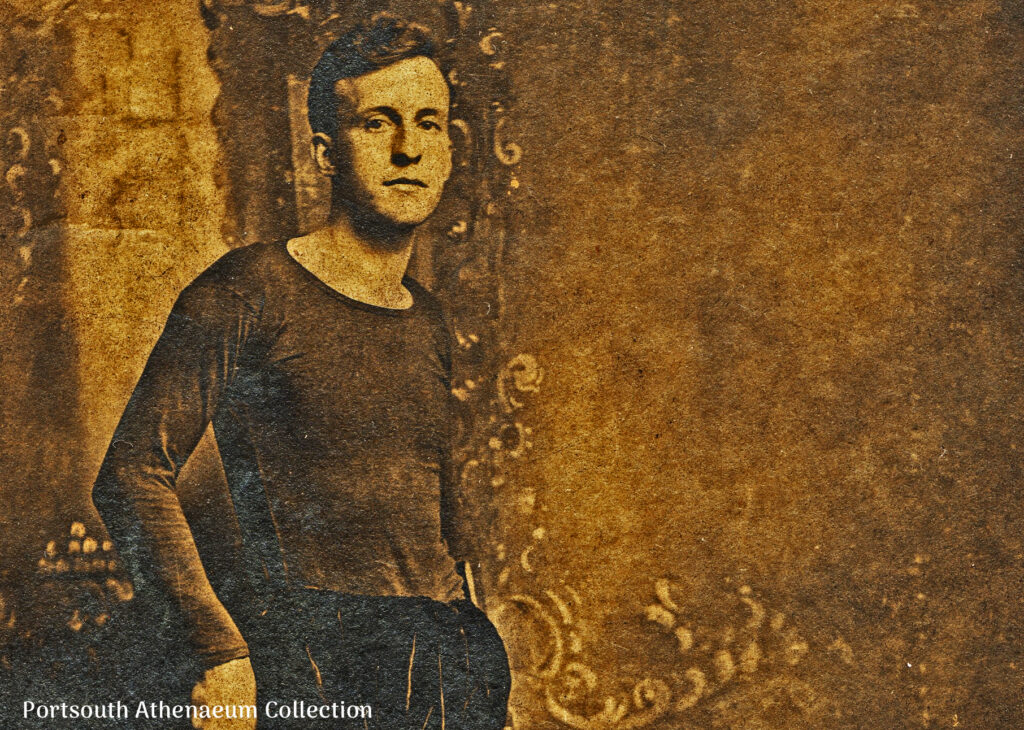
Photos of Ernest Howard Byrns (1883-1961) were donated to the archive by his granddaughter. Perhaps you knew him. He was the owner of Byrnes auto Electric store on State Street in Portsmouth, NH. Before that, Byrnes travelled the region in the vaudeville era, demonstrating the powers of electricity. His stage name was King Dynamo. How great is that? And like a bolt from the blue, Portsmouth history sparks and crackles anew.
READ: Fear of electricity in 1900
Why the King is wearing those bulging shorts, carrying that metal rod, and standing before that frightening device has yet to be explained. In another picture, he is wearing what appears to be a dark rubber raincoat with a wizard-style hood. So far, that’s all we know. The photograph was taken in the early 20th century by Frank Goss in his Newburyport, MA, studio.
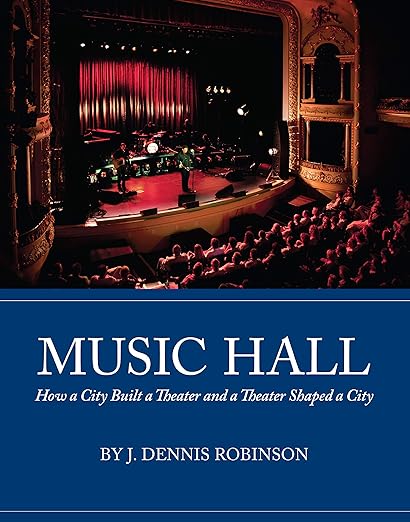
Although Byrnes was born in Somerville, MA and lived in Concord, NH, he eventually found his way, like so many of us lost souls, to the Port City. So let us officially conduct this shocking new hero into the pantheon of particularly peculiar Portsmouth people–the hallowed hall to which we all aspire.
(Photo courtesy Portsmouth Athenaeum Collection/All rights reserved. Text (c) J. Dennis Robinson, as seen in MUSIC HALL: How a City Built a Theater and a Theater Shaped a City)
NOTE FROM A READER: Hi, Mr. Robinson. Saw the picture of “King Dynamo” in the Herald. The dynamo is an induction coil somewhat similar to the old Ford spark coils used in the ignition of early autos. They, of course, were fired by batteries. Your coil could have been fired by batteries, but would have required a large bank of them and would have been quite unwieldy to lug around to halls for speaking engagements. Likely since he was probably touring in the late twenties and early thirties, he was powering the primary from the AC or DC mains at around 100-120 volts. Judging by the size of that coil, the output would have been considerable, probably 5000 or more volts, but would have only been capable of very low current (amperage), so the secondary voltage, though high, would not be hazardous to people. It would, however, have been capable of some pretty vigorous sparks and would have been intimidating to an unsophisticated viewing audience.
Regards, Bill Holly, Kittery Pt., ME
 John Lord: The Boy Who Hated Portsmouth