


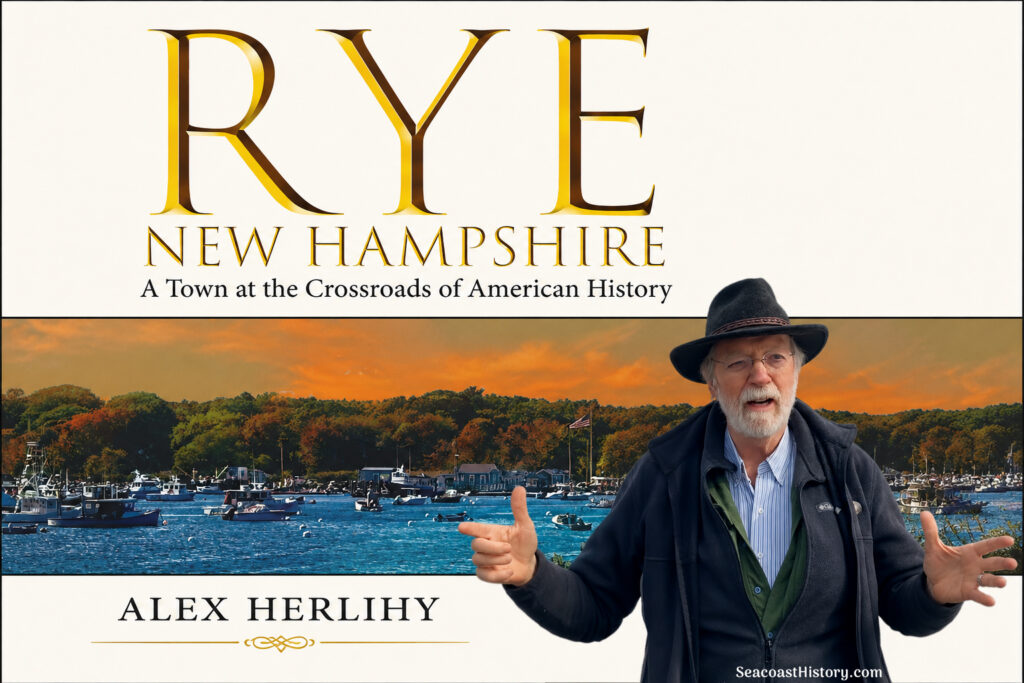
I sat down virtually with teacher and historian Alex Herlihy to discuss the making of his long-awaited book, Rye, New Hampshire: A Town at the Crossroads of American History (2025). Here’s what we had to say.
JDR: Alex, writing a 400-year town history. What were you thinking?
ALEX: I have been soaking up Rye history since I was a kid and saw Parsons’ History of Rye on my mother’s table. In 1973, she suggested I talk to Emma Foss (1882-1978) to learn about life in Rye in the 1890s. Emma was too shy to be recorded, so she sent me a precious five-page letter which I have kept close to me all these years and is in my book.
My mother, Jessie Herlihy, founded the. Rye Historical Society in 1976, and the rest is…Rye history. Around 2000, I began taking notes on Rye history resources, and when the town museum opened in 2002, I really soaked up those stories from visitors.
But the real catalyst for beginning the book was the Rye History Trolley tours I started for RHS in 2011. I wrote a two-page timeline for the first tour, and it soon became 100 pages, proving that we often don’t know what we know until we start writing. That was the skeleton for my book, but over the years, life, the town of Rye, and helping other people publish their books got in the way.
JDR: When did you realize you were going to take this all the way to a printed book?
ALEX: Finally, in 2018, I got my first copy edit done with help on parts of the draft from friends. I kept plugging away through COVID until book designer and publisher Grace Peirce, who scanned my images for me, put me on to editor Tom Holbrook in early 2024. Over the next year and a half, we got it to the RHS board. They agreed to publish it.
JDR: Please describe your process for keeping records and working on the book over the years.
ALEX: I was inundated by printed material from the RHS and my own collections. I kept hard copy material in file folders. I am pretty low-tech. I started working on the 100-page timeline and expanded that into sentences, paragraphs, and chapters. I decided to make five Word documents, one each for the 1600s, 1700s, and 1800s, and two for the 1900s, because the latter was most in need of documenting. Tom Holbrook dissuaded me from going into too much detail on this century, so I reduced 36 pages to six pages of highlights.
Once I had those five Word docs, it was easy to keep inserting material that I had or that was fed to me, things like historic newspaper archive material, which really enriched the turn of the 20th century.
When Tom took over as editor, he put the whole thing into one file, and made all changes after that. He deleted repetition, excess, etc. He asked me to take out my mother’s poems about Rye since they are in a published book (“Rye and Beyond: The Poems of Jessie Herlihy,” 1990, RHS). He had a sense that 400-450 pages were enough. He was right.
There is no need to include everything you know in a local history book. And that is one big reason I started my own website in 2023, which complements the book with many thematic narrative topics. (See link at the bottom of this page.)
JDR: How daunting was this 400-page work?
ALEX: I knew the thing was a bear. Early on, it was over 500 pages, which shows you how much Tom cut. I have the original drafts for reference, especially the 36 pages on the 21st century. My next project is to engage residents in the recent history of the town, especially its political history.
I strayed from the project many times because I found more compelling things to work on, but always circled back to it. People began asking: Where is the book? I would give a future publication year. It would pass, and I began to call it the “Cry Woolf” book!
JDR: What was your process for including images?
ALEX: I had hoped to get some help on images, but none was forthcoming. This became very much a solo project, which, I think, most books are until you get to the editing stage. I knew I would include some already-published images. I also had many unpublished images from the 1900s. In 2023, Grace Peirce was a great help in scanning 170, so they were ready for Tom to drop into the interior book file.
JDR: Print-on-demand publishing came of age just in time. You no longer had to raise a ton of money to print a large edition. How did that go?
ALEX: With Tom’s guidance, the Rye Historical Society did a pre-buy campaign in October 2025, before the book launch event in November. This is not unusual. Centuries ago in England, for example, publishers did the same thing. Why go into the red if you don’t have to? RHS has remained in the black because sales of the book were high enough.
Tom found a printer for the hardcover in Peterborough, England. Book Vault had the best value and quality. So the hardcover is only available from RHS, which buys it in batches of 50 from Book Vault. The paperback is available online.
JDR: It’s been over 120 years since Langdon Parsons issued the first history of Rye in 1905. The two of you are now linked forever. What did Parsons do best? What were his flaws?
ALEX: Parsons is in that great tradition of antiquarian, amateur, town historians who collected and published town histories at the turn of the 20th century. Just like the Bicentennial in 1976, the Rye Centennial in 1876 sparked a strong interest in local history. Parsons’ used primary sources, especially the Provincial Papers. He drew on oral history and printed matter that he could find in the late 1800s.
His book is thematic with chapters on town government, churches, education, etc., but he reflects his times when it comes to Indigenous Peoples. That chapter is entitled “Indian Depredations.” To his great credit, Parsons devoted the second half of his book to the genealogy of Rye names, an invaluable resource. For some reason, he did not use annual town reports or newspapers, both of which were of great help to my book.
JDR: During seven years of working on my recent New Castle book, I got very close to John Albee, who wrote a 1884 history of the town. Did you make a similar link to Parsons?
ALEX: Parsons and the later town historian, my mentor Bill Varrell, were with me throughout the venture. I could hear their voices telling me to “use this” and “use that” from their books because their work needed to be highlighted in mine.
JDR: What is the website component all about?
ALEX: In 2023, at the request of Rye Junior HIgh staff and students with whom I had been working that year, I created my Rye history website. (Visit: RyeHistoryRocks.com)
JDR: Now that you’ve laid your book burden down, what’s up with Alex Herlihy?
ALEX: My parents wrote letters to each other for 3 1/2 years from 1942-45. Their correspondence is a goldmine of information and stories, especially about Rye during the war. The letters are also about all the places my father was stationed in the Army Air Corps—including Trinidad and Tobago—as a trainer of glider pilots, preparing for the Nazi invasion of South America.
I am also working with the Rye Civic League to publish a political history of the town, especially in this century, in recognition of 2026 being the 300th anniversary of our town government.
JDR: How did you deal with any controversial and emotional issues?
ALEX: The 250th anniversary of the country offers an opportunity to reflect on our past. Clearly, there are those who would try to whitewash the past. I was asked at my book launch how I dealt with controversial issues. I paraphrased Cathy Gorn, director of the annual National History Day for high school students, a history teacher who was addressing this issue. She said, “When you teach all of our history, including the tragic parts, some people think that this will make the students feel bad, even guilty. The exact opposite is true. When you give a full accounting of our history, students gain an understanding of how Americans have worked so hard to make this a better country. And when you do that, you help to create thoughtful, informed patriots.”
Copyright 2026, Harbortown Press/SeacoastHistory.com
OUTSIDE LINKS:
Buy the book on Amazon
Alex’s website: RyeHistoryRocks
Visit the Rye Historical Society
ABOUT ALEX HERLIHY
Born in 1945, Alex Herlihy is a native of Rye who grew up on Wedgwood Farm on Lang Road, purchased by his parents in 1937. His lifelong passion for local history was inspired by his family home, his mother’s curiosity about the past, and a career teaching history at Oyster River High School in Durham. A charter member of the Rye Historical Society (founded in 1976) and longtime member of the Rye Civic League, Herlihy has also served on several town boards. He credits his parents, Jessie and Edward Herlihy, for inspiring his enduring love of Rye’s story.
——————
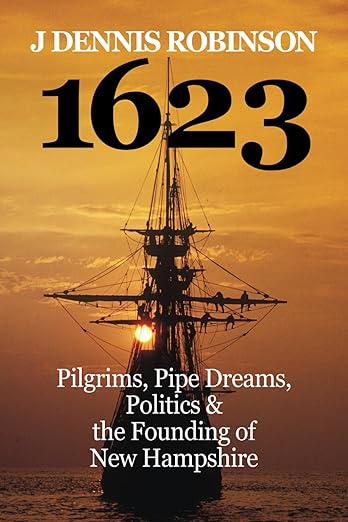
For much more on the founding of Rye and Seacoast NH, check out 1623, available from Amazon.com in paperback, eBook, and hardcover formats, or ask at your local bookshop or historical society
 John Robinson: The Last Sound Ranger